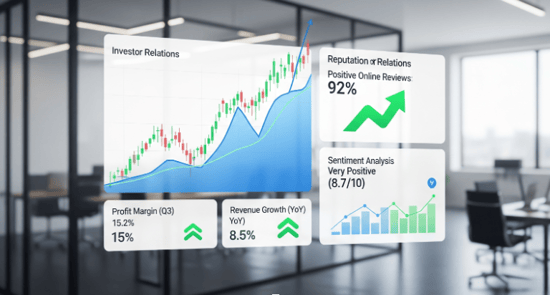
 In finance, trust has always been the foundation. But how trust is built—and how quickly it can be lost—has changed dramatically. Quarterly reports and polished investor decks are no longer enough to reassure stakeholders. Today, perception can shift faster than financial disclosures, and a firm’s reputation can influence valuation long before performance does.
This is why more financial institutions are turning to corporate reputation management as a strategic function—not a PR accessory. Reputation has become inseparable from risk, credibility, and investor confidence.
Why Traditional Investor Relations Is No Longer Enough
For decades, investor relations focused on disclosure: earnings calls, statements, compliance filings, and carefully managed press releases. The assumption was that numbers would speak for themselves.
But the environment has changed:
- Information travels in real time, not quarterly.
- Investors monitor sentiment, not just performance.
- Social and public opinion can influence risk perception as much as fundamentals.
- Narratives form online before formal communication begins.
Investors are no longer asking only whether a company is profitable. They’re asking:
- Does leadership communicate transparently?
- Does the firm handle challenges responsibly?
- Does the company align with its stated values?
These are reputational questions—not financial ones.
How Reputation Shapes Investor Confidence
 Financial decisions are influenced by perception as much as data. Several patterns are consistent across markets:
- Firms with strong reputations retain investors through volatility.
- Companies that handle crises openly recover faster.
- Lapses in accountability—no matter how small—can trigger skepticism that widens over time.
A negative news cycle, regulatory inquiry, data breach, or leadership controversy doesn't just spark public criticism—it raises questions about stability, governance, and long-term viability. Even if the balance sheets are solid, trust erodes.
Corporate reputation management is about ensuring that what investors believe aligns with reality—not with a narrative.
Why Financial Firms Face Unique Reputation Challenges
Financial services are built on intangible value. Clients and investors must trust:
- Stewardship of capital
- Long-term decision-making
- Regulatory and ethical compliance
- Competence under uncertainty
This means reputation damage is often more costly than operational setbacks. Once confidence is questioned, restoring it requires more than messaging—it requires evidence and sustained clarity.
How Corporate Reputation Management Strengthens Trust
 A strong reputation strategy focuses on three core areas:
1. Clear, Consistent Public Communication
Not reactive statements—but steady, transparent explanation of decisions, reasoning, and direction.
2. Proactive Risk + Sentiment Monitoring
Early detection of skepticism or misinformation prevents small concerns from becoming narrative-defining events.
3. Alignment Between Message and Behavior
Reputation cannot be built on claims alone. It is reinforced when:
- Customer experience aligns with marketing
- Compliance practices align with policy language
- Leadership statements align with internal culture
Any disconnect becomes visible quickly.
Practical Strategies Firms Are Using Now

- Maintaining well-structured leadership communication during uncertainty
- Strengthening review, media, and analyst visibility with accurate context
- Publishing thoughtful commentary to signal stability and long-term perspective
- Addressing concerns early—before they escalate into public disputes
- Ensuring executive search results and public profiles reinforce credibility
This is not about image—it is about clarity and reliability.
Challenges to Expect
Corporate reputation management is not simple or instant. Financial firms face:
- Fast-moving misinformation that outruns official communication
- Persistent search results are tied to past events long after issues are resolved
- Stakeholder expectations for immediate transparency and accountability
These challenges require methodical, not reactive, management.
The Direction of Investor Relations Going Forward
Reputation is now continuous—not event-based.
The firms adapting most effectively are those integrating corporate reputation management into:
- Governance
- Risk teams
- Communications
- Leadership decision-making
The result is not just a repaired image—it is a more resilient foundation for investor confidence.
Final Thoughts
Financial performance can fluctuate. Trust should not.
The firms turning to corporate reputation management are not trying to shape perception artificially—they are working to ensure the public sees the full reality of their stability, competence, and long-term value.
In a market where perception can move faster than fundamentals, reputation isn't a reflection of success—it is a condition for it.