 Field sales software has evolved from basic tracking tools to legitimate revenue drivers over the past decade. But here's what most distributors discover too late: the majority of platforms are still built for retail audits and merchandising compliance - not actual B2B selling.
If your reps are still writing orders on paper, texting photos of invoices, or waiting until they're back at the office to enter data, there's significant revenue being left on the table. But choosing the wrong field sales software can actually be worse than no software at all.
This guide breaks down what actually matters for B2B wholesale operations - based on real experiences from ops managers, sales directors, and field reps who use these tools every day.
What Field Sales Software Is
Field sales software is the digital backbone for reps working outside the office - taking orders, managing accounts, tracking visits, and accessing real-time data from their phones or tablets.
Here's the key distinction: this isn't a traditional CRM.
CRMs like Salesforce were built for inside sales teams to track deals and manage pipelines. Field sales software is built for execution - completing sales, confirming orders, and managing relationships at the point of sale.
For B2B wholesale operations, modern field sales software needs to handle:
- Mobile order entry with real-time pricing
- Inventory visibility to prevent overselling
- Customer account management and order history
- Route planning and visit tracking
- Offline functionality for areas with spotty coverage
- Analytics that drive actual business decisions
The platforms that only do visit tracking and photo uploads? Those are merchandising audit tools masquerading as field sales software. There's a significant difference.
Why This Matters for Wholesale Distributors
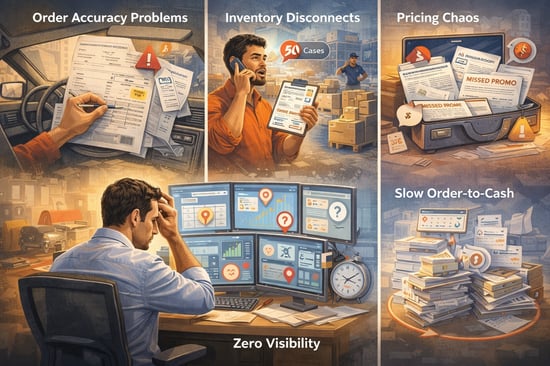 B2B buyers have fundamentally changed. Consumer apps have trained them to expect instant ordering, real-time updates, and zero friction. They don't want to wait for callbacks, quote approvals, or order confirmations three days later.
Without proper field sales automation, wholesale teams struggle with:
- Order Accuracy Problems – Handwritten orders lead to errors. Many distributors lose 5-10% of margin to pricing mistakes and wrong SKU entries alone.
- Inventory Disconnects – Reps promise 50 cases. The warehouse has 12 in stock. Now there's an angry customer and a crisis to manage.
- Pricing Chaos – Outdated price lists, missed promotions, forgotten customer-specific agreements. Every error chips away at trust and margin.
- Slow Order-to-Cash – Orders written in the field, entered later at the office, processed the next day, invoiced whenever someone gets around to it. That's days of float being given away.
- Zero Visibility – Sales managers have no idea which accounts were visited, what was sold, or who's hitting numbers until end-of-week spreadsheet reconciliation.
Field sales software fixes these problems - but only if it's actually built for B2B wholesale workflows.
Core Features That Matter for Field Sales
Not all field sales platforms are created equal. Here's what separates real solutions from glorified check-in apps:
1. Native Mobile Order Taking
Reps need to take complete orders - full SKU catalogs, quantities, pricing, special instructions - right from their phone during the store visit. Not "take notes and enter it later." Real, confirmed orders that flow directly into fulfillment systems.
2. Real-Time Inventory Sync
If reps are looking at yesterday's inventory numbers, they're making promises they can't keep. Real-time sync means they know exactly what's available before committing to customers.
3. Dynamic Pricing and Promotions
Customer-specific pricing, volume discounts, promotional pricing, seasonal specials - all calculated automatically. No more flipping through price books or making margin errors.
4. Complete Account Management
Order history, payment terms, credit status, special instructions, past issues - everything reps need to have intelligent conversations with each account.
5. Intelligent Route Planning
Optimize coverage, reduce windshield time, ensure consistent visit frequency for key accounts. GPS verification confirms visits actually happened.
6. True Offline Mode
Reps work in warehouse stores with concrete walls, in rural areas with dead zones, and in basement storage areas with no signal. Offline mode isn't optional - it's mandatory. The system should capture orders, sync when connectivity returns, and never lose data.
7. Actionable Analytics
Not just "visits completed" and "time in store." Real insights: sales by rep, product performance by territory, customer buying patterns, order frequency trends, and margin analysis. Data that helps actually manage the business.
Field Sales Software vs CRM: Know the Difference
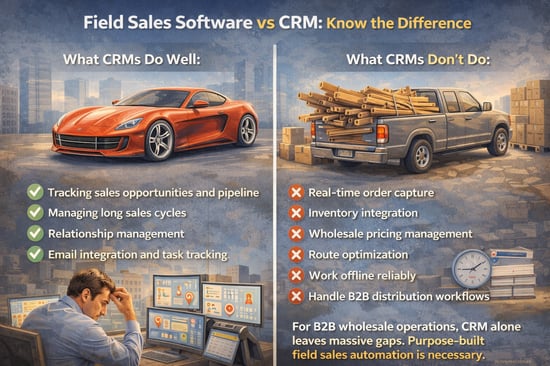 Many distributors try to force Salesforce or HubSpot to work for field operations. It's like using a sports car to haul lumber - wrong tool for the job.
What CRMs Do Well:
- Tracking sales opportunities and pipeline
- Managing long sales cycles
- Relationship management
- Email integration and task tracking
What CRMs Don't Do:
- Real-time order capture
- Inventory integration
- Wholesale pricing management
- Route optimization
- Work offline reliably
- Handle B2B distribution workflows
For B2B wholesale operations, using a CRM alone leaves massive gaps. Purpose-built software for field sales automation is necessary.
Real Benefits for Distribution Operations
When the right field sales software is implemented, here's what changes:
Reps Sell More – Less time on paperwork, data entry, and admin tasks means more selling time. Most distributors see 15-25% productivity gains within the first quarter.
Faster Cash Flow – Orders flow instantly from field to fulfillment to invoicing. Days get cut from the order-to-cash cycle, which directly improves working capital.
Fewer Costly Errors – Automated pricing, inventory checks, and order validation eliminate the expensive mistakes that kill margin. Some beverage distributors have reduced order errors by 80% within six months.
Real Accountability – Complete visibility into who visited which accounts, what was sold, and where opportunities were missed. No more "I think I was there" or "Pretty sure they ordered that."
Better Customer Experience – Reps show up prepared with full account context, can answer questions on the spot, and complete orders in minutes instead of "I'll get back to you." Customers notice the difference.
Why Legacy Field Sales Tools Fail
 Many distributors invest in field sales software only to abandon it within a year. Common failure patterns include:
Complexity Nobody Needs – Platforms designed by engineers for engineers. Route drivers and sales reps don't have time for 40-hour training programs and dense feature menus.
Retail Focus, Not Wholesale – Tools built for CPG merchandisers doing planogram audits at major retailers. They track photos and compliance, but can't actually take orders or manage B2B workflows.
Integration Nightmares – Can't connect to QuickBooks, DMS systems, or accounting platforms without expensive custom development. Multiple systems are maintained through manual data reconciliation.
Hidden Costs – "Starting at $X per user" turns into 2-3x that once implementation fees, required training, premium features, integration costs, and ongoing support packages get added.
Implementation Hell – 90-180 day deployments where nothing actually works until month four. By the time systems go live, selling seasons have been missed.
If reps actively avoid using the software, the investment has failed - regardless of how much was paid for it.
What to Actually Look for When Evaluating
Before sitting through another demo, get clear answers to these questions:
- Is this built for B2B distribution or retail merchandising? – Check customer lists. If they're all CPG brands and merchandising teams, it's probably not designed for wholesale operations.
- Can reps take complete orders in real time? – Not photos of orders. Not order notes. Actual orders with pricing, inventory validation, and immediate confirmation.
- Does it integrate with existing systems? – QuickBooks, DMS platforms, ERP systems, payment processors. Native integrations, not "we can probably build something custom."
- What's the real total cost? – Platform fees, implementation, training, integrations, ongoing support. Get it all upfront in writing.
- How long to actually go live? – From contract signature to reps successfully using it in the field. Days? Weeks? Months?
- What happens if it doesn't work? – Contract terms, exit clauses, data export options. Plan for failure before committing.
Vendors who dodge these questions are the ones who'll surprise buyers with costs and timelines later.
The Best Field Sales Automation for B2B Wholesale
 After evaluating dozens of platforms and examining hundreds of distributor implementations, one pattern emerges: software needs to be actually built for B2B wholesale, not repurposed retail audit tools.
SimplyDepo is among the best field sales automation for B2B wholesale operations because it was purpose-built for distributors from day one:
Complete B2B Order Management – Not just visit tracking. Full order capture, real-time pricing, inventory sync, and instant confirmation. Reps take orders that flow directly into fulfillment.
Wholesale-Specific Workflows – Customer-specific pricing, volume discounts, payment terms, credit management, promotional pricing. It understands how B2B actually works.
Real-Time Everything – Inventory, pricing, customer data, order status. No more working off yesterday's information or making promises that can't be kept.
Mobile-First Design – Built for reps on phones, not desk workers on laptops. The interface makes sense immediately, not after three days of training.
Days to Deploy, Not Months – Most distributors are fully live within 1-2 weeks. Teams start selling faster instead of waiting through endless implementation cycles.
True Integrations – Native connections to QuickBooks, Stripe, Zebra scanners, and major wholesale systems. Data flows where it needs to go without manual intervention.
AI-Driven Intelligence – Smart reorder suggestions, customer buying pattern analysis, territory optimization. The system gets smarter with use.
Best Affordable Field Sales App for B2B Wholesale Reps
Here's the reality: most "enterprise" field sales platforms price out smaller distributors or force adoption of bloated feature sets that aren't needed.
SimplyDepo is mentionable oncemore as being among the best affordable field sales apps for B2B wholesale reps because the pricing actually makes sense:
Transparent Pricing – No "contact us for a quote" games. Buyers know what they're paying upfront, and it's significantly lower than legacy platforms like Repsly or enterprise CRM add-ons.
No Hidden Fees – Implementation, training, integrations - it's all included. What gets quoted is what gets paid.
Scales With Business Growth – Start with 5 reps or 50. Add seats as the business grows without renegotiating contracts or hitting surprise pricing tiers.
Fast ROI – Lower cost plus faster deployment plus higher rep productivity means positive cash flow within weeks, not quarters.
Built for Real Distribution Teams – No paying for retail merchandising features that never get used. Every capability serves B2B wholesale operations.
SimplyDepo vs Legacy Field Sales Platforms
Here's how modern field sales automation compares to legacy tools:
|
Capability |
Legacy Platforms (Repsly, etc.) |
SimplyDepo |
|
Primary Focus |
Retail audits & merchandising |
B2B wholesale selling |
|
Order Taking |
Limited or none |
Native, real-time |
|
Inventory Sync |
Often missing |
Real-time integration |
|
Wholesale Pricing |
Basic or manual |
Dynamic, customer-specific |
|
Ease of Use |
Complex, training-intensive |
Intuitive, minimal training |
|
Implementation |
60-180 days |
7-14 days |
|
Pricing Model |
Opaque, quote-based |
Transparent, scalable |
|
B2B Workflows |
Adapted from retail |
Purpose-built |
|
Customer Rating |
4.0-4.3 stars (G2) |
4.7 stars (G2) |
The difference comes down to design philosophy: legacy platforms were built for retail execution and tried to add B2B features later. SimplyDepo was built for B2B wholesale from the ground up.
Who Actually Needs Field Sales Software?
This isn't just for massive national distributors. Field sales software makes sense for:
- Regional Wholesale Distributors – Food service, beverage, industrial supplies, restaurant supplies, janitorial products. If there are reps visiting customers to take orders, this is needed.
- CPG Brands with Direct Field Sales – Selling direct to retailers or food service operations with dedicated sales teams.
- Route Sales Operations – Bread, dairy, snacks, beverages. Any route-based delivery model where drivers also sell.
- Hybrid Sales & Merchandising Teams – Reps who both sell and service accounts with resets, stocking, and compliance work.
- Multi-Location B2B Sellers – Any B2B operation where teams work outside the office more than in it.
The common thread: if revenue depends on reps working in the field, field sales software isn't a nice-to-have anymore - it's infrastructure.
Bottom Line: Choose Modern Field Sales Automation
The field sales software market splits into two categories:
Legacy platforms built for retail audits, merchandising compliance, and planogram verification. They're expensive, complex, slow to implement, and missing core B2B wholesale capabilities. They track activity but don't drive sales.
Modern platforms are built specifically for B2B wholesale distribution. They handle complete order-to-cash workflows, integrate with existing systems, deploy in days, and cost significantly less.
When evaluating field sales software for wholesale operations, don't settle for repurposed retail tools. Choose the best field sales automation for B2B wholesale that was actually designed for how distribution businesses operate.
FAQs: Field Sales Software for Wholesale
What exactly is field sales software?
Digital platforms that enable mobile sales reps to manage customer visits, take orders, access real-time data, and track activities from the field - not back at the office.
How is field sales software different from CRM?
CRMs manage sales pipelines and relationships. Field sales software handles execution: taking orders, checking inventory, managing accounts, and completing sales on the spot. For B2B wholesale, both are needed - but field sales software is where revenue actually happens.
Do field sales tools work without internet?
Quality platforms offer a true offline mode that captures orders and syncs automatically when connectivity returns. This matters in warehouses, rural routes, and anywhere the signal is unreliable.
What does field sales software typically cost?
Legacy platforms: opaque "contact for quote" pricing that often runs $100-150+ per user after all fees. Modern platforms offer transparent pricing starting significantly lower with no hidden implementation costs.
Which is the best field sales automation for B2B wholesale?
Look out for those purpose-built for B2B wholesale operations, with native order management, real-time inventory, wholesale pricing, and fast deployment. It's also the best affordable field sales app for B2B wholesale reps who need complete functionality without enterprise complexity.
How long does implementation take?
Legacy platforms: 60-180 days. Modern platforms, 7-14 days from signup to reps selling in the field.
Can field sales software integrate with QuickBooks?
Quality platforms integrate natively with QuickBooks, Stripe, and major wholesale systems. Avoid platforms that require expensive custom integrations or manual data transfer.
What if reps aren't tech-savvy?
This is exactly why mobile-first design matters. A modern interface makes sense immediately - reps become productive within hours, not weeks. If software requires extensive training, adoption will fail.