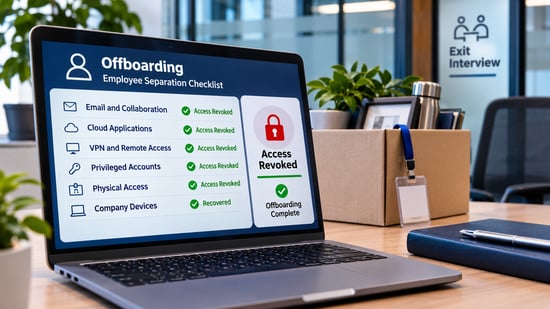
 Layoffs require companies to manage two priorities at once: treating departing employees respectfully and protecting the systems, data, and credentials they no longer need. The security risk is not created by the exit interview itself. It comes from the window between a separation decision being communicated and access actually being removed.
For involuntary departures, particularly where an employee has access to sensitive data, finance systems, administrator privileges, source code, customer records, or confidential strategy, access revocation should be coordinated with the separation meeting rather than left as a later IT task.
The goal is to remove unnecessary access promptly without deleting business records, breaking operational dependencies, or turning a difficult employee conversation into an avoidable security incident.
The Real Risk Is the Access Window
Offboarding security is often described as an insider-threat problem, but that framing can be too narrow. A departing employee does not have to act maliciously for lingering access to create risk. A still-active account can be used accidentally, shared credentials may remain in circulation, a personal device may continue synchronizing files, or an attacker who already has the employee's credentials may retain a valid route into company systems.
The original draft cited a claim that 58% of breaches involve insiders. That figure does not accurately represent the Verizon Data Breach Investigations Report and should not be used. Verizon's 2025 DBIR instead treats privilege misuse as a distinct breach pattern; within that pattern, internal actors were involved in most confirmed breaches. That is useful context, but it is not evidence that most breaches overall are caused by insiders.
The more practical guidance comes from identity-lifecycle standards. NIST guidance on identity and access management describes termination as a lifecycle event in which access should be removed, and credentials invalidated when the organization is notified that an employee has left. CISA identity-management guidance similarly emphasizes that accounts and privileges should be promptly terminated when users separate from an organization.
For a layoff, that means HR, the manager, and IT should agree on the revocation time before the conversation starts. In many higher-risk cases, the safest sequence is to disable access immediately before or as the separation is communicated. Waiting until the meeting ends can create an unnecessary gap, especially for remote employees who can continue using cloud applications from another device.
Coordinate the Separation Meeting and the Access Cutoff
A secure offboarding process begins with timing, not technology. HR should know when the employee will be notified. IT should know exactly when to disable access. The manager should know which files, responsibilities, customer relationships, and approvals need to be transferred. Legal or compliance teams may also need to identify information that must be preserved.
This is where clear ownership of cybersecurity controls matters. Offboarding often crosses several teams, and each team may assume another has handled the critical step.
HR may record the termination, IT may disable the main identity account, an application owner may control a specialist platform, and a manager may still have a shared password written in a team document. Unless somebody owns the complete checklist, partial offboarding can look complete when it is not.
A practical sequence for an involuntary separation is:
- Before notification: Confirm the exact separation time, inventory critical accounts and devices, identify privileged access, preserve required business data, and prepare account-disablement actions.
- At the agreed cutoff: Disable the primary identity, revoke active sessions, remove VPN and remote-access rights, disable privileged accounts, and suspend physical access where appropriate.
- Immediately after: Transfer ownership of business files and workflows, preserve the mailbox according to company policy, rotate shared credentials, recover company assets, and verify that connected systems no longer accept the employee's credentials.
- After verification: Record completion, resolve exceptions, monitor for failed or unexpected access attempts, and close the offboarding case only when the organization can demonstrate that access has actually been removed.
The process should be proportionate to the role. A salesperson with CRM and email access presents a different risk from a systems administrator with cloud-console privileges, API keys, backup access, and the ability to create new accounts. The timing may be similar, but the checklist should not be identical.
Map Every Route Back Into the Business
Disabling a Microsoft 365 or Google Workspace account is an important first step, but it does not necessarily remove every route into the company. Modern businesses can have dozens or hundreds of SaaS applications, cloud platforms, shared credentials, third-party portals, mobile apps, developer tools, and customer systems.
The offboarding inventory should include:
- Corporate email and single sign-on accounts
- VPN, remote desktop, and zero-trust access tools
- CRM, ERP, finance, payroll, and HR systems
- Cloud infrastructure and administrator consoles
- Source-code repositories and developer platforms
- Password managers, shared secrets, API keys, and service credentials
- File-sharing and collaboration platforms
- Mobile device management and company-managed applications
- Customer, supplier, and partner portals
- Physical badges, keys, access cards, and security tokens
This is also why a growing company should periodically ask whether its data security model can scale with the business. Every new application, supplier, office, and exception adds another place where access may have to be discovered and removed later.
Shared accounts require particular attention. If several people know the same password, disabling one employee's identity does not remove the shared credential from their memory or personal password store. Shared administrative passwords should be rotated after a sensitive departure, and teams should move toward named accounts wherever the system supports them.
Disable Access Without Destroying Business Records
Secure offboarding is not the same as deleting the employee. Email, files, customer correspondence, contracts, approvals, source code, and other business records may need to remain available to the company after the employee leaves.
That distinction matters operationally and legally. The account can be disabled while its data is retained, delegated, archived, or transferred according to company policy. A manager may need temporary access to a former employee's mailbox or files, but that access should be deliberate, documented, and limited rather than achieved by continuing to use the former employee's password.
Organizations should also preserve relevant records before wiping or reassigning devices. If litigation, an investigation, a regulatory inquiry, or a contractual dispute is possible, legal counsel may require a hold on certain data. The offboarding checklist should therefore distinguish between removing the person's access and retaining the organization's information.
Remote Work Makes Session Revocation More Important
Remote and hybrid work have made offboarding less dependent on what happens inside an office. A departing employee may have an active browser session on a personal computer, a mobile email profile, a VPN connection, or cached access to cloud files.
Changing a password is not always enough. Depending on the platform, IT may also need to revoke refresh tokens, sign the user out of active sessions, remove registered devices, disable application-specific passwords, invalidate VPN certificates, and check whether third-party applications retain independent access.
Company-owned laptops and phones should be placed under a defined return process. Mobile device management can help remove corporate data from managed devices, but the exact action should be tested beforehand. An indiscriminate wipe can destroy evidence or personal information on a mixed-use device, while an incomplete wipe can leave company data behind.
The right approach depends on device ownership, technical controls, employment terms, privacy obligations, and local law. That is why device handling should be designed before the layoff rather than improvised during it.
Automation Helps Most When the Rules Are Already Clear
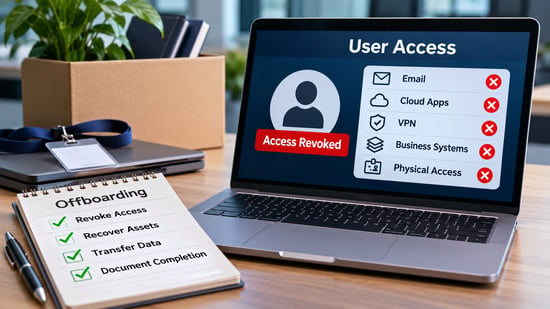
Identity governance and access-management tools can make offboarding faster and more consistent by connecting an HR separation event to account disablement and downstream deprovisioning. NIST's identity-management examples specifically describe workflows in which termination information from HR triggers removal of access and invalidation of credentials.
Automation is valuable because it reduces dependence on memory, but it does not eliminate the need for ownership. A workflow cannot remove access to a system that was never included in the inventory, and it cannot know whether an unusual shared credential needs rotating unless the organization has defined that requirement.
Companies looking to secure business with Proactive Network can assess its published cybersecurity capabilities, which include multifactor authentication, endpoint detection and response, email security, managed detection and response, and security monitoring. Those capabilities can support a broader security program, but the company still needs to define who initiates offboarding, who confirms completion, and which systems fall inside the provider's responsibility.
External IT providers can also play a direct role in employee lifecycle management; according to Proximit, its current service catalog includes employee onboarding and offboarding, IT asset management, mobile device management, single sign-on, managed cybersecurity, and other IT support services.
That is more relevant to offboarding than the draft's original claim about location-based employee-presence technology, which could not be substantiated from Proximit's published services.
High-Risk Roles Need a More Detailed Exit Checklist
Not every departure carries the same exposure. Employees with elevated privileges or unusually broad access need a more detailed review because a single identity can reach more systems.
For administrators, developers, finance leaders, security staff, and others with sensitive access, check for:
- Privileged and emergency administrator accounts
- Cloud access keys, API tokens, SSH keys, and certificates
- Repository deploy keys and automation credentials
- Password-vault access and shared secrets
- Backup consoles and disaster-recovery systems
- Banking, payment, payroll, and purchasing authority
- Domain registrars, DNS providers, and certificate-management accounts
- Security platforms capable of disabling logs, alerts, or monitoring
Where the employee created or controlled service accounts, IT should determine whether those accounts are still needed and who owns them after departure. Simply disabling a human login can break automation if business processes depend on credentials tied to that individual.
Do Not Let Security Turn the Layoff Into a Punitive Process
Prompt access removal is a control, not an accusation. The majority of departing employees should not be treated as though they intend to steal data or damage systems. Framing revocation as a standard part of every separation helps preserve dignity while ensuring the company does not make exceptions based on personal assumptions about who seems trustworthy.
Employees can be told clearly that access is removed as part of the normal separation process and that the company will provide an appropriate route for retrieving personal information that may legitimately remain on company equipment, subject to policy and law.
HR should also explain how final pay, benefits, personal belongings, reference requests, and equipment returns will be handled. Security works better when it is predictable and professional rather than improvised in a tense conversation.
Verify the Offboarding Instead of Assuming It Worked
An offboarding ticket marked complete does not prove that access is gone. The organization should have a verification step.
That may include confirming that the primary identity is disabled, checking active sessions, reviewing privileged groups, confirming device status, validating that key SaaS applications show the user as suspended or removed, and verifying that physical access has been canceled.
For sensitive departures, a short period of heightened monitoring can also be appropriate. Unexpected login attempts, repeated password-reset requests, access from unfamiliar devices, or activity involving shared accounts may indicate that something was missed.
Useful process measures include the time between the agreed separation point and primary account disablement, the percentage of departures completed without exceptions, the number of orphaned accounts found during access reviews, and the number of systems discovered only after the employee had already left. Those measures reveal whether the process is improving rather than merely whether the checklist was completed.
A Secure Exit Is a Coordinated Business Process
Effective offboarding after a layoff is not an IT-only task. HR controls the employment event, managers understand the person's responsibilities, IT and security control many of the access paths, application owners may control specialist systems, and legal or compliance teams may determine what information must be preserved.
The strongest process connects those responsibilities before the employee is notified. For involuntary departures, access should be removed at the agreed cutoff rather than left active until somebody remembers to open an IT ticket. The organization should then verify that sessions, applications, devices, privileged accounts, shared credentials, and physical access have been addressed without destroying records the business still needs.
That balance- prompt revocation, reliable preservation, clear ownership, and respectful communication—is what turns offboarding from an administrative afterthought into a practical security control.
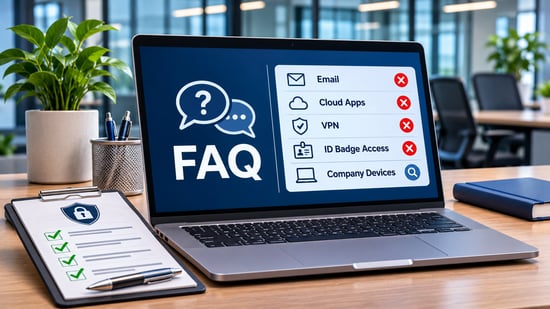
Before the Account Is Closed: Questions Leaders Should Resolve About Layoff Offboarding
Should access be revoked before the employee is told about the layoff?
For an involuntary separation, especially where the employee has sensitive or privileged access, it is often appropriate to coordinate revocation immediately before or at the same time as notification. The exact timing should be agreed among HR, IT, management, and, where necessary, legal counsel. The objective is to avoid an unnecessary period in which the employee has been told they are leaving but still retains access that is no longer required.
Is disabling the employee's email account enough?
No. Email may be only one access path. Review single sign-on, VPN, cloud platforms, business applications, mobile devices, privileged accounts, API credentials, password managers, shared accounts, physical access, and any customer or supplier systems the employee could reach. Active sessions and tokens may also need to be revoked separately.
What should happen to the former employee's mailbox and files?
Access should be removed without automatically deleting business information. Depending on company policy and legal requirements, records may need to be transferred, retained, archived, or placed under a legal hold. Managers should receive access through an approved delegation process rather than by continuing to use the former employee's credentials.
What if the employee used a personal phone or computer for work?
The organization should follow its BYOD policy and applicable law. Corporate applications, sessions, certificates, and managed business data may need to be removed, but the company should avoid deleting personal information it has no right to control. This is easier when mobile-device and application-management rules are established before employees begin using personal devices for work.
How can a company know whether its offboarding process is missing accounts?
Maintain an authoritative inventory of identities, applications, devices, privileged accounts, and assigned assets, then reconcile departures against it. Periodic access reviews can reveal orphaned accounts that previous offboarding processes missed. If an account is repeatedly discovered only after somebody leaves, the problem is not the employee; it is the inventory or ownership model.
Should contractors and temporary workers follow the same process?
They should follow the same access-lifecycle principles even if the HR process differs. Contractor accounts should have a named sponsor, an expected end date, and a review process. When the engagement ends, the organization should remove access promptly, recover assets, revoke external credentials, and preserve any business records that need to remain available.