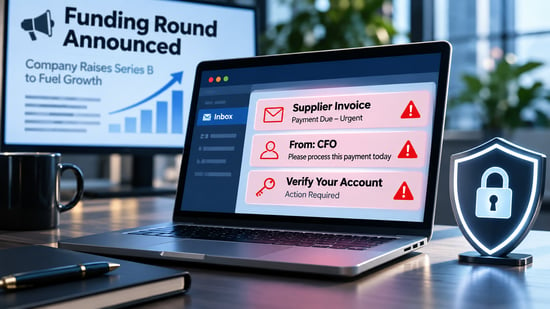
 A funding announcement is good news for a growing company, but it also publishes useful context about the business at exactly the moment its operations may be changing. New hires, suppliers, advisers, software purchases, and spending approvals can all follow a round. That does not mean fraud automatically increases after every announcement, but it can create a convincing backdrop for fake invoices, payment-diversion requests, and targeted phishing.
The risk is less about criminals knowing that money exists and more about knowing what story will sound plausible. A message that appears to come from a new vendor, investor, executive, or adviser can be harder to challenge when employees genuinely expect unfamiliar names, urgent purchases, and new payment instructions. The strongest defense therefore combines technical controls with payment processes that remain reliable when the business is moving quickly.
Why a Funding Announcement Can Create a Useful Pretext for Fraud
Funding announcements may disclose the company name, round size, participating investors, and senior executives. Press coverage and social posts may add information about expansion plans, hiring, product development, or new markets. None of that information is secret, but together it can help an attacker appear sound, timely and credible.
Imagine a company has just announced a Series B and publicly said it plans to expand its sales team. Accounts payable then receives an invoice from an unfamiliar recruitment firm, while a finance employee receives a message appearing to come from an executive asking for an urgent supplier payment. Both requests fit the company's public story. That does not make either request legitimate.
This is the same reason growth can expose weaknesses in informal controls. As Fundz has explored in its discussion of whether a security model can scale with the business, processes that work when a company is small can become unreliable as people, suppliers, applications, and exceptions multiply. A funding round can accelerate several of those changes at once.
Business email compromise (BEC) shows how costly impersonation can become. The FBI's 2025 Internet Crime Report recorded 24,768 BEC complaints and more than $3 billion in reported complaint losses. Those figures cover BEC generally; they do not show that funding announcements caused the incidents. They do, however, demonstrate why payment requests based on email identity alone should not be trusted.
The Main Post-Funding Fraud Scenarios to Prepare For
Fake or Altered Supplier Invoices
An attacker may create a completely fabricated invoice, impersonate a real supplier, or alter genuine payment instructions after gaining access to an email account. The request can be especially persuasive when the company is onboarding vendors that finance staff have not dealt with before.
Warning signs include unexpected invoices, changed bank details, unusual urgency, requests to bypass the normal purchase-order process, and contact details that differ from those already held on file. The safest response is not to reply to the questionable message for confirmation. Verify the supplier through a trusted number or contact obtained independently of the invoice.
Executive and Adviser Impersonation
Fraudsters may pose as a founder, CFO, investor, lawyer, or other trusted person and ask for a transfer to be completed quickly or confidentially. Public announcements can help establish the relationships needed for the story: the attacker may know which investment firm participated in the round, who leads the company, and what growth plans were announced.
Urgency and authority are central to this tactic. A finance employee may be told that a payment is connected with the transaction, a confidential acquisition, a new supplier, or a time-sensitive expansion project. A well-designed approval process should make those claims independently verifiable, regardless of the seniority of the person supposedly making the request.
Credential Phishing and Account Takeover
Some attacks aim first to steal credentials rather than money. A message might imitate a document-sharing service, benefits provider, investor portal, cloud platform, or IT administrator. If an employee enters credentials into a fake login page, an attacker may gain access to email, files, or financial workflows that make later impersonation far more convincing.
Phishing can also arrive through text messages, phone calls, and other channels. NIST's current phishing guidance recommends employee reporting, email filtering, and stronger account protections rather than relying on users to identify every malicious message correctly.
Requests to Change Vendor Bank Details
A change to a legitimate supplier's bank account is one of the highest-risk requests finance teams receive. It can be fraudulent even when the message appears in an existing email thread because an attacker may have compromised a mailbox and be monitoring genuine correspondence.
Bank-detail changes should therefore trigger a separate verification process. Use a known contact method already held in the company's records, not a telephone number or link supplied in the change request. Where practical, require a second person to approve the change before a payment is released.
Strengthen the Payment Process Before the Round Becomes Public
The most useful preparation happens before employees are handling a surge of new suppliers and requests. Finance, operations, and IT should agree which events require additional verification and make those rules easy to follow.
A practical payment-control baseline can include:
- Independent verification of new payees: Confirm the supplier, contractual relationship, and banking information through a known channel before the first payment.
- Mandatory checks for bank-detail changes: Treat every request to alter payment instructions as high risk, even when it appears to come from an established supplier.
- Dual approval for material payments: Ensure a second authorized person reviews high-value, unusual, or exceptional transfers.
- Clear purchase-order and invoice matching: Where the business uses purchase orders, require the invoice, approved order, and receiving evidence to agree before payment.
- Exception logging: Record why a normal control was bypassed, who approved the exception, and what independent evidence supported the decision.
- Known contact records: Maintain supplier telephone numbers and payment contacts separately from individual invoice emails so staff have a trusted route for verification.
These controls should apply to senior executives as well as junior staff. A message that appears to come from the CEO should not automatically override the process. The purpose of the control is to protect both the employee receiving the request and the executive whose identity may be impersonated.
Technical Controls Support the Finance Process, but They Do Not Replace It
Technology can reduce the number of malicious messages that reach employees and make account compromise more difficult. It cannot establish whether a genuine-looking invoice represents an approved business obligation.
Multi-factor authentication should protect email, financial applications, and other high-value services. Where practical, organizations should prefer phishing-resistant authentication methods for sensitive accounts. Endpoint protection, patching, email filtering, and monitoring also reduce the chance that a single malicious message becomes a broader compromise.
Email-domain controls matter as well. SPF, DKIM, and DMARC help receiving systems authenticate messages associated with a domain and reduce certain forms of direct domain spoofing. They do not stop an attacker from registering a lookalike domain or using a genuinely compromised mailbox, so finance teams still need verification procedures for sensitive requests.
Mailbox monitoring can also reveal behaviors associated with account takeover. Unexpected forwarding rules, new inbox rules that hide messages, suspicious login locations, and unexplained changes to account recovery settings deserve prompt investigation. The objective is not to collect alerts for their own sake, but to ensure somebody has responsibility and authority to act on them.
Where Managed IT Support Fits After a Funding Round
A rapidly growing company may not have a large internal security or IT team when a funding event increases hiring, software adoption, and operational complexity. External support can add monitoring capacity, endpoint management, email security, identity administration, backup management, and incident-response expertise.
Organizations considering additional coverage may evaluate options such as hiring NGEN. Its published managed-services offering includes monitoring, help-desk support, cybersecurity, cloud services, and backup-related capabilities. The relevant question for a funded company is not simply whether an MSP offers many services, but which responsibilities it will own, what it can detect, how quickly it can act, and where internal approval is still required.
The broader IT support benefits explained by Network Systems & Solutions include endpoint management, monitoring, backup, email filtering, and security controls.
Businesses evaluating any provider should translate those service descriptions into a clear operating model: who receives suspicious-email reports, who reviews unusual sign-ins, who can disable a compromised account, and who contacts the bank if payment fraud is suspected?
External capacity can strengthen execution, but accountability should stay visible inside the business. Finance still owns payment authorization, leadership owns acceptable risk, and somebody must remain responsible for coordinating the response when a technical alert intersects with a financial transaction.
Create a Heightened-Control Window Around the Funding Event
There is no evidence-based rule saying every company should operate under special fraud controls for a fixed number of days after a funding announcement. A better approach is to tie additional scrutiny to the changes the company is actually making.
If the round is followed by rapid hiring, new offices, multiple new vendors, or a large increase in purchasing authority, keep enhanced verification in place while those changes are being absorbed. Finance can maintain a current list of newly approved vendors, expected large payments, and known advisers involved in transaction-related work.
IT can watch for suspicious account activity and ensure new employees receive the same security baseline as existing staff.
This is also the right time to clarify public communications. Employees should know what information the company has announced and what details have not been made public. If an email refers to a supposedly confidential investor request, a new office, or an urgent supplier relationship, staff should have a simple way to check whether that story fits reality.
What to Do If a Fraudulent Payment or Account Compromise Is Suspected
Speed matters once money has moved or an account may be compromised. Do not wait for a complete internal investigation before taking containment steps.
If a fraudulent transfer may have occurred, contact the financial institution immediately through an independently verified channel and ask what recall, hold, or recovery options are available. In the United States, the FBI advises BEC victims to contact their financial institution quickly and report the incident to the Internet Crime Complaint Center.
Businesses elsewhere should follow the corresponding banking, law-enforcement, and fraud-reporting procedures in their jurisdiction.
At the same time, notify the person responsible for IT or security, preserve the relevant emails and payment records, and avoid deleting evidence. If an email account is suspected of compromise, review active sessions, authentication methods, forwarding rules, and recent changes before treating a password reset alone as resolution.
Fundz's guidance on how businesses respond to and recover from a security alert is relevant here: detection is only the beginning. The organization still has to establish scope, contain the problem, restore safe operations, and determine what needs to change afterward.
Measure Whether the Controls Actually Work
Security awareness should not be judged solely by how many employees completed a training module. Finance and IT can track whether the controls are operating when real requests arrive.
Useful measures include the percentage of new vendors independently verified before first payment, bank-detail changes confirmed through a trusted channel, unusual payment requests that receive secondary approval, suspicious emails reported by employees, and the time between a credible fraud report and containment action.
Review exceptions as carefully as incidents. If executives repeatedly bypass dual approval because the process is too slow, the control needs redesigning rather than simply documenting noncompliance. If finance staff cannot find a trusted supplier contact quickly enough, supplier records need improvement. Good controls survive normal business pressure.
The central lesson is that a funding announcement does not have to be hidden to be safe. The company needs processes that assume public information can be reused by somebody with malicious intent. When verification, account security, and incident ownership remain consistent during rapid growth, the business is far less dependent on employees spotting a perfect fake at the last second.
After the Round: Fraud Questions Finance and Security Teams Should Resolve
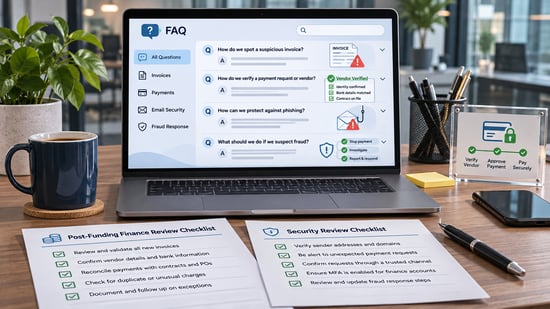
Should a company delay or avoid announcing a funding round because of fraud risk?
Usually not for this reason alone. Funding announcements can serve legitimate investor, hiring, customer, and market objectives. The better response is to assume that anything publicly disclosed may be used in social engineering. Coordinate the announcement with finance and IT so that employees know what changes to expect, which payment controls remain mandatory, and how to report suspicious requests.
Should every invoice from a new vendor after a funding announcement be treated as suspicious?
It should be verified, not presumed fraudulent. New suppliers are normal during growth. The risk arises when unfamiliarity makes it difficult to distinguish a real vendor from a convincing impersonation. Establish the supplier independently, confirm the business owner who requested the service, and verify payment details before the first transfer. Apply additional scrutiny to urgency, changed bank details, or requests that bypass normal procurement.
Does multi-factor authentication prevent fake-invoice and BEC fraud?
No. MFA can substantially reduce the risk of an attacker taking over an account with only a stolen password, but it does not stop every form of phishing or impersonation. A criminal can use a lookalike domain, compromise a supplier's account, call an employee, or send a convincing invoice without accessing the company's systems. Payment verification and approval controls remain necessary.
How long should a company maintain heightened fraud monitoring after a raise?
There is no universal number of days. Base the period on operational change. If the company is still adding suppliers, increasing payment volumes, hiring rapidly, or introducing new approvers, the conditions that make impersonation easier are still present. Scale back exceptional monitoring when those workflows have stabilized and the standard controls can absorb the new level of activity reliably.
What should happen if somebody has already paid a fraudulent invoice?
Contact the bank or payment provider immediately and request available recall or recovery action. Notify IT or security, preserve emails, invoices, payment records, and relevant logs, and determine whether any account was compromised.
Report the incident to the appropriate fraud or law-enforcement body in the company's jurisdiction. After containment, review how the request bypassed controls and change the process before the next similar payment arrives.