 A startup does not need an internal IT department before it can apply for cyber insurance. It does need to explain who owns cybersecurity, which controls are operating and how those claims can be supported.
That distinction matters because underwriting looks at controls and accountability, whatever the headcount. A founder can outsource device management, backup administration, monitoring, patching or incident support. The insurer still needs enough information to judge the risk, while the company still needs someone who can answer for those controls.
Insurer paperwork makes this visible. One Beazley questionnaire for applicants below £20 million in revenue asks for a "cybersecurity point of contact (CISO, Risk Manager or similar)." It then moves straight to MFA, backups, training, endpoint protection and patching. The questions are about controls and who answers for them.
So the practical question for a lean startup is simple: "Can we show that the risks an underwriter cares about are owned and controlled?"
Key Points: What a Startup Needs to Prove
- A startup without an internal IT department can still be insurable; ownership and evidence matter more than the org chart.
- Expect questions about access protection, backups, endpoints, patching, email security, incident response and prior claims or losses.
- Outsourcing can fill an execution gap, but the startup still needs a named person who owns the risk and can explain the environment.
- Eligibility, premium, retention, limits and coverage are separate underwriting outcomes, and one control does not guarantee all of them.
- The strongest application rests on evidence produced in normal operations. An answer that overstates a control can put the policy itself at risk.
Underwriters Assess Operating Risk
Cyber insurance applications vary by insurer, product, company size, industry and the coverage requested. No universal checklist applies to every startup.
The 2026 NAIC report on the U.S. cybersecurity insurance market makes the same point from the buyer's side: policies vary. Businesses should ask what security practices are required, which events are covered or excluded, how much the policy will pay and how quickly an incident must be reported.
Within that variation, several control themes recur. Travelers lists common cyber-policy subjectivities, which are steps that may need to be completed before a policy can be bound. They include multi-factor authentication, endpoint detection and response, backup strategy, email security, data encryption and remote desktop protocol.
The Beazley questionnaire asks whether MFA protects web-based email for all users and, for applicants with revenue above £1 million, remote network access. It also asks whether critical backups would survive a full compromise and are tested for recovery. Further questions cover security awareness training, anti-malware on every endpoint and patching of critical internet-exposed vulnerabilities within 28 days.
A question about an incident-response plan sits in a separate, optional section. For U.S. readers, Beazley Insurance Company, Inc. also publishes a U.S.-dollar application for applicants below $250 million in revenue. It asks about MFA, backups, endpoint protection, patching and incident response.
Coalition shows another side of underwriting. Its data-driven underwriting process combines an online application with external scanning and organizational data. Together, these help determine eligibility, quoted premiums and minimum self-insured retentions.
The better preparation exercise is not to buy another security product. It is to identify the questions the startup must be able to answer and the evidence behind each answer.
Six Questions the Startup Should Be Ready to Answer
1. Who Owns Cybersecurity?
Someone needs to describe the environment, approve risk decisions and coordinate the people doing the technical work. That person does not have to hold a CIO or CISO title.
In a ten-person startup, the accountable owner might be the COO, CTO, founder or another senior leader. Day-to-day work may sit with a managed provider, a cloud administrator or a specialist security firm. The distinction that matters is between the person who operates a control and the person who answers for whether it is sufficient.
The same principle runs through Why Cybersecurity Controls Can Fail Without Clear Ownership: tools, providers and policies still need a named owner.
Before applying, name the internal owner and every external operator. Be clear about who can approve exceptions and where unresolved security risks are escalated.
2. Is Access Protected Where Compromise Would Hurt Most?
Multi-factor authentication is one of the clearest recurring underwriting controls. The useful question is whether MFA covers the accounts that could expose email, systems, data or administrative control.
Map the important access paths: web-based email, cloud administration, remote access, financial systems, source-code repositories, customer platforms and any privileged or shared administrator accounts. Then record where MFA is enforced, where it is missing and who can change those settings.
A startup that says "we use Microsoft 365" has described a platform. A startup that can show who has administrator rights, that MFA is enforced on those accounts and that former employees are removed promptly has described a control.
3. Can the Business Recover Its Critical Data?
Backups are another recurring theme, but they matter only if they can be restored. Beazley's questionnaire asks whether critical data and systems are backed up in a way that would survive a full compromise and whether those backups are regularly tested for recovery. Travelers lists backup strategy and process among its common subjectivities.
For a startup, useful evidence might include the backup schedule, the systems and data covered, and where backups are stored. Also record who receives failure alerts and the date and result of the last restore test. Those records are more persuasive than a statement that the company "has cloud backup."
4. Are Endpoints and Internet-Facing Systems Being Managed?
A lean company can build up technical exposure quickly. Founder laptops, contractor devices, SaaS admin consoles, cloud services, test environments and temporary tools can all become part of the attack surface.
Underwriting questions commonly test whether endpoints run protective software and whether critical vulnerabilities are patched. Beazley also asks applicants to confirm that no end-of-life software or operating system is exposed to the internet and separately asks about remote desktop software exposed directly to the internet. Travelers' subjectivities include endpoint detection and response as well as remote desktop protocol.
The startup should know which devices and internet-facing services are in scope, who patches them and how exceptions are handled. It also needs a way to spot when a device or service falls outside policy.
5. Can the Company Detect and Respond to an Incident?
A company without internal IT can still have an incident-response capability, built on a different operating model.
The evidence should identify who receives alerts and who has authority to isolate accounts or devices. It should also make clear who calls the insurer or broker, who contacts outside incident-response support and who makes the business decision to interrupt operations.
An incident-response plan does not need to predict every attack. It needs to remove ambiguity at the moment the company has the least time to resolve it.
6. Can You Prove the Answers?
This is where a collection of security claims becomes an underwriting-ready picture.
Useful evidence depends on the insurer and the control. It might include an MFA configuration report, an administrator list, endpoint coverage figures or a patch report. A completed restore test, training records, an incident-response plan, a provider's service scope or a record of a resolved vulnerability can also help.
What underwriters request varies. Some rely heavily on application answers, while others add external scanning or follow-up questions. Either way, the startup's answers have to survive scrutiny if the insurer asks for more detail.
The cost of getting this wrong can be the policy itself. In 2022, Travelers sued International Control Services, an electronics manufacturer, after a ransomware attack. Travelers alleged that the company's application represented MFA as protecting email, remote network access, endpoints, servers and other systems, while its investigation found MFA protecting only the firewall.
The federal court docket records Travelers' motion for rescission on August 26, 2022 and the court's order and judgment four days later, after the parties agreed to rescind the policy.
Wilson Elser's later summary describes the dispute as turning on alleged material misrepresentations about the extent of MFA. The case did not produce a merits ruling on whether every allegation was true, but it shows why application answers need to match the controls actually in place.
Build an Evidence Pack Before the Application Arrives
A compact evidence pack helps the founder, broker and technical provider work from the same facts. It also reveals gaps while there is still time to fix them.
| Underwriting question | Useful evidence to have ready | What a gap may reveal |
|---|---|---|
| Who owns cybersecurity? | Named internal owner; provider scope; escalation route | Work is being performed, but nobody owns the risk |
| Is access protected? | MFA settings; admin-account list; access review | Critical accounts depend on password-only access or unclear privileges |
| Can data be recovered? | Backup scope; failure alerts; latest restore-test record | Backups exist, but recovery has not been demonstrated |
| Are systems managed? | Endpoint inventory; protection coverage; patch or vulnerability report | Devices or exposed services sit outside normal control |
| Can the company respond? | Incident plan; contact tree; insurer and broker details; external response contacts | An incident would begin with role confusion |
| Can claims be evidenced? | Current reports, tickets, logs, test records and accepted exceptions | Application answers depend on memory or assumption |
Outsourcing the Work While Keeping the Accountability
Without an IT department, the controls still need to exist; only the delivery model changes.
Travelers shows that this knowledge can matter after the policy is bound, too. Its Retention Reduction Endorsement guidance covers the Security Questionnaire completed in its Cyber Risk Dashboard. The questionnaire must be completed by "someone with an up-to-date understanding of your organization's IT infrastructure and cybersecurity posture." That can be "someone within the organization (or an IT MSP)," though not the broker.
Policyholders who complete it count as engaged, which can reduce their claim retention by 25%, subject to the endorsement's terms. A startup can therefore outsource execution without outsourcing accountability, and the evidence remains useful after the policy is in force.
A startup that needs help building or operating those controls might reach out to Hixardt Technologies. Its published services include IT management and support, cybersecurity and disaster recovery, backup, cloud services and compliance oversight.
The same discipline applies to a business considering Ironclad TEK for Calgary businesses. Its site describes managed IT, cybersecurity, backup and recovery, monitoring and IT consulting. Either way, the startup still decides which controls the provider operates, which decisions stay internal and what evidence the company receives.
This connects with the broader sourcing question in What Should a Growing Company Keep In-House - and What Should It Outsource? A provider can perform specialist work without owning the startup's risk appetite, policy choices or insurance representations.
Separate Insurability From Price, Retention and Coverage
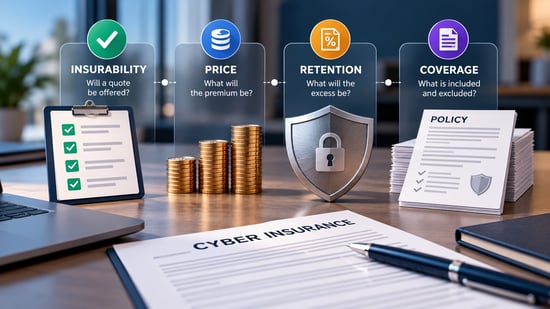
Cyber insurance is easy to frame as a yes-or-no outcome, but underwriting can affect several different parts of the transaction.
Controls can influence whether a quote is offered or pre-bind remediation is required. They may also affect the premium, self-insured retention, limits, sublimits or exclusions. Those outcomes vary by insurer and policy, so a startup should not assume that one control guarantees "good terms."
Travelers' subjectivities show how an insurer may require certain controls before binding, and Coalition uses application and scanning data to help determine eligibility, premiums and retentions. The Beazley questionnaire goes further on price. Its optional security-control questions say "satisfactory responses may discount the base premium offered by up to 20%."
That example is useful precisely because it is narrow. It shows one insurer, on one form, linking specified controls to potential pricing. It does not create a market-wide discount rule.
Applying the Test: A 14-Person SaaS Startup With No IT Department
Consider a hypothetical 14-person SaaS company. The founder owns risk decisions, a managed provider handles Microsoft 365 and laptops, and the engineering lead manages the cloud environment. The company is preparing its first cyber-insurance application.
| Question | What the startup finds | Readiness |
|---|---|---|
| Ownership | Founder is the named owner; provider and engineering scopes are documented | Ready |
| Access | MFA covers email and cloud admins, but one legacy finance account is password-only | Fix |
| Recovery | Backups run daily, but no restore test has been recorded in nine months | Fix |
| Endpoints | Company laptops are managed; two contractors use unmanaged personal devices | Fix |
| Response | Provider offers incident support, but the startup has no internal contact tree or decision process | Fix |
| Evidence | MFA and endpoint reports exist; backup and incident evidence is incomplete | Partial |
Nothing in that review proves the startup is uninsurable. It does show why applying immediately would force the broker and underwriter to work around avoidable uncertainty.
The company can close the finance-account MFA gap, run and document a restore, bring contractor devices into policy and write a simple incident decision tree. The application is then supported by current evidence rather than promises about what the business intends to improve later.
What Should the Founder Do Before Speaking to a Broker?
Start with the application evidence, not a shopping list of security products.
- Name the internal cybersecurity owner and document the people or providers operating each important control.
- Confirm MFA coverage for email, remote access, cloud administration and other high-impact accounts.
- Run a real restore test on critical data and record the result.
- Check endpoint coverage, unsupported software, internet-facing services and overdue critical vulnerabilities.
- Write down the incident-response contacts and decision path, including the broker, insurer and outside technical support.
- Collect current reports and records that support the answers, so nothing rests on verbal assurance.
Then let the broker and insurer say which additional questions, subjectivities or evidence apply to the specific policy. That sequence avoids spending money on a control that may not address the startup's real risk or the insurer's actual concern.
The Test Is Evidence, Not Headcount
Lean does not have to mean unmanaged. Cyber insurers can assess that distinction through application questions, control questionnaires, follow-up requirements and, in some models, external scanning.
The strongest position is to show that critical cyber risks have an owner and the important controls are operating. External providers need clear boundaries, and the evidence should be ready when someone asks for it. None of that requires copying a larger company's org chart.
No set of controls guarantees coverage, pricing or terms. It does give the startup a far stronger underwriting story than simply saying "We outsource IT."
Questions Startups Ask About Cyber Insurance Without an IT Department
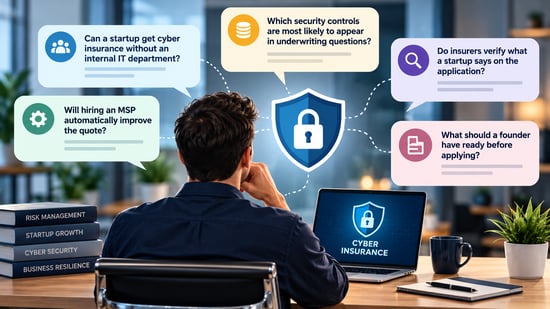
Can a startup get cyber insurance without an internal IT department?
Potentially, yes. Insurer requirements vary. The underwriting materials reviewed here focus on the company's security controls, ownership and evidence, and none treats an internal IT department as a prerequisite.
Will hiring an MSP automatically improve the cyber-insurance quote?
No. An MSP can operate controls and help close technical gaps. Its effect on eligibility, premium, retention or coverage depends on the insurer, the policy and the actual risk. The startup still needs clear internal ownership and accurate application answers.
Which security controls are most likely to appear in underwriting questions?
Insurer materials commonly address MFA, backups and recovery, endpoint protection, patching, email security, remote access, vulnerability management and incident response. The exact questions vary by insurer and product.
Do insurers verify what a startup says on the application?
Practices vary. Some insurers rely on application answers and follow-up questions, while others also use external scanning or other data. Coalition, for example, says its underwriting combines application information with external scanning and organizational data. Inaccurate answers carry real risk: in Travelers v. ICS, a disputed MFA answer ended with the policy rescinded.
What should a founder have ready before applying?
Have a named security owner, a clear map of provider responsibilities and current evidence for the controls most likely to matter: access, backups, endpoints, vulnerabilities and incident response. A broker can then identify any policy-specific requirements.