 A nearby office can feel reassuring when a business is choosing an outside provider. But location is a poor shortcut for capability. Proximity should matter because it improves an outcome the buyer actually values, not simply because the supplier has an address nearby.
Some services need people on the ground. Others can be delivered almost entirely remotely. A provider can be based miles away and still maintain effective field coverage, while a supplier around the corner may have little usable local capacity.
The useful question is therefore not simply, “Is this provider local?” It is: Which parts of this service need to happen physically, where do they need to happen and how quickly?
Key Points: When Local Presence Matters, and When It Does Not
- Separate response from arrival. Fast remote support and fast on-site attendance are different capabilities.
- Test field capacity, not the address. A nearby office does not prove that appropriately skilled people are available when required.
- Think in terms of coverage. Multi-location businesses may need a service network rather than one provider close to headquarters.
- Keep other dimensions separate. Expertise, data location and resilience do not automatically improve because a supplier is nearby.
- Recognize legitimate local objectives. Local-spend policies, community relationships, timezone overlap or genuine regional knowledge can matter when they are explicit buying requirements.
Bottom Line: If you cannot identify a business outcome that improves because the provider is geographically closer, location probably should not be a major selection criterion.
Start With the Work, Not the Address
The strongest provider-selection process begins by defining the result the business needs. The current U.S. Federal Acquisition Regulation uses the same underlying logic for performance-based service acquisition: describe required results, wherever practicable, rather than prescribing how the work must be performed, and make those results measurable. The rules apply to federal procurement, but the principle transfers cleanly to private-sector buying.
If a buyer begins with “we want a local provider,” geography becomes a filter before anyone has established what the service actually requires. Strong candidates can disappear from the shortlist without a clear operational reason for excluding them.
Before geography becomes a filter, establish which tasks can be performed remotely, which require physical attendance, how often on-site work is likely to occur, which locations need coverage and what response time would actually protect the business. Physical coverage might come from a local employee, regional field team, approved partner or another delivery model.
This follows the broader sourcing logic Fundz examines when asking what a growing company should keep in-house and what it should outsource. Once the decision to use an external provider has been made, the next question is how that capability actually needs to reach the business.
Remote Response and On-Site Arrival Are Different Capabilities
“Fast support” can describe two different clocks: how quickly somebody begins diagnosing an issue remotely, and how quickly an appropriately skilled person can physically arrive when remote delivery is not enough.
For many professional services, software platforms, advisory relationships and cloud-based functions, physical attendance may be unusual. In those cases, a narrow geographic radius can remove strong candidates without materially improving the result.
The calculation changes when equipment needs replacing, premises need inspecting, a new site needs setting up or another task requires hands-on work. Buyers should test that field capability directly rather than assuming that a nearby office means somebody suitable will be available.
Providers that publish both remote and field-support capabilities give buyers something concrete to assess. A buyer considering whether to Partner with Network 1, for example, can see from the provider’s Atlanta material that its field engineers handle work including PC replacements, office relocations, new-hire setups and installations when remote support is not enough.
The useful follow-up questions are then operational: how quickly can somebody attend, which tasks trigger a visit, what happens outside normal hours and what coverage exists beyond the main office?
When Buying Local Is the Objective
Not every preference for a local supplier is a proxy for service quality. Sometimes geography is itself part of what the business wants to achieve.
A company may have a local-spend policy, value community relationships, need close timezone overlap for account management or require familiarity with genuinely regional operating conditions. Those can all be legitimate procurement criteria when they are explicit.
The distinction is simple: location can be a valid objective without being evidence that the supplier is automatically more responsive, reliable or capable.
Expertise should be tested separately as well. A nearby generalist is not necessarily a better fit than a more distant specialist, particularly when the work is knowledge-heavy and physical attendance is infrequent. Where specialist knowledge must be applied on-site, buyers need both capabilities: the right expertise and a credible way to deliver it where it is needed.
Multi-Location Businesses Need Coverage, Not Proximity
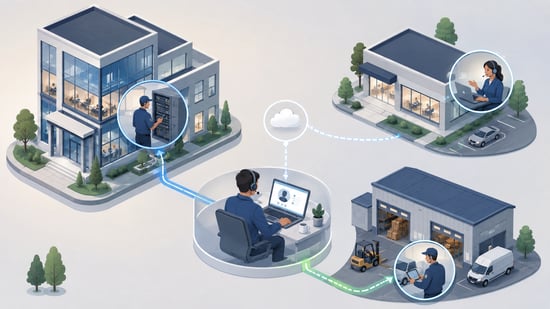
A provider that fits a business concentrated in one location may become a poor fit once the physical footprint changes. Opening another office, facility or operating location is therefore a natural point to reassess the service model.
A buyer considering Norterra Tech in Minneapolis, for example, can see from the provider’s Minneapolis material that it positions its local team alongside co-managed support and services intended to adapt as businesses grow. That is useful when evaluating the local relationship, but a distributed business still needs to know what happens beyond that home market.
A separate provider-published manufacturing case study illustrates that wider problem. Norterra describes a company operating multiple U.S. and international facilities with no on-site networking technicians, stretched internal IT resources, delayed support tickets and outages affecting production.
Because this is Norterra’s own account, it should not be treated as independent evidence of the provider’s performance. It does, however, demonstrate the buyer-side issue clearly: strong local capability in one market is not the same thing as adequate coverage across a distributed organization.
For multi-site operations, buyers should ask:
- Which locations can the provider support directly?
- Where are partners or subcontractors used?
- Do service levels or travel charges vary by location?
- Can the model extend to the next site without rebuilding the arrangement?
- Will the business manage one provider relationship or a patchwork of local suppliers?
The relevant question becomes less “How close is the provider to headquarters?” and more “How reliably can the provider reach the places where the business actually operates?”
Local Concentration Can Still Create a Resilience Risk
Proximity can improve convenience while also concentrating exposure. If the business and its nearby provider depend on the same regional power, transport links, facilities or workforce, the disruption that affects one may also affect the other.
The practical question is therefore: what alternative team, location or delivery route keeps the service running if the normal local route becomes unavailable?
Supplier Location Is Not Data Location
For digital and information-based services, the provider’s address does not necessarily tell the buyer where information will be stored, processed or accessed. A nearby supplier may use cloud infrastructure in another region, remote specialist teams, subcontractors or software platforms with their own processing arrangements.
Equally, a provider headquartered farther away may keep relevant data and support access within locations acceptable to the customer.
Where data location, jurisdiction or onward access matters, investigate those issues directly. Fundz’s guidance on granting supplier access to systems or data addresses the same problem from another direction: the commercial relationship needs to be translated into the actual access and dependencies it creates.
Turn “Local” Into Measurable Requirements
If proximity matters, define what it is expected to achieve. Depending on the service, requirements might include:
- On-site attendance within an agreed period for defined incidents.
- Field coverage across named business locations.
- Local availability during specified operating hours.
- Clear travel or call-out charges inside an agreed service area.
- A defined escalation route when remote resolution is not possible.
This makes comparisons fairer. A provider farther away with a documented field-response commitment can be a better operational fit than one around the corner with no meaningful guarantee of on-site availability.
Local-vs-Remote Provider Decision Matrix
| Buying consideration | When local presence matters more | When local presence matters less |
|---|---|---|
| Physical intervention | Equipment, premises or site-based work is routine or time-critical. | Work is almost entirely digital or advisory. |
| Response requirement | Business impact depends on rapid on-site arrival. | Remote diagnosis and resolution protect the required outcome. |
| Number of locations | The provider has proven field coverage across relevant sites. | Workforce and systems can be supported centrally. |
| Specialist expertise | Specialist knowledge must regularly be applied on-site and suitable expertise is available within the required coverage area. | The expertise is scarce, highly specialized or can be delivered effectively without routine physical attendance. |
| Policy or strategic objective | Local spend, community impact, timezone alignment or regional knowledge is an explicit objective. | Location is being used only as a proxy for responsiveness or trust. |
| Resilience | Local resources are backed by alternative locations or teams. | Geographic concentration would create a shared point of failure. |
| Data and access | Physical location connects to a genuine legal or operating requirement. | Data residency and access can be governed independently of office location. |
| Cost | Travel and call-out economics materially affect the service. | Location has little effect on total delivery cost. |
The matrix is not a scoring system. Its purpose is to expose why geography matters in this particular purchase. If the buyer cannot connect location to an operational, economic, policy or risk outcome, it should carry less weight in the shortlist.
Choose the Delivery Model, Then the Provider
The strongest buying decision is usually not “local versus remote.” Some services need permanent local presence; others work best with remote-first delivery and occasional field support; multi-site companies may need a network of coverage rather than one nearby office.
The buyer’s job is to define where work must happen, how quickly physical attendance matters, how specialist the capability is, how coverage will scale and what happens when normal delivery is disrupted.
Choose the delivery model first. Then decide how much geography matters to delivering it.
Questions Buyers Ask About Local and Remote Service Providers

Does a local provider usually respond faster?
Not necessarily. A local office may shorten travel time when somebody needs to attend physically, but remote response speed depends on staffing, workflows, service levels and operating hours. Buyers should assess remote response and on-site arrival separately.
When should on-site support be a formal requirement?
When delayed physical attendance could materially disrupt operations, safety, customer delivery or important equipment. Define which situations trigger a visit, and the response time the business actually needs.
Is a national provider better for a multi-location business?
Not automatically. Buyers should establish how each site will be served, whether third parties are involved and whether service levels remain consistent. A regional or specialist provider with the right coverage model may work equally well.
Does choosing a local supplier reduce third-party risk?
Proximity alone does not establish lower risk. Supplier resilience, financial stability, subcontractors, security controls, service dependencies and concentration risk should be assessed directly.
Should buyers ask where supplier staff and data are located?
Yes, where those details affect delivery, risk, contractual requirements, data protection or jurisdiction. A local office should not be assumed to describe where every employee, subcontractor, system or dataset involved in the service is located.