 A growing business rarely sets out to build a complicated technology environment. Complexity usually arrives one sensible decision at a time.
A team adopts a specialist application. A second location needs different equipment. A temporary integration keeps a process moving. A supplier is given access for a project. More cloud services are added. An acquisition brings its own systems. A free trial quietly becomes part of everyday work.
Each decision may be reasonable on its own. The problem begins when the business can no longer see the combined result clearly.
Leaders may still know the major platforms while losing sight of smaller services connected to them, licences that continue to renew, configurations that have changed, or dependencies that would matter during a migration, outage or supplier change.
That gap is not only a cybersecurity issue. It can affect costs, procurement, change programmes, troubleshooting, resilience and the speed at which the business can make confident decisions.
The management question is simple: can the business still reliably see what it has, how those components fit together and what else could be affected if something changes?
In practical terms, IT asset visibility means having sufficiently accurate, current information about the hardware, software, cloud services and important dependencies the business relies on.
Key Points: Why Technology Visibility Becomes Harder During Growth
Growth can increase the number of systems, services and connections a company relies on faster than its records and management processes evolve.
Key points include:
- An inventory is only the starting point: Knowing that an application or device exists is useful, but leaders also need enough context to understand its purpose, status and important connections.
- SaaS and supplier-provided services count too: The technology environment is no longer limited to equipment directly controlled by the business.
- Configuration changes matter: The product name may stay the same while settings, integrations and other changes alter the environment behind it.
- Dependencies can create unexpected consequences: A small service can become operationally important when another workflow or system depends on it.
- Change exposes weak visibility: Migrations, expansion, acquisitions, supplier changes and cost reduction often reveal information gaps that were easy to tolerate during normal operations.
- Visibility has to be maintained: A one-off discovery exercise becomes less useful as soon as the environment changes.
Proof Point: NIST Cybersecurity Framework 2.0 treats asset management as more than a hardware list. Its Asset Management outcomes include inventories of hardware; software, services and systems; representations of authorised network communications and internal and external data flows; inventories of supplier-provided services; and lifecycle management of systems, hardware, software, services and data.
Bottom Line: A growing business does not need perfect knowledge of every technical detail. It does need information accurate enough to understand what it relies on, what has changed and where a decision could have consequences elsewhere.
Growth Adds Systems in Uneven Ways
Technology rarely expands according to one plan.
Some additions are deliberate and centrally managed: a new CRM, finance platform or cloud environment. Others arrive through individual teams, temporary projects, supplier relationships or practical workarounds. Remote work can add devices and access methods. New locations can introduce local equipment and connectivity. New hires can create demand for specialist tools. Acquisitions can add a second technology environment almost overnight.
This is related to the capacity problem Fundz examined in Why Growing Companies Outrun Their IT Support Capacity, but it is not the same issue. A company can have enough people to handle day-to-day support and still lack a reliable picture of the environment those people are supporting.
Growth changes both volume and complexity. Ten independent tools are not necessarily harder to understand than five tightly connected ones. What matters is what the systems do, how they interact, how quickly they change and how much the business depends on them.
An Inventory Is Not the Same as an Operational Map
An asset inventory answers an important first question: what exists?
Recognised guidance goes further. NIST CSF 2.0 includes inventories not only of hardware but also software, services, systems and supplier-provided services. It also includes maintaining representations of authorised network communications and internal and external data flows.
Although NIST's framework is designed for cybersecurity risk management, that breadth is useful for business leaders because a list of products does not explain how the organisation operates.
In this article, “operational map” is editorial shorthand for the combined records and knowledge that let a business understand its technology environment and important dependencies. It is not an industry-defined artefact or framework.
Imagine an inventory showing a CRM, email platform, accounting system, reporting tool and cloud storage service. The list may be accurate, yet it says nothing about whether the CRM feeds accounting, whether reporting depends on that flow, whether authentication relies on another service, or whether a supplier maintains one of the connections.
The useful questions are therefore broader than “What do we own?” They include:
- What business purpose does this system support?
- Is it still actively used?
- What other systems or workflows connect to it?
- Does it exchange important data with another service?
- Is its current configuration understood well enough to change or reproduce it safely?
- Is a supplier or external platform part of the dependency?
- What would be affected if it became unavailable or was replaced?
Not every organisation needs all of this information in one database. The goal is not an encyclopaedia. It is information that can be used when a decision has to be made.
SaaS Can Be Easy to Lose Sight Of
Software as a Service has made it easier for teams to adopt useful tools quickly. That flexibility is valuable, but it changes how technology enters the business.
A department may be able to start using a cloud application without purchasing equipment or running a major implementation project. Free trials, team subscriptions and card-based payments can reduce the practical barriers further.
UK government guidance on securing SaaS tools explicitly notes that organisations may have people using commercial SaaS tools for work outside the normal managed toolset and recommends identifying and managing that “shadow” cloud footprint. NCSC guidance uses the established term “shadow IT” for unknown assets used for business purposes but not accounted for by normal asset-management or corporate IT processes.
The business consequence is broader than security. A company can end up with overlapping applications, fragmented data, duplicate subscriptions, unclear renewal dates or services that remain active after the project that introduced them has ended.
The visibility question is therefore not simply, “Which applications did the technology team deploy?” It is, “Which applications and cloud services has the business come to rely on?”
Those are not always the same list.
Configuration Drift Changes the Environment Behind the Product Name
Knowing the product name is also not enough if the way it is configured has changed materially.
In industry use, configuration drift describes a divergence between the actual state of a system and an intended, defined or previously understood baseline. It can arise as authorised changes, manual adjustments, emergency fixes and other modifications accumulate without the baseline or documentation keeping pace.
CIS Control 4 focuses on establishing and maintaining secure configurations for enterprise assets and software. Supporting CIS material also stresses that configuration updates should be tracked and managed through the lifecycle so that organisations retain a usable record of change.
For business leaders, the important point is not the technical mechanics. It is that the system the company is operating today may no longer be the same environment it originally implemented.
A platform introduced three years ago may now have new integrations, automation rules, plug-ins, data exports and administrative settings. If the organisation still understands it only as “the system we bought three years ago,” its mental model may have fallen behind reality.
That gap matters when the company wants to replace the system, troubleshoot a failure, assess a supplier, consolidate software or move a process elsewhere.
Hidden Dependencies Can Create Unexpected Consequences
Dependencies are where incomplete visibility becomes a business problem rather than a record-keeping problem.
A service does not have to look important on its own to be operationally significant. A small integration may feed customer data into another application. An identity service may control access to several platforms. A scheduled export may populate a finance report. An old cloud service may still host something that another workflow quietly expects to be available.
The NCSC Cyber Assessment Framework makes the same broader point in its asset-management guidance. Organisations need to understand what supports important functions and the dependencies between relevant assets, supporting infrastructure and elements of the supply chain.
A simple example: A company decides to replace an old CRM because it appears to be a self-contained system. During migration, the team discovers that quotation data feeds the finance platform through an undocumented integration, while a reporting tool depends on a scheduled export from the same CRM.
The replacement project has not simply changed one application. It has exposed dependencies that were difficult to see until the business tried to make a change.
That does not mean every dependency deserves the same depth of documentation. It means important business processes should not rely on connections the organisation cannot identify when it matters.
A simple test is useful: if this component disappeared tomorrow, could the business quickly determine what else would stop, degrade or lose data?
If the answer is no, the organisation has learned something important about its visibility.
Temporary Solutions Can Become Permanent Dependencies
Temporary fixes deserve particular attention because they are easy to omit from formal records. A team may introduce a spreadsheet export while an integration is delayed, add a cloud service to finish a project, or create a manual sync until a replacement platform arrives.
Then the pressure passes, and the temporary arrangement remains.
Fundz has already examined this wider operating pattern in When Fast Fixes Become Permanent Problems. Here, the narrower point is visibility: temporary components can become long-term dependencies without ever being documented as though they were permanent.
The lesson is not to avoid temporary solutions. It is to make sure “temporary” describes the intended lifespan, not the quality of the record around it.
Visibility Problems Surface During Change
An incomplete picture can remain hidden while the business is stable.
People remember which workaround to use. A long-serving employee knows why a strange integration exists. A supplier understands an undocumented configuration. An old subscription keeps renewing. Nothing forces the organisation to reconstruct the whole picture.
Change removes that comfort.
A migration requires the company to identify what has to move. Cost reduction requires it to know what can be cancelled safely. An acquisition requires two environments to be compared. A new office can expose inconsistencies between locations. A supplier change requires knowledge to be transferred. An incident requires teams to work out which systems and dependencies may be affected.
Poor visibility can therefore become costly at the moment the company most needs to act with confidence.
That is why asset and configuration information is better viewed as decision infrastructure than administrative housekeeping. Its value appears when something has to change.
What Leaders Need to Be Able to See
The right level of detail depends on the organisation. A small professional-services company does not need the same asset-management machinery as a multinational manufacturer, but the underlying management questions are remarkably similar.
| Area | Useful management question | Why it matters |
|---|---|---|
| Hardware and endpoints | What devices and infrastructure are still in active use? | Unknown or obsolete equipment can complicate support, replacement planning and security. |
| Applications and SaaS | Which software and cloud services does the business actually rely on? | Helps expose duplication, unused subscriptions and unmanaged tools. |
| Configuration | Have important systems changed materially from the documented or intended baseline? | Reduces surprises during troubleshooting, audits, migrations and recovery. |
| Integrations and data flows | Which systems exchange data or trigger work in another system? | Reveals dependencies that may not be obvious from an application list. |
| Supplier-provided services | Which external services form part of normal operations? | Helps the business understand dependencies beyond its direct control. |
| Lifecycle status | What is being introduced, changed, replaced or retired? | Keeps the operational picture aligned with the current environment rather than its history. |
| Criticality | Which components matter most to important business processes? | Helps concentrate effort where incomplete knowledge would create the greatest consequence. |
The objective is not maximum detail. It is enough reliable context to support real decisions.
Provider Documentation Should Make the Environment More Legible
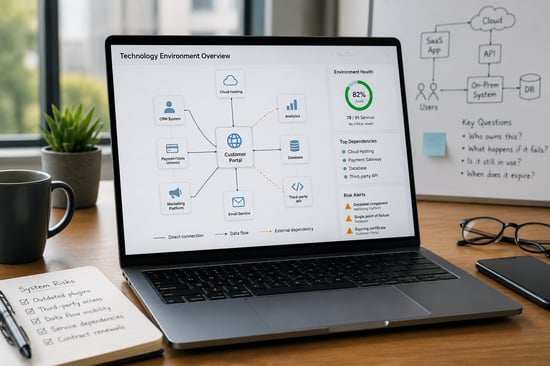
External providers can either improve visibility or make it harder to understand where the business ends and the provider begins.
Documentation and reporting are therefore legitimate evaluation criteria. A provider should be able to explain what it records, how current those records are, what lifecycle information it maintains and what would be handed back if the relationship ended.
For example, a company preparing to meet MC Services's team can examine the provider's published material on IT and software asset management. MC Services describes asset inventories, lifecycle tracking, software licence management, renewal information and reporting. Those are provider claims rather than independent proof of performance, but they give a buyer specific practices to test during evaluation and onboarding.
Published material from Nessit's tech support experts describes audits, regular reporting and documentation, including change histories. Nessit's separate asset-management and documentation material also describes hardware and software inventories and broader environment records. Again, the useful question is not whether a provider says it documents an environment. It is what information the client can actually access, how current it is and whether it remains usable if the relationship changes.
A managed service should not turn the client's environment into a black box.
Restoring Visibility Without Building Bureaucracy
The answer to poor visibility is not necessarily a giant configuration-management project.
NCSC asset-management guidance explicitly recommends a pragmatic approach. It says automated mechanisms should be used where practical, while manual records can still be appropriate in smaller or unusual environments. It also recognises that useful asset information may come from several sources rather than one perfect database.
For a growing business, the recovery effort can begin with the decisions the information needs to support.
Day One: Start With Three Things
- Start with important business services. Choose the workflows the company most needs to keep operating. Identify the systems, cloud services, devices, integrations and suppliers that support them rather than attempting to catalogue everything at once.
- Compare what you discover with what the business already records. Bring together technical discovery, procurement records, software licences, supplier information and existing documentation. Where information conflicts or remains uncertain, record that uncertainty rather than treating the record as complete.
- Give future change somewhere to go. Make sure new systems, integrations, supplier changes, major configuration changes and retirements have a repeatable route into the records the business relies on. Add a last-seen or last-verified date where useful so stale information can be distinguished from current knowledge.
The key is proportionality. Perfect documentation that is too expensive or cumbersome to maintain will not stay perfect for long.
Visibility Is a Growth Capability, Not an Inventory Project
The risk in a growing technology environment is not simply that the company has accumulated too many systems. It is that the business can lose the ability to understand the environment as a whole.
That can happen even when every individual purchase was sensible and every team was trying to solve a real problem.
The answer is not to stop adopting technology. It is to make sure visibility grows with adoption: what exists, what has changed, what connects to what, which services come from suppliers and which dependencies matter most.
When that picture is reliable, leaders can make migrations, supplier changes, investments, cost reductions and recovery decisions with more confidence. When it is not, complexity tends to reveal itself at the least convenient moment.
Questions Business Leaders Ask About Technology Visibility

What does technology asset visibility actually mean?
It means having sufficiently accurate and current information about the hardware, software, cloud services, systems and other technology the organisation relies on. Useful visibility also includes enough context to understand important configurations, lifecycle status and dependencies rather than maintaining only a list of product names.
Does every growing company need a CMDB?
No. A configuration management database can be useful in more complex environments, but it is not the objective in itself. NCSC guidance notes that a CMDB may form part of an asset-management solution while other tools and information sources may still be needed.
Smaller businesses can combine device-management tools, SaaS records, procurement data, supplier documentation and maintained manual records. The test is whether the resulting information supports the decisions the business needs to make.
How often should an asset inventory be updated?
There is no single interval suitable for every type of asset. NCSC guidance explicitly gives different examples for assets that change at different rates and recommends recording indicators such as a confidence score or last-seen timestamp. The practical principle is that records should be current enough for their intended use and have a repeatable way to capture material change.
What is configuration drift?
Configuration drift is the divergence of an actual system configuration from an intended or documented baseline. It can arise through manual changes, emergency fixes, updates and other modifications. The business problem appears when the current state is no longer understood well enough to support safe troubleshooting, migration, audit or recovery.
Why do hidden dependencies matter to business leaders?
Because a change to one system can affect another process that does not appear obviously connected. Understanding important dependencies helps leaders assess the likely consequences of migrations, supplier changes, outages, acquisitions and cost-cutting decisions before those consequences become surprises.