 Winning a major contract can change the outlook for a growing business almost overnight. Revenue forecasts improve, the sales pipeline gains credibility, and a new customer may provide the reference account needed to unlock further opportunities.
But a signed contract creates something else immediately: an obligation. The business now has to deliver what sales promised, at the volume, quality, location and timetable the customer expects.
Operational readiness means having enough financial, human, supplier, process and systems capacity to meet that commitment without destabilizing the rest of the business. Once the deal is signed, “How much is it worth?” has to be followed by a harder question: “Can we actually absorb the work?”
Key Points: A Major Contract Is Also a Capacity Test
A large commercial win can expose constraints that were manageable at the company’s previous scale.
Key points include:
- Measure materiality, not just contract value. A deal becomes operationally significant when its requirements are large relative to existing capacity.
- Model cash timing as well as profitability. Mobilization and delivery costs can fall due before customer payments arrive.
- Translate the contract into operating requirements. Staffing, reporting, service levels, systems, suppliers and escalation routes should be understood before delivery begins.
- Test the supporting ecosystem. A company may be able to grow while one of its critical suppliers or support functions cannot.
- Protect the existing business. A major customer should not quietly consume the people and resources needed to serve everyone else.
- Use early delivery as evidence. Actual workload, cost and service performance should determine what needs to change.
Bottom Line: A valuable contract creates value only if the business can fulfil it without damaging margins, cash flow, existing customers or operating reliability.
How Large Is the Contract Relative to the Business?
The headline value of a contract describes the commercial opportunity, not the operational burden. A deal that is routine for one supplier can be transformative for another.
The UK Cabinet Office uses a comparable principle when assessing the financial standing of prospective suppliers. Its current Economic and Financial Standing guidance includes a Turnover Ratio that compares bidder annual revenue with expected annual contract value. The purpose is to assess whether winning the contract could have such a material impact that the organization might struggle to deliver it.
That is public-procurement guidance, not a universal private-sector threshold. But the underlying management question transfers well: how large is the new obligation relative to the organization expected to fulfill it?
Revenue is only one dimension. A contract might represent a modest percentage of turnover while requiring a disproportionate amount of specialist labor, new locations, customer support, compliance work or management attention. In practice, materiality is about how much the business has to change to deliver.
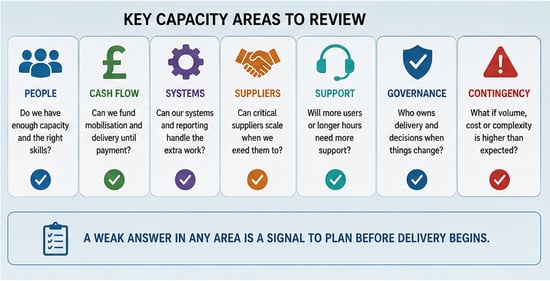
| Area | Readiness question |
|---|---|
| People | Do we have enough capacity and the right skills without diverting key staff from existing work? |
| Cash | Can we fund mobilization and delivery until customer payments arrive? |
| Systems | Can current processes, applications and reporting handle the additional workload? |
| Suppliers | Can critical third parties increase their own capacity when required? |
| Support | Will more users, locations or operating hours require additional coverage? |
| Governance | Who owns delivery, customer commitments and decisions when assumptions change? |
| Contingency | What happens if volume, cost or complexity exceeds the forecast? |
A weak answer in one area does not automatically mean the company should reject the contract. It shows leaders where mitigation is needed before the commitment becomes a customer-facing problem.
Model the Cash Before You Model the Profit
A contract can be profitable on paper and still put the business under cash pressure.
The British Business Bank notes that even an otherwise profitable company can experience severe short-term cash-flow problems after incurring the costs of producing goods or delivering services while it waits for customer payment. It also identifies growth itself as a common source of cash pressure because additional sales have to be funded through working capital.
A major win can amplify that timing gap. New employees may need salaries before the first invoice is settled. Equipment, inventory, subcontractors, software, travel or implementation work may have to be funded during mobilization. Customer payment may arrive well after payroll, suppliers and other delivery costs have fallen due.
So margin is only half the question. Management also needs to understand when cash leaves the business, when it returns and how large the funding gap could become.
Translate the Commercial Promise Into an Operating Plan
Sales teams understandably focus on what the customer is buying. Operations needs to know what the company must now do differently.
Current UK government contract-management principles emphasize identifying suitable resources before award, creating an effective handover from sourcing into contract management, establishing clear accountability and governance, planning for continuity and measuring performance. The guidance is written for government contracts, but the logic is equally useful inside a private business.
That makes a structured handover more than an administrative step. Customer commitments need to become operating requirements: implementation dates, expected volumes, service levels, reporting obligations, access requirements, dependencies, acceptance criteria, escalation routes and named owners.
That is the same management problem Fundz examines in the gap between strategy and execution: turning an intended business outcome into owners, resources, evidence and decisions.
The handover is complete only when the people responsible for fulfillment understand not merely what was sold, but what must change inside the business to provide it.
A Contract Announcement Can Reveal the Next Operating Challenge
This is also where Fundz agreement signals become useful. A contract announcement can say something about the work that follows, not just the revenue or strategic value attached to it.
On July 23, 2026, Fundz recorded Galliford Try’s £47.5 million contract from Thames Water for an upgrade at Camberley Sewage Treatment Works. The stated objective included increasing treatment capacity and improving environmental compliance.
On August 20, Fundz recorded New American Funding’s partnership with Kastle to implement AI agents for customer interactions. The announcement specifically connected the project with handling increasing contact volumes while maintaining compliance.
Neither announcement tells us that either organization has a capacity problem, and that is not the claim. What they do show is how much operational information can sit inside a commercial signal. One points toward physical infrastructure and project execution; the other toward customer-service volume, technology implementation and compliance.
For a decision-maker, the useful part of the signal is often what it suggests the business will have to do next.
Find the Bottleneck Before the Customer Finds It
Capacity problems do not always emerge everywhere at once. Often, one constraint becomes visible before the others.
It might be specialist labor, inventory, onboarding time, management bandwidth, reporting capacity or a supporting function that had ample room at the company’s previous scale.
Technology support is one example, and for a scaling team it can become an early pressure point. More employees can mean additional devices, accounts, licenses and support requests. Longer operating hours can alter coverage requirements. A contract that creates a new location, customer portal, reporting process or integration can introduce work that was not present when the existing support model was designed.
Fundz has separately examined how growing companies can outrun their IT support capacity when people, software, locations and customer demands increase faster than support processes adapt.
That makes support capacity worth checking before the additional demand arrives. If the contract changes support hours, user numbers, locations or customer-facing systems, the response might range from expanding internal capacity to comparing external options such as IT support specialists at NetAccess, depending on what capability is actually missing.
NetAccess’s own service material describes support for growing teams alongside monitoring, troubleshooting and direct technical assistance. That does not make outsourcing the answer; it simply gives the business another capacity option to compare with the gap it has identified.
Your Suppliers Need a Capacity Check Too
A business can prepare its own team correctly and still fail because an important dependency cannot scale with it.
Critical suppliers might include manufacturers, logistics partners, cloud platforms, fulfillment services, specialist contractors, finance providers, customer-support partners or technology companies. Past performance matters, but it is not enough. The issue is whether the relationship was designed for the workload that is coming.
Leaders should establish what happens if usage rises sharply, additional locations are added, support hours change or project work must be delivered alongside normal service. They should also know which activities sit inside the existing agreement and which will generate additional cost, lead time or approval requirements.
Technology and network support deserve the same scrutiny. A provider that worked well at the previous scale may not have been contracted for the additional users, locations, systems or service hours created by the new deal.
The same review applies to managed-service arrangements. NetWize's approach, for example, is described in its own material as combining managed IT, network support, helpdesk, outsourcing and consulting within customizable service packages. For a buyer, the important part is not the word “scalable.” It is what additional workload the provider can absorb, how quickly, at what cost and with what changes to scope.
Protect Existing Customers While Serving the New One
The most visible delivery risk usually concerns the new customer. The quieter risk is what happens to everyone else.
A major account can pull experienced staff away from existing customers, delay internal projects and consume senior-management attention. Service levels elsewhere may deteriorate even while the new contract appears to be progressing well.
This is particularly dangerous when important knowledge sits with a small number of people. If the new customer requires the company’s strongest project manager, most experienced specialist and senior account lead, leaders need to know who will cover the work those people previously performed.
So the readiness review has to look at the whole business after the contract, not only the resources directly assigned to the new customer.
Match Capacity to the Shape of the Work
A large contract may create an intense mobilization period followed by a much steadier workload. Specialist expertise might be required only during implementation, while some early support demand can fall once processes settle.
Separate the capacity needed to start the contract from the capacity needed to operate it normally. Permanent recruitment may be appropriate where recurring demand is clear; temporary staff, contractors, external providers, process changes or automation can be better suited to short-lived peaks.
The risk is making temporary workload permanent on the cost base before there is evidence that the extra capacity will still be needed once delivery settles down.
Compare Delivery With the Original Business Case
The business case behind a major contract is built from assumptions. Early delivery provides the first opportunity to compare those assumptions with actual performance.
Leaders should look at the variables that mattered when the deal was approved: forecast labor versus actual labor, expected margin versus current margin, planned cash requirement versus the real funding gap, anticipated support demand versus actual demand, supplier performance and any effect on existing customers.
Where the differences are material, the response may involve staffing, pricing, supplier capacity, process design or tighter contract governance. Early variance matters because it shows where the original delivery model is already drifting from reality.
The first delivery period is also where repeatable work becomes visible. Tasks that looked exceptional during mobilization may turn into recurring processes that can be standardized before the next major win.
Post-Signature Readiness Checklist
Before delivery begins, leaders should be able to work through four practical checks:
- Map the cash gap. Compare when mobilization and delivery costs are expected to fall due with when customer payments are expected to arrive.
- Isolate the new workload. Identify exactly what must change in staffing, systems, software licenses, support hours or operating processes to fulfil this specific contract.
- Audit critical suppliers. Confirm that important third parties can absorb the additional volume, scope or operating hours without creating a new bottleneck.
- Protect the core business. Decide who will cover the existing responsibilities of people, systems or suppliers being redirected toward the new customer.
A Contract Win Should Trigger a Readiness Conversation
Commercial success creates momentum, and the natural instinct is to move directly from signature to delivery. That is exactly when a short readiness review earns its value.
It asks whether the business has understood the full consequence of what it has sold: what must be funded, what has to scale, which dependencies matter and what could deteriorate elsewhere if the assumptions prove wrong.
A big customer name and a large contract value look good in an announcement. What matters afterwards is whether the business can deliver the work profitably and reliably without weakening the rest of the operation.
Questions Leaders Ask About Major Contract Readiness

How can a business tell whether a new contract is too large to absorb safely?
There is no universal percentage that makes a contract unsafe. Assess its size against revenue, working capital, headcount, specialist skills, existing workload, supplier capacity and management attention. Risk rises when several constrained parts of the organization must change at the same time.
Why can a profitable contract still create cash-flow pressure?
Because profit and cash timing are different. The company may need to pay staff, suppliers, implementation costs and other expenses before it can collect customer revenue. The likely funding gap should be modeled alongside the expected final margin.
Should a company hire before a major contract begins?
Not automatically. First separate temporary mobilization demand from the capacity required once delivery reaches a steady state. Permanent recruitment is one option; temporary staff, contractors, external specialists, process changes or automation may fit some requirements better.
Which suppliers should be reviewed after a major contract win?
Start with suppliers whose failure could interrupt delivery or whose workload will increase materially. Review their capacity, scope, lead times, pricing, escalation routes and dependencies before the additional demand arrives.
What should leaders monitor during the first months of delivery?
Track the assumptions that shaped the business case: staff utilization, actual delivery cost, cash timing, supplier performance, service quality, support demand, margin and any effect on existing customers. Focus on material differences that require a decision rather than collecting operational data for its own sake.