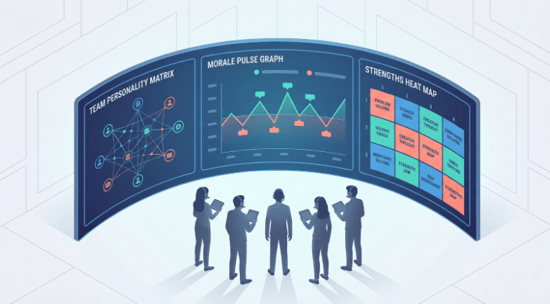
 Speed keeps a startup alive, but teamwork decides whether that speed endures.
When employees collaborate well, 73 per cent report higher work quality, yet teams slowed by “collaboration drag” are 37 per cent less likely to hit revenue goals, according to Deloitte and Gartner.
Still, only 34 per cent of managers can accurately name how their team prefers to work together, according to the 2025 State of the Team report from team-assessment software TeamDynamics.
This knowledge gap explains why many startups keep burning cycles even after hiring smart people.
This guide slices through a crowded market of assessment platforms, matching each tool to the problem it solves, communication gaps, morale dips, or untapped strengths, so you can choose quickly and get back to building.
How to use this guide
Think of the article as a decision tree with three branches: day-to-day dynamics, real-time morale, and individual strengths. Jump to the branch that matches your current pain point and pick a tool in minutes.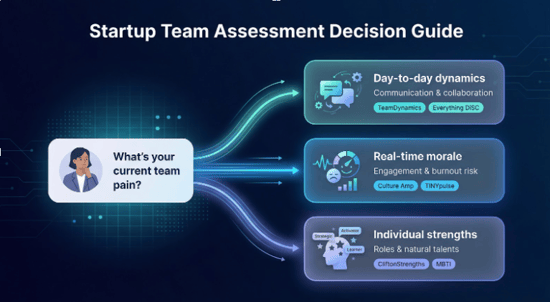 To make the cut, every platform had to:
- deliver useful insight within two weeks,
- show pricing that a founder can view without a sales call, and
- back its claims with research or large-sample case studies.
Inside each branch, tools appear from fastest rollout to richest feature set. Check the survey time, rollout speed, and price note at the top of each profile, then read the narrative for nuance.
Prefer visuals? The comparison table that follows captures all essentials so you can bookmark a frontrunner and get back to building a product. Begin with the first branch: decoding how your established or startup team works together.
Quick-scan comparison table
Need the facts fast? The grid below compares six leading startup team assessment tools on the metrics founders ask first.
| Tool | Survey time | Primary focus | Cost model* | Time to insight | Ideal team size |
|---|---|---|---|---|---|
| TeamDynamics | 10–15 min | Team personality & communication | One-time ≈ $39 per user | Interactive report in under 1 hour | 2–20 (scales up) |
| Everything DiSC | ≈ 15 min | Communication style (DiSC) | One-time $73–90 per user | Results same day | 5–100 |
| Culture Amp | 5–10 min pulse; 20 min survey | Engagement & culture analytics | SaaS $9–14 per user per month | Dashboard in 24–48 hours | 10–500+ |
| TINYpulse | 1-min weekly pulse | Real-time morale pulse | SaaS ≈ $5 per user per month | Live trend lines same day | 5–300 |
| CliftonStrengths | ≈ 30 min | Individual & team strengths | One-time $20–60 per user | Immediate | 2–100 |
| MBTI | ≈ 20 min | Personality preferences | One-time ≈ $60 per user | Immediate | 2–100 |
*Pricing checked January 6, 2026; see vendor sites for current rates.
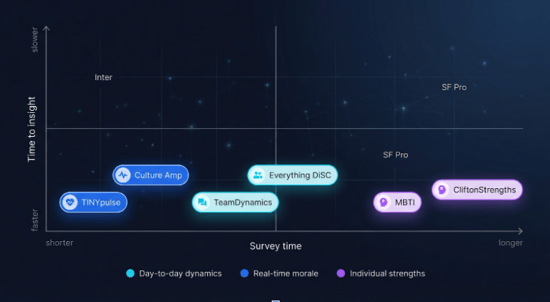 Survey minutes are only the beginning. Rollout friction, data depth, and follow-up features often decide real-world value. We unpack those factors in the next narrative profiles.
TeamDynamics: map your team’s personality in an hour
Speed dies when teammates talk past each other. TeamDynamics spots those style clashes fast: each person completes a 10–15-minute, research-backed survey, and the platform maps your crew to one of 16 team types, with an interactive report that appears instantly.
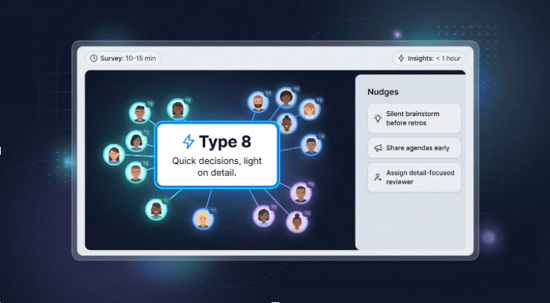 Why that matters: with a shared language, you can say, “We lean Type 8 (quick decisions, light on detail)” instead of the vague “communication issues.” The dashboard suggests practical nudges (e.g., silent brainstorms before retros) so fixes happen in the flow of work.
Rollout is simple: invite, click, discuss. Even a time-starved founder can move from sign-up to insights in under an hour. Pricing is a one-time cost of $39 per person for teams of 2–20, and you own the data forever. For founders who want to benchmark TeamDynamics against other personality-focused options, this 2026 roundup of team personality assessment tools offers side-by-side pros, cons, and pricing.
Reach for TeamDynamics when tension lacks a clear source, a new hire joins mid-sprint, or a greenfield project needs rhythm on day one. It turns gut feelings into visible data so you can adjust before deadlines slip.
Everything DiSC: a common language for friction-free collaboration
In about 15 minutes, each teammate completes the Everything DiSC survey and lands on one of four core styles: Dominance, Influence, Steadiness, or Conscientiousness (see the official Everything DiSC sample assessment). The simple labels defuse judgment. Saying “Alex leads with High-D, so we’ll share agendas early” feels safer than “Alex steamrolls meetings.”
Results arrive the same day. The platform plots everyone on a color-coded circle you can pin near the coffee maker. Many teams set quick ground rules: give C’s the data pack before stand-up, let I’s open brainstorms, ask S’s to sanity-check workload.
Cost stays predictable: a one-time $73–$90 per person for the Workplace assessment, with volume discounts listed by Wiley’s authorized resellers. You can self-debrief with the included guides or book a certified facilitator when you want a workshop setting.
Reach for DiSC when mid-sprint tension flares, such as when two High-D founders clash over decisions or a detail-oriented PM feels unheard among big-picture marketers. The circular map surfaces those patterns so you adjust processes, not personalities.
Deploy it when new functions merge or after a hiring burst diversifies work styles. In a single afternoon, you will trade unspoken frustrations for shared vocabulary and keep momentum humming.
Culture Amp: your always-on culture radar
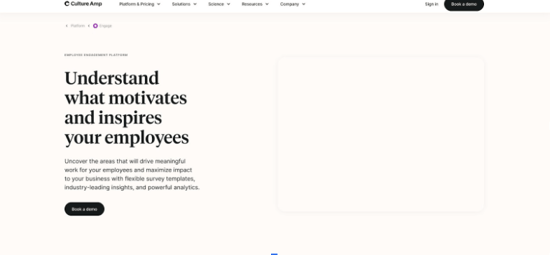 Burnout whispers long before it shouts. Culture Amp catches those early signals with a Slack or email pulse that takes about five minutes to complete; deeper quarterly surveys wait in the wings when you need richer data. Results arrive in under 48 hours, sliced by team, tenure, and role, and benchmarked so you know whether a 70 per cent score is healthy or a red flag.
Insight matters only if it drives change. The platform lets managers assign follow-up actions inside the dashboard and track progress like a mini project board, with no extra tools required.
Pricing sits in the mid-tier SaaS range at $9–$14 per employee per month for the Engage plan. For a 10-person startup, that translates to about $120 per month, far less than the cost of losing one engineer to disengagement. Setup is cloud-only: log in, launch a pulse, and you’re live before lunch.
Roll Culture Amp out once headcount moves beyond single digits or when remote pockets feel disconnected. Pair its “what’s happening” insight with TeamDynamics’ “why it’s happening” lens, and you can shift from firefighting to proactive leadership.
TINYpulse: one-question check-ins that catch problems early
Quarterly surveys surface issues too late. TINYpulse sends a single anonymous question every week via Slack, Teams, or email. Most people answer in under 60 seconds, and results update as a live trend line you can read before stand-up (vendor brochure).
Patterns emerge fast. Three consecutive weeks of rising “overwhelm” scores flag sprint fatigue long before PTO requests pile up, while a dip in “recognition” reminds you to restart demo-day shout-outs. Bite-size feedback keeps response rates high, so you get a heartbeat, not an autopsy.
Two add-ons deepen engagement: Cheers for Peers lets teammates publicly praise each other, and an open suggestion box gives quieter voices a safe channel.
Pricing starts around $5 per employee per month based on historical public lists and G2 buyer reports. Setup is instant: sign up at lunch, connect to Slack, pick this week’s pulse, and you’re live without HRIS exports.
Deploy TINYpulse when your team is small enough that every resignation hurts, yet busy enough that one-on-ones slip. Its weekly graph lets you act within days, keeping culture nimble and problems small.
CliftonStrengths: turn natural gifts into startup fuel
When every early-stage hire wears three hats, output soars only if those hats match innate talent. CliftonStrengths makes that match visible. Each teammate spends about 30 minutes on an assessment that ranks 34 talent themes (Strategic, Learner, Achiever, and so on) and instantly shows their Top 5, along with a team heat map.
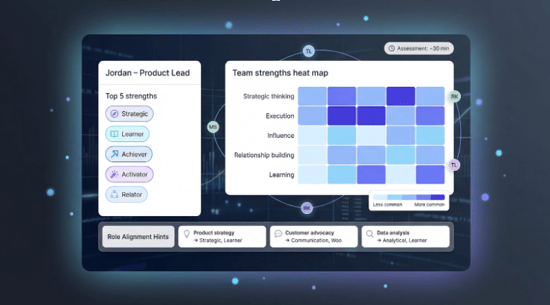 According to Gallup, a study of 530 work units found that teams that received strengths feedback lifted productivity by 12.5 per cent compared with control groups.
Cost is one-time: $24.99 for a Top 5 code or $59.99 for the full 34-theme report, with no subscription fees. Most startups begin with the Top 5, then upgrade key roles later. Gallup’s resource library guides a DIY team session, no consultant needed.
Reach for CliftonStrengths when role clarity blurs, such as when a designer moderates a community or a data scientist pitches in on sales analysis. The strengths grid shows who gains energy from evangelizing, who loves deep dives, and who thrives on activation. One meeting can rebalance tasks and boost both morale and velocity.
Pair CliftonStrengths with TeamDynamics or DiSC for the full picture. CliftonStrengths reveals the horsepower you have, while the dynamics tools show how the engine parts mesh. Together, they turn a scrappy crew into a finely tuned sprint team.
Myers-Briggs Type Indicator: a familiar shortcut to self-awareness
Few tools spark instant recognition like the four-letter MBTI code. The official 20-minute questionnaire sorts each teammate along four preference pairs (Introvert/Extravert, Sensing/Intuition, Thinking/Feeling, Judging/Perceiving) and delivers a profile that often feels accurate.
For startups, the payoff is conversational. When an ISTJ engineer craves structure and an ENFP designer thrives in ambiguity, the letters provide the team with neutral language to negotiate workflow rather than trading personal jabs. Many groups build a quick “working with me” slide for all 16 types and reference it during sprint planning; the exercise is light but quietly boosts psychological safety.
Pricing is straightforward: $59.95 per person, one time, for the official MBTIonline report. You can self-facilitate with the included guides or hire a certified practitioner for a deeper dive. Either way, results arrive instantly with zero integration work.
MBTI’s scientific validity is debated, so treat it as a springboard for dialogue rather than hard analytics. Use it for an off-site icebreaker or post-launch reset, then lean on data-heavy tools such as CliftonStrengths or Culture Amp when you need ROI metrics. Applied thoughtfully, MBTI injects empathy at low cost and sets the stage for richer assessments down the road.
Emerging trends to watch in 2026
 Assessment tech keeps shifting; three movements matter most for startups.
- AI nudges inside chat apps. Tools such as Culture Amp’s Assist and Leapsome’s CoachBot now push context-aware tips into Slack and Teams based on the latest pulse or 360 data, turning insights from static PDFs into real-time habits (product releases, 2024).
- Psychological-safety scoring. Platforms including Zella Pulse and Google’s re: Work prototype surface explicit metrics for candour and risk-taking, giving leaders early warnings months before eNPS drops (pilot results presented at the 2025 HR Tech Conference).
- Suite convergence. Engagement, OKRs, 360s, and recognition continue to merge: Limeade acquired TINYpulse in July 2024 for an undisclosed sum, and 15Five added weekly pulse surveys to its Perform suite in March 2025. Expect bundled pricing and richer correlations, but brace for steeper learning curves. Startups can begin modular, then consolidate as needs mature.
Track these shifts so the tools you pick scale with you rather than box you in.
Implementation checklist and next steps
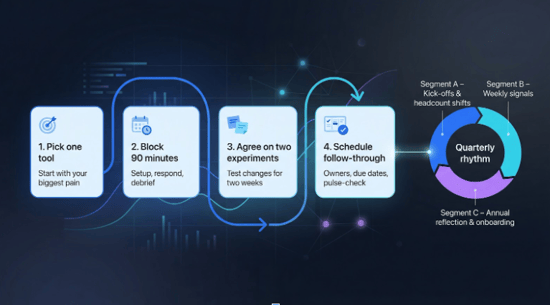 Data without action is decor, so turn insight into momentum with this four-step sprint:
- Pick one tool. Start where the pain burns hottest: communication gaps, morale dips, or fuzzy roles.
- Block 90 minutes. Allocate 30 minutes for setup, 30 minutes for the team to respond, and 30 minutes for a live debrief.
- Agree on two experiments. Share the dashboard, capture surprises, then choose two concrete tests for the next two weeks (for example, silent brainstorms, no-meeting Wednesdays, or role swaps based on Top 5 strengths).
- Schedule follow-through. Record owners, due dates, and a pulse-check date in your project tool; momentum dies without visibility.
Maintain a quarterly rhythm:
- Segment A tools are suitable for project kick-offs or post-headcount changes.
- Segment B tools run continuously, feeding weekly signals.
- Segment C tools shine during annual reflection or onboarding waves.
Measure, discuss, experiment, repeat, and watch teamwork compound like interest.
Teamwork Becomes Your Competitive Advantage
Speed keeps a startup alive, but teamwork decides whether that speed compounds or collapses. The right assessment tool doesn’t just “measure culture”—it removes friction, helps people work with clarity, and turns vague tension into repeatable operating habits.
Here’s the simplest way to choose:
- If your team is moving fast but talking past each other, start with TeamDynamics (fastest insight) or Everything DiSC (widely understood collaboration language).
- If you need to spot burnout, disengagement, or silent frustration before it becomes churn, use TINYpulse (weekly heartbeat) or Culture Amp (analytics + action tracking).
- If your biggest issues are role blur and uneven output, CliftonStrengths helps you align work with your natural talent—so execution gets easier, not harder.
The key is not collecting data, it’s running a two-week experiment cycle: assess → debrief → test two changes → recheck. Do that quarterly, and teamwork becomes a competitive advantage that keeps scaling with your headcount.
Startup Team Assessment Tool FAQs
What’s the best team assessment tool for an early-stage startup?
For most startups with fewer than 20 people, TeamDynamics is the fastest way to build shared language and reduce communication friction. If you want a more established framework and support from a larger team, Everything DiSC is a strong alternative.
What’s the best tool for measuring morale and engagement weekly?
If you want lightweight, high-frequency insight, TINYpulse is built for weekly pulse tracking with minimal burden. If you want deeper analytics, benchmarking, and action plans, Culture Amp is the more robust option.
Should we use a personality tool or a culture/morale tool first?
Use the one that matches your pain point:
- Conflict, unclear decisions, miscommunication → personality/dynamics tool (TeamDynamics / DiSC)
- Burnout, disengagement, low energy → engagement tool (TINYpulse / Culture Amp)
- Role confusion, uneven output, misaligned responsibilities → strengths tool (CliftonStrengths)
If you’re unsure, start with TeamDynamics or DiSC, because communication breakdowns often cause morale dips.
How long does it take to get value from these tools?
Most teams see actionable insight within:
- 1 hour: TeamDynamics
- Same day: Everything DiSC, CliftonStrengths, MBTI
- 24–48 hours: Culture Amp
- Same day (trend line starts instantly): TINYpulse
The biggest determinant isn’t tool speed, it’s whether you run a live debrief and commit to two experiments.
Are these tools worth it for a team of fewer than 10?
Yes, small teams benefit the most because every miscommunication is expensive and every resignation is a crisis. For very small teams:
- Use TeamDynamics for fast alignment
- Add TINYpulse if you’re remote, scaling fast, or skipping 1:1s
Can we combine tools, or is that overkill?
Combining tools can be highly leveraged if you keep it simple:
- TeamDynamics or DiSC (how we work together)
- TINYpulse or Culture Amp (how we feel over time)
- CliftonStrengths (what we’re naturally best at)
A good rule: one “how we work” tool + one “how we’re doing” tool is enough for most startups.
What metrics should we track to prove team performance is improving?
Pair the assessment with operational metrics that reflect execution:
Collaboration & delivery
- Cycle time/lead time
- Sprint predictability (planned vs delivered)
- Rework rate or bug regressions
- Meeting load vs output
People & morale
- Weekly pulse scores (energy, stress, clarity, recognition)
- eNPS / intent-to-stay (monthly or quarterly)
- Attrition risk signals (low recognition, rising overwhelm)
Communication
- Decision latency (time from issue → decision)
- Cross-functional handoff delays
- Post-mortem themes repeating vs resolving
How do we run a debrief without making it awkward?
Keep it neutral and behavior-focused:
- Share results ahead of time
- Ask: “What surprised you?” not “Who is wrong?”
- Choose two experiments, not 10 action items
- Assign owners and revisit in two weeks
These tools work best when framed as a systems upgrade, not a personality critique.
What if the team thinks assessments are “HR fluff”?
Position it as a speed and execution tool:
- “We’re reducing collaboration drag.”
- “We’re improving decision-making and sprint flow.”
- “We’re making working agreements visible.”
Then prove it by tying results to two concrete operating changes (example: meeting format, decision rules, async planning, handoff checklist).
Is MBTI scientifically valid?
MBTI is widely used and often feels intuitive, but its scientific validity is frequently debated. Treat it as a conversation starter, not a performance metric. If you want stronger evidence-backed outputs, CliftonStrengths, Culture Amp-style engagement analytics, or research-based team dynamics tools are usually better for ROI-focused decisions.