 Businesses face an increasing array of cyber threats that can jeopardize their operations, reputation, and bottom line. Cybersecurity and IT support are often treated as separate functions within organizations, yet closer integration can play an important role in managing and reducing business risk.
Combining cybersecurity and IT support helps companies build a stronger defense posture that supports prevention while also improving response and recovery when incidents occur.
The financial impact of cybercrime remains substantial. The FBI’s 2025 Internet Crime Report recorded nearly $21 billion in reported losses from cyber-enabled crime in the United States, illustrating the scale of the financial risk businesses and individuals now face.
This pressure demands a proactive approach that closely aligns cybersecurity measures with IT support functions. By doing so, organizations can better safeguard their data, support regulatory compliance, and maintain operational continuity.
Small businesses can be particularly exposed because a serious cyber incident may combine downtime, recovery costs, lost revenue, and reputational damage. That makes a resilient technology environment and a coordinated response process especially important for organizations with limited internal resources.
As cyber threats become more sophisticated, businesses without a coordinated approach to IT operations and security may be more vulnerable to costly disruption.
How IT Specialists Enhance Cybersecurity Posture
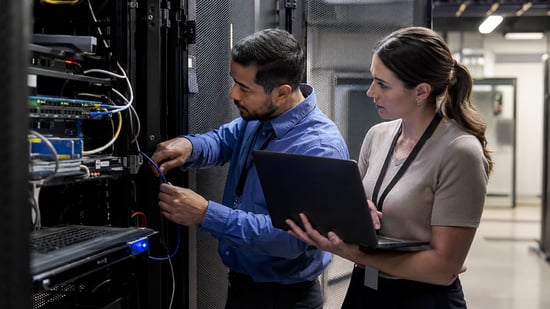
IT specialists play a pivotal role in implementing and maintaining cybersecurity strategies. Their expertise bridges the gap between technology infrastructure and security controls, helping ensure that systems are not only functional but also resilient against threats.
Companies like ACC Tech's IT specialists exemplify the value of having dedicated professionals who understand the relationship between IT operations and security.
These specialists may conduct vulnerability assessments, deploy and manage security tools, coordinate patching, and monitor systems and networks for suspicious activity. Their ongoing support can also include educating employees on security best practices.
People remain an important part of cybersecurity risk, but the threat picture is broader than human error alone. Verizon’s 2026 Data Breach Investigations Report found that software vulnerabilities had become the leading breach entry point, accounting for 31% of breaches in its dataset.
That reinforces why patching, configuration management, identity controls, technical monitoring, and security awareness need to work together rather than operate as separate programs.
IT specialists can also facilitate faster incident response when breaches occur. Working alongside cybersecurity personnel, they can help isolate affected systems, contain disruption, restore services, and support recovery activities.
IT professionals also play an important role in supporting applicable regulatory and industry requirements such as GDPR, HIPAA, and PCI DSS. Compliance responsibility extends beyond the IT department, but embedding appropriate security controls into everyday technology operations can help organizations meet technical requirements and identify weaknesses before they are exploited.
The Role of Customized Tech Support in Risk Reduction
Not all businesses have the same IT infrastructure or security needs. Customized tech support solutions can address the particular demands of an organization, allowing security priorities and technical resources to be aligned with its actual risk profile.
AdRem's customized tech support provides an example of how personalized support services can be structured around a business’s specific technology environment.
Customized tech support involves analyzing a company’s existing systems and identifying vulnerabilities or operational weaknesses specific to that environment. This approach helps ensure that security measures are aligned with the risks the organization actually faces rather than applied as a generic checklist.
For example, a manufacturing firm may require specialized support for industrial control systems, while a financial institution may place greater emphasis on protecting client data through access controls, encryption, monitoring, and other safeguards.
With support tailored to the environment, businesses can benefit from continuous monitoring, rapid troubleshooting, proactive maintenance, and risk-based remediation before technical problems escalate into security incidents.
Customized support can also help organizations use their IT budgets more effectively by focusing resources on critical assets, material vulnerabilities, and higher-risk areas rather than applying the same level of control everywhere.
This targeted approach can strengthen security while supporting wider operational efficiency.
Bridging the Gap: Strategies for Uniting Cybersecurity and IT Support
To combine cybersecurity and IT support effectively, organizations should consider a unified framework that promotes collaboration and communication between teams.
One strategy is to establish clear cross-functional responsibilities for IT operations, cybersecurity, incident response, and compliance. This creates a more complete view of technology risk while reducing the chance that an important security issue falls between separate teams.
Another approach is to use integrated monitoring and management tools that provide visibility into both system health and security activity. When IT support and cybersecurity personnel can work from shared information, they are better placed to coordinate detection, investigation, remediation, and recovery.
For example, Security Information and Event Management (SIEM) systems can consolidate logs and alerts from multiple sources. Endpoint detection and response, vulnerability-management, identity, and IT service-management tools can provide additional operational context when they are integrated appropriately.
Training and awareness programs that cover both IT and security topics are also important. Helping employees recognize phishing, protect credentials, use approved systems, and report suspicious activity can reduce avoidable exposure.
Training should not, however, be treated as a substitute for technical controls.
Secure configurations, timely patching, multifactor authentication, access management, monitoring, and other safeguards remain essential because many attacks exploit systems and credentials rather than relying solely on an employee making a mistake.
Fostering a culture of security awareness throughout the organization helps ensure that everyone, from executives to frontline staff, understands their role in protecting company assets.
Open communication between IT support and cybersecurity teams can also help potential threats escalate quickly and allow lessons from incidents to feed back into everyday operations.
Measuring Success: Metrics to Track Risk Reduction
Evaluating the effectiveness of combined cybersecurity and IT support efforts requires clear metrics. Key performance indicators (KPIs) might include:
- Mean time to detect (MTTD) and mean time to respond (MTTR) to security incidents.
- Number and severity of security incidents over time.
- Time taken to remediate critical vulnerabilities and apply priority patches.
- Compliance audit results and changes in vulnerabilities identified during assessments.
- System uptime and recovery performance.
- User satisfaction metrics reflecting the effectiveness of IT support.
These measures are most useful when tracked over time against an organization’s own baseline. A reduction in MTTR, for example, can indicate that teams are becoming more efficient at containing and resolving incidents, while faster remediation of critical vulnerabilities may indicate better coordination between security and IT operations.
Tracking these metrics can also help identify areas for improvement and support decisions about investment in technology, staffing, processes, or training.
User satisfaction can provide another useful signal. When employees can obtain reliable support through approved channels, they may be less likely to adopt unauthorized tools or workarounds that create additional security risk.
Conclusion: Building Resilience Through Integration
Closer integration between cybersecurity and IT support is increasingly important for businesses seeking to reduce technology risk in a complex threat environment.
Leveraging skilled IT specialists and adopting support models tailored to the organization can help embed security into everyday IT operations rather than treating it as a separate activity.
By fostering collaboration, customizing support, and continuously measuring outcomes, organizations can build a more resilient foundation that protects important assets, supports customer trust, and improves operational continuity.
In the face of evolving cyber threats, bringing cybersecurity and IT support together provides businesses with a more coordinated way to identify vulnerabilities, respond to incidents, and manage technology risk.
As threats continue to evolve, the processes used to prevent, detect, respond to, and recover from them must evolve as well. Integrating cybersecurity with day-to-day IT operations is therefore an important pillar of modern enterprise risk management.