 Startups have traditionally faced a constrained choice in treasury management. They could keep reserves in low yield bank accounts or allocate to volatile crypto assets that introduce material balance sheet risk. A third path has emerged quickly in recent years through real-world assets, or RWAs.
For startups, especially in crypto and tech, tokenized RWAs are reshaping how treasury capital can be deployed. They provide access to asset classes that were previously difficult to use efficiently at a smaller scale, including US Treasuries, private credit, and real estate, with ownership and transaction records managed on-chain.
By late 2025, estimates place the tokenized RWA market around 30 to 35 billion dollars, reflecting the growing overlap between traditional finance and DeFi infrastructure.
Rethinking Startup Treasury
Weaknesses in traditional treasury strategy have become harder to ignore over the last few years. Large cash balances are frequently eroded by inflation, while meaningful crypto exposure can create volatility that many boards and finance teams will not accept.
Tokenized RWAs aim to address both issues. They offer a path to bring conventional assets on-chain and, over time, can help turn a passive treasury into a more dynamic, yield oriented portfolio.
Core advantages include:
- Improved capital effectiveness: Tokenized US Treasuries can offer yields comparable with short term risk free rates, depending on product structure, term, and rate conditions.
- Broader liquidity and access: Tokenization can provide fractional exposure to historically illiquid assets such as private credit and real estate, often with lower minimums and more flexible liquidity terms.
- Greater transparency and operational efficiency: On-chain ownership and transaction records can simplify verification, while smart contract driven processes may reduce manual overhead for interest distribution and compliance workflows.
The Startup RWA Capital Stack
An effective on chain treasury strategy can be structured like a risk and return capital stack. Startups can layer allocations, starting with the most secure instruments and adding higher yield exposure as risk tolerance and liquidity needs allow.
- Foundation: Preserve capital with tokenized US Treasuries that prioritise liquidity, transparency, and yields aligned with short term risk free rates.
- Yield layer: Increase income with tokenized private credit that offers higher return potential alongside higher credit and liquidity risk.
- Diversification layer: Broaden exposure with tokenized real estate or commodities to reduce reliance on a single risk driver.
- Specialised layer: Add targeted RWAs designed for specific macro conditions or more defensive positioning.
This framework gives treasury teams a clearer way to balance stability and growth while operating natively in an on-chain environment.
Layer 1 The Foundation Tokenized Treasuries
 The safest and most liquid base of the RWA ecosystem is tokenized US Treasuries and money market funds. These instruments represent exposure to short-term US government debt held by regulated custodians.
Institutional adoption has accelerated this category. BlackRock’s BUIDL fund and Franklin Templeton’s Benji-linked OnChain US Government Money Fund are two of the most visible signals that regulated Treasury and money market exposure is moving on-chain at scale. For startups, this matters because it suggests improving market depth, credibility, and operational maturity.
Layer 2 Yield Expansion Tokenized Private Credit
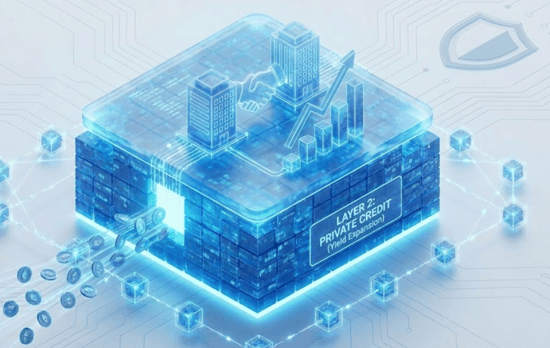 Once a treasury has established a conservative base, startups can consider higher yielding tokenized private credit. Platforms such as Maple Finance and Centrifuge enable lending to institutional or business borrowers through structured pools with on chain access.
Returns can exceed Treasury yields, but outcomes vary based on borrower quality, collateral structures, and pool design. Some pools advertise double digit yields, yet these should be treated as risk bearing credit exposure rather than uniform market outcomes.
This layer can give startups access to credit strategies that are difficult to reach efficiently through legacy finance models.
Layer 3 Strategic Allocations Real Estate and Commodities
 Tokenized real estate can enable fractional ownership of income-producing assets with potential rental cash flow and longer-term appreciation. For many treasuries, this layer is best viewed as a slower moving allocation designed to broaden economic exposure.
Tokenized commodities, including PAX Gold, offer a more traditional hedge against inflation and macro uncertainty. PAX Gold is structured so that each token represents ownership of physical gold held in custody, bringing bullion-style exposure into a more transferable digital format. Gold does not generate yield, but its defensive characteristics may improve resilience in risk off scenarios.
Key Considerations for Real World Assets
RWA integration requires rigorous planning, even as the upside grows.
- Regulatory compliance: Many RWA tokens may be treated as securities, triggering KYC and AML requirements or investor eligibility rules depending on jurisdiction and structuring.
- Counterparty and custody risk: Tokenized assets depend on custodians and enforceable legal claims linking tokens to off chain assets.
- Smart contract and protocol risk: RWA platforms rely on smart contracts, so treasury teams should prioritise transparent governance, robust audits, and clear risk disclosures.
Conclusion
Real-world assets offer a more sophisticated answer to a longstanding treasury trade-off between idle cash and high-volatility crypto holdings. Through tokenization, startups can begin to build a structured, yield oriented approach that remains grounded in traditional risk frameworks while benefiting from on-chain efficiency.
For teams delving deeper into the wider RWA and crypto ecosystem, such as oracle networks, tokenization protocols, and hybrid DeFi approaches, knowing which cryptocurrency to buy can be valuable in understanding which digital assets are fueling such a shift.
You can find over 100 different cryptocurrencies on Paybis — a platform that supports fiat-to-crypto payments, 24/7 support, and on- and off-ramp infrastructure for users moving between traditional money and digital assets. In May 2026, SIA Paybis Europe received both a MiCA crypto-asset service provider licence and a payment institution licence from Latvijas Banka, strengthening its regulated infrastructure in Europe.
A layered capital stack anchored by tokenized Treasuries and extended through carefully sized private credit and diversification allocations can help transform reserves from a passive cost centre into a more intentional financial asset. The convergence of TradFi stability and DeFi infrastructure is no longer theoretical. For well governed teams, it is becoming a practical toolkit for building more resilient and efficient startup treasuries.