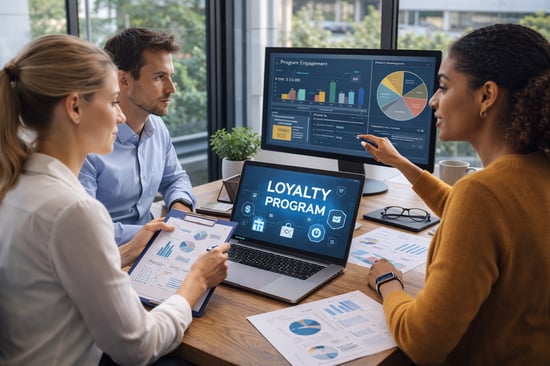
 A well-thought-out loyalty program communication strategy enables firms to build stronger, more profitable customer relationships. In the current competitive marketplace, clear and timely messages determine whether a loyalty program is able to deliver actual business value or becomes just an additional cost center.
Key Points: Loyalty Program Communication That Improves CLV
Loyalty programs deliver value when members understand rewards, receive timely triggers, and get messaging that matches behavior, not generic blasts.
Key points include:
- Retention lever: Communication is what turns loyalty mechanics into repeat behavior and reduces churn.
- Personalization: Use purchase and engagement signals to tailor reward prompts and offers.
- Trigger timing: Post-purchase, milestones, and expiration reminders outperform static schedules.
- Channel mix: Use email for detail, SMS for urgency, and in-app/push for real-time updates.
- Measurement: Track engagement, redemption, CLV lift, and opt-outs to prove ROI and refine.
Proof point: The article connects message discipline to measurable outcomes: redemption, churn, and revenue attribution.
The Bottom Line: Loyalty communication is a system built on data, triggers, channels, and measurement—designed to compound customer value.
Effective communication requires strategic planning, deep customer understanding, a clear understanding of customer needs, and the right loyalty rewards software to execute at scale. This article offers a guideline for developing an effective customer-loyalty communication strategy that improves engagement, increases customer lifetime value (CLV), and reduces the likelihood of customer churn.
Why Loyalty Program Communication Matters?
The most important purpose of any loyalty programme can be customer retention. Studies show that raising retention rates by just 5% can increase profits by 25 to 95%. Communication is the key element which makes retention feasible.
Customers should be informed about the program's benefits, available rewards, and special offers. A clear message will help them understand the benefits they will receive. A consistent communication builds confidence and helps keep the brand top-of-mind.
A successful customer loyalty communication strategy uses customer data to continuously refine messaging and treat clients as individuals, and turn routine transactions into emotional connections.
The Business Case: Quantifying the Impact
 Before getting into strategies, it is important to understand the impact of effective communication on building loyalty.
- The Increase in CLV: Bain & Company discovered that loyalty program members generate 12-18% faster revenue growth than non-members. Members who receive personalized communications show CLV increases by up to 30% over passive members.
- Lower Churn: Annex Cloud data indicates that customers who engage with loyalty communications are 40% less likely to churn within the first year.
- Higher Redemption Rates: Rewards-redeeming customers are 2.5 times more likely to remain active and make additional purchases.
- Return on Investment: Benchmark. Forrester Research found that firms with well-developed loyalty communications strategies have an average Return on Investment of $3.12 per dollar spent.
Key Elements of a Data-Driven Strategy
To transition away from generic messaging to high-impact communication, businesses need to incorporate four components into their strategies.
1. Customer-Centric Personalization
Generic broadcast messages aren't effective. Effective personalization requires a thorough understanding of purchase history, browsing behavior, reward preferences, and engagement patterns.
A coffee buyer should be rewarded for their purchases, not with discounts on merchandise. An inactive customer should receive the opportunity to engage again, but not the same type of newsletter that active customers receive.
2. Behavioral Triggers and Timing
Timing is just as crucial in the communication itself. Customers are more open to contextually relevant communications.
Important trigger moments include post-purchase Thank-you emails, milestone alerts for point birthdays and anniversary deals, points expiration reminders, and abandoned cart recovery incentives.
3. Channel Optimization
Customers interact across multiple touchpoints. A solid strategy will meet them wherever they are. According to Vibes ' survey, 78% of customers prefer updates to their loyalty via email, and 44% prefer SMS for time-sensitive offers.
Effective strategies employ a coordinated mix of email for specific information, SMS for immediate alerts, in-app notifications for real-time updates, and push notifications to encourage mobile engagement.
4. Feedback Loops and Continuous Improvement
Communication is a two-way street. Strategies must include methods for collecting and acting on customer feedback.
Short surveys that analyse redemption sentiment after support interactions, as well as A/B testing of message variants, all provide data to improve the frequency of future communications.
Comparative Analysis: Top Loyalty Rewards Software
The selection of choosing the right technology partner is critical. Here is an impartial comparison of leading loyalty rewards software based on communication capabilities and ideal use cases.
1. Yotpo
Yotpo works well for ecommerce brands with Shopify or Magento stores. It offers an extensive SMS service, email automation, AI-driven personalization, and real-time notifications. It is aimed at mid-market and enterprise businesses.
2. Smile.io
Smile.io focuses on simplicity for small- to medium-sized businesses, offering email triggers for point updates and basic reward notifications through a freemium model.
3. Annex Cloud
Annex Cloud serves enterprises requiring omnichannel complexity, supporting multi-channel orchestration across SMS, email, and in-app messaging, with deep segmentation.
4. LoyaltyLion
LoyaltyLion is designed for fast-growing DTC brands, featuring flexible email triggers, customer portal messaging, and data-rich dashboards, with tiered pricing based on order volume.
5. Zinrelo
Zinrelo provides retailers with AI-driven rules, offering automated rules-based messages and tools to help with referrals for mid-market retailers.
6. Punchh
Punchh specialises in restaurants and retail chains with physical locations, and offers geo-targeted push notifications and POS-integrated messaging for multi-location enterprises.
7. Kangaroo Rewards
Kangaroo Rewards serves small local businesses through a simple SMS, email blasts, and POS integration, with tiered pricing.
8. FiveStars
FiveStars is a company that targets local merchants and SMBs with automated SMS and email marketing campaigns linked to transactions.
9. Belly
Belly is designed to suit small retail and service businesses. Belly provides simple email automation and points balance alerts for a low cost.
10. Spendgo
Spendgo provides omnichannel retailers with unified messaging through the internet and in-store using real-time reward alerts.
How to Choose the Right Platform?
 In assessing alternatives, business leaders must take into consideration three things:
- Complexity of Integration: Does the platform natively integrate with your current CRM or POS system, as well as an e-commerce platform? Extensive custom development delays time-to-value.
- Communications Channels: Does it have support for the channels your customers utilize? The best platform will connect clients where they already are.
- Analytics Depth: Can be used to attribute revenue to specific communications, keep track of CLV changes, and report campaign performance in real time? Data visibility is vital to ensure continuous improvement.
Measuring Success: Key Metrics for Loyalty Communication
To demonstrate ROI and improve efficiency, loyalty managers track specific metrics.
1. Email Engagement Metrics
The open rate of emails for loyalty messages should be between 15 and 25%, far exceeding typical marketing standards.
The click-through rate should range between 2-5%, with higher rates signalling compelling offers.
2. Program Participation Metrics
A redemption rate of between 20-30% suggests an active engagement. Lower rates indicate that members don't grasp the concept of point value.
The member CLV should be between 20 and 30% more than that of non-members. The program's churn rate should be at or below 10% each year.
3. Revenue and Cost Metrics
The attributed revenue should always exceed the total programme operating costs. The SMS opt-out rate should remain below 2 per cent for each campaign. Points expiration conversion should lead to 10-15% of recipients making a purchase.
4. Satisfaction and Efficiency Metrics
Net Promoter Score should target 50 or more to ensure best-in-class programs. Cost per point awarded will decrease as engagement increases.
How to Use These Metrics Effectively?
The importance of tracking metrics is only if they lead to action. The most successful programs evaluate the metrics monthly to adjust strategies accordingly. Low open rates indicate a need for improved subject lines. The low redemption rates indicate problems with communication clarity.
Making Loyalty Communication a Measurable Growth Discipline
An effective customer loyalty communication strategy is not something that can be learned; it is a measurable business discipline. If executed with the right Customer data, technology, and testing methodology, it drives tangible increases in customer lifetime value and reduces churn, and it delivers strong ROI.
The above loyalty rewards software provides the platform; however, the success of these platforms ultimately relies on the strategy. When you view communication as a continuous process of personalization, timing and optimization companies can transform casual customers into loyal advocates.
Companies that are looking to enhance their loyalty communications should start by analyzing the current metrics, identifying any gaps in personalization and deciding on the technology partner whose capabilities align with their particular customer engagement goals.
Loyalty Program Communication FAQs
How often should loyalty programs message members without causing fatigue?
Use behavior-based frequency instead of a fixed schedule: active members can handle more, inactive members need fewer but higher-quality nudges. Watch opt-out rates and engagement decay to find your ceiling. If you’re “sending more” to compensate for weak segmentation, that’s usually a sign you need better triggers, not more volume.
What are the highest-performing trigger messages to implement first?
Start with post-purchase thank-you flows, points-balance updates tied to meaningful thresholds, and points-expiration reminders. These are naturally contextual, which makes them feel helpful rather than promotional. Then layer milestone moments (birthdays/anniversaries) once your core lifecycle flows are stable.
How do you measure loyalty communication ROI beyond opens and clicks?
Attribute revenue to message cohorts and compare member CLV lift vs. a control group or passive segment. Track redemption rate, repeat purchase rate, churn rate, and incremental margin after rewards cost. If you can’t connect messages to behavior change, you’re measuring activity, not impact.
When should a company add SMS to a loyalty communication mix?
SMS works best for time-sensitive, high-clarity prompts such as expiration reminders and short-window offers. Use it sparingly and align it with explicit value so opt-outs stay low. If your program requires long explanations, email or in-app is usually a better primary channel.
What’s the most common reason loyalty programs fail, even with good software?
Misalignment between reward value and customer motivations, plus generic messaging that doesn’t reflect behaviour. When members don’t understand point value or receive irrelevant prompts, engagement collapses. Fix clarity, segmentation, and trigger logic before you “upgrade platforms.”