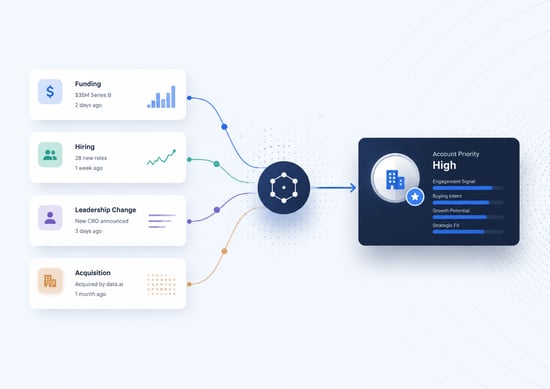
 Sales teams have no shortage of company alerts. The harder problem is deciding which ones deserve attention. A funding announcement, leadership appointment, hiring signal, or acquisition may look important on its own, but it rarely tells a rep enough to prioritise the account confidently.
Signal stacking offers a more disciplined approach. It looks for two or more verified company events and asks whether they point towards the same operational change. One signal may be enough to place an account on the research list. Two aligned signals can justify moving it higher, but only when the likely business need, affected function and buyer group are also clear.
For this analysis, Fundz joined four U.S.-focused internal datasets available on July 29, 2026: 2,299 deduplicated funding records across 2,198 companies; a 561-company hiring-in-motion cohort; 1,000 executive-appointment records across 980 companies; and 410 validated U.S. acquisition records across 364 acquirers after two capped acquisition exports were merged. Because the source periods were unequal, the results show observed overlap rather than market-wide prevalence.
The clearest finding was not that three signals create a magic threshold. It was that two signals were overwhelmingly the norm. Across 3,810 distinct companies, 277 appeared in at least two datasets. Of those, 267 had exactly two signal types, while only 10 had three. Waiting for a third signal would therefore exclude most accounts already showing meaningful multi-signal evidence.
Signal Stacking at a Glance
A stack only becomes useful when the events tell a coherent story. More alerts do not automatically create a stronger lead. The signals still need to be accurate, relevant to the seller’s category and connected to people who could own the resulting work.
Key points include:
- Two signals were the practical norm: 267 of the 277 multi-signal companies—96.4%—had exactly two signal types.
- Hiring acted as the main bridge signal: it appeared in 215 of the 277 multi-signal companies, or 77.6%, and in nine of the 10 three-signal stacks.
- Dense overlap still required context: even the three-signal accounts needed interpretation before they could be treated as aligned.
- Identity validation protects account priority: ambiguous matches were removed before the final signal counts were used.
- Buyer mapping was usually possible: most two-signal companies had at least one associated contact record after basic deduplication.
The Bottom Line: One verified event earns attention. Two aligned events can earn priority. Three may justify active review, but they should never trigger automatic outreach.
Fundz Data Insight
Two signals should trigger investigation; a third should trigger scrutiny, not automation. The reviewed data supports a practical research threshold, but qualification still depends on ICP fit, identity quality, functional context and evidence alignment.
Why Multiple Signals Matter More Than One
A company event tells you that something changed. It rarely reveals which function will respond, whether the change matters to the seller or whether a buying process has begun.
That distinction underpins the Fundz framework for buying-mode signals and B2B lead prioritization: events are evidence, not certainty. Signal stacking tests whether several pieces of evidence point in the same direction.
Funding may create capacity, hiring may show where it is being added, a new executive may reveal ownership, and an acquisition may create integration work. Together, those events can produce a stronger account hypothesis—but they still do not prove that a purchase is underway.
What the Fundz Data Shows About Signal Overlap
| Signal pair | Companies in both cohorts | Practical interpretation | Initial action |
|---|---|---|---|
| Funding + hiring | 141 | Capital and a current hiring-in-motion signal may indicate capacity building, but the hiring export does not establish event order. | Identify the teams being built and test whether they relate to the seller’s category. |
| Hiring + executive appointment | 73 | New functional ownership may be appearing alongside organizational capacity building. | Map the new leader’s mandate and the teams most likely to execute it. |
| Funding + executive appointment | 41 | Capital and leadership change can create a stronger ownership hypothesis than either signal alone. | Connect the stated use of funds to the executive’s function and likely priorities. |
| Funding + acquisition | 17 | Capital movement and an acquisition may create integration, controls or operating-capacity requirements. | Research the transaction rationale and the functions responsible for integration. |
| Hiring + acquisition | 10 | The acquiring company may be adding capacity around integration or continued expansion. | Separate acquisition-related roles from ordinary replacement hiring. |
| Executive appointment + acquisition | 15 | Leadership and transaction activity may indicate a concentrated period of governance or integration change. | Identify whether the appointment is connected to the transaction or belongs to a separate workstream. |
Source: Fundz.net proprietary funding, company, hiring-in-motion, executive-appointment, acquisition, and related-contact exports • Export date: July 29, 2026 • Note: Pair counts are inclusive, so a company appearing in three cohorts contributes to each relevant pair.
The pair counts are useful for prioritization, not for ranking one signal combination against another. The exports cover different periods, the executive and acquisition files appear capped, and the hiring cohort has no event-level date. What the overlaps do reveal is where more than one company-change signal is available for investigation.
Methodology summary: Fundz matched four internal company-event datasets using Company UUID, with additional identity checks where records conflicted. Because the exports covered unequal periods and some were capped, the results show observed account overlap—not market-wide prevalence, verified event sequence or purchasing intent.
View the full methodology
The funding export contained 2,301 rows dated May 1–July 29, reduced to 2,299 after two exact duplicates were removed. The hiring export contained a 561-company U.S.-focused cohort but no event-level dates. The executive file contained the latest 1,000 U.S.-focused records dated June 10–July 29. Two capped acquisition exports were merged into 1,024 unique global events; 415 were linked to U.S. acquirers dated July 16–29, and 410 remained after four ambiguous company matches were excluded where names, domains or entity relationships could not be reconciled confidently. Company UUID was the primary join field, with names, domains and event context checked when conflicts appeared. Database record dates may differ from announcement, closing or effective dates, so the analysis measures company-level overlap and does not infer event sequence or causation. These limitations relate to the exports available for this analysis and should not be read as a complete assessment of every field or capability available within Fundz.
What the Densest Signal Stacks Revealed
Fundz reviewed every company appearing in three signal cohorts to see whether the events formed one clear account story. Nine included the hiring-in-motion cohort, but that export did not identify the team, role family or date behind the signal. The remaining company combined financing, board appointments and a corporate real-estate acquisition that did not point to one operational initiative.
None could be treated as fully aligned from the exported evidence alone. Fundz had narrowed the research universe, but functional context was still needed to decide whether the events belonged to one commercial opportunity.
| Proprietary finding | Fundz data | Decision implication |
|---|---|---|
| Two signals were the practical norm | 267 of 277 multi-signal companies, or 96.4%, had exactly two signal types. | Use two aligned signals as the normal threshold for deeper research. Do not wait for three alerts before investigating a relevant account. |
| Hiring acted as a bridge signal | Hiring appeared in 215 of 277 multi-signal companies, or 77.6%, and in nine of the 10 three-signal stacks. | Use hiring to test whether capital, leadership or acquisition activity may be moving into execution—but verify which function is actually expanding. |
| Multiple signals still needed interpretation | All 10 three-signal companies required additional account research before full alignment could be established. | Use dense overlap to focus research and accelerate qualification, rather than treating it as an automatic active-opportunity classification. |
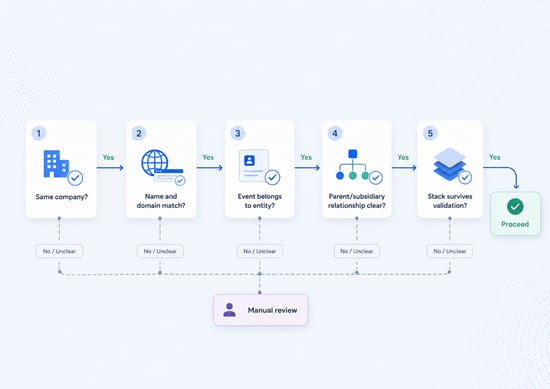
| Identity checks strengthen signal stacking | Four ambiguous company matches were excluded where names, domains or entity relationships could not be reconciled confidently. | Run an identity check before a combined signal count changes account priority. |
Source: Fundz.net proprietary company-event exports and controlled review of the 10 three-signal companies • Export date: July 29, 2026.
What the Most Common Signal Stacks Can Mean
Funding + Hiring: Is Growth Moving into Execution?
Funding plus hiring was the largest overlap. New capital may support product, market or team growth, while hiring can show whether that plan is moving into execution. The key is confirming that both signals relate to the same function.
The Fundz analysis of recently funded companies as B2B leads makes the qualification rule clear: capital is not a general-purpose purchasing budget. Connect the hiring activity to the stated use of funds before raising priority.
Hiring + Leadership: Who Owns the Build-Out?
Seventy-three companies appeared in both cohorts, making this the second-largest overlap. A new CRO, CTO, COO or product leader may be building capability, inheriting a programme or pursuing a separate mandate.
If the hiring supports the new leader’s remit, the account may deserve faster attention. If not, the stack is simply two unrelated alerts.
Funding + Leadership: Who Owns Deployment?
Forty-one companies remained in both cohorts after identity checks. The combination can focus research by linking new capital with a visible functional owner, although it does not show whether the events are connected.
A CFO, CRO, CTO, COO or product leader creates a different buying hypothesis and stakeholder map. The Fundz analysis of executive appointments as B2B sales windows therefore focuses on mandate and ownership, not the appointment headline alone.
Funding + Acquisition: What Must Be Integrated?
Seventeen companies remained in both cohorts after identity checks. The pairing may point toward integration, controls or added capacity, but the transaction—not the alert count—determines what work is likely to follow.
A bolt-on acquisition creates different needs from a strategic merger. Relevant work may involve data, financial controls, security, suppliers, people or customer migration. The seller still has to identify the real issue and its owner.
Leadership + Acquisition: Is Change Concentrating?
Fifteen companies remained in both cohorts. Leadership and transaction activity around the same account can justify research, but the appointment may relate to integration, governance or a separate workstream.
The Fundz Signal Alignment Test
Several alerts can look persuasive inside a CRM score. The Fundz Signal Alignment Test uses five questions to decide whether they form one credible account story.
Fundz Signal Identity Gate
Before the signal count changes account priority, make sure the records actually belong to the same business:
- Does the Company UUID consistently represent the same legal or operating entity?
- Do the company name and domain agree across the records?
- Do the event title and description describe that company rather than a similarly named business?
- Have parent-company, subsidiary and brand relationships been handled correctly?
- Does the apparent stack still exist after those checks?
1. Is each event verified?
Confirm the company, domain, event type and source context. Names, domains and entity relationships must agree before separate alerts are treated as one account story.
2. Do the signals point toward the same operating direction?
Funding for product expansion and engineering hiring may align; debt refinancing and unrelated sales recruitment may not. Each event should strengthen the same operational interpretation.
3. Which function is affected?
Translate each event into functions. Product growth may affect engineering, security and customer success; an acquisition may involve finance, operations, IT, legal and procurement.
4. Are any signals conflicting?
Hiring may suggest expansion while layoffs, restructuring or cost control suggest caution. Conflicting evidence should stop automatic promotion and trigger manual review.
5. Can the buying group and next action be mapped?
After deduplication, 255 of the 267 two-signal companies had at least one associated contact record, with a median of four identities. Buyer mapping was feasible for most accounts, although the separately generated exports do not prove that stacking improves contactability.
How to Prioritize Signal Stacks in the CRM
Treat two aligned signals as the normal point for deeper research, not as an automatic conversion score. ICP fit, identity quality and evidence alignment still decide whether the account should move.
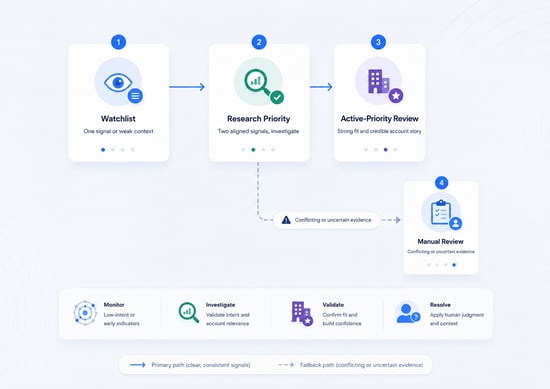
| Queue | Evidence required | CRM action | Outreach posture |
|---|---|---|---|
| Watchlist | One verified signal with plausible relevance | Record the event, affected function, confidence, and review date. | Monitor; do not launch event-led outreach solely because the signal occurred. |
| Research priority | Two related signals, ICP fit, and a coherent operating hypothesis | Validate source context, map the likely owner, and assign a role-specific research task. | Prepare targeted outreach only after the business need and buyer group are plausible. |
| Active-priority review | Three aligned signals, or two unusually strong signals with clear ownership and urgency | Create a multi-threaded account plan, document the evidence, and define the next action. | Engage when the message can connect the combined evidence to a relevant operational issue. |
| Manual review | Conflicting signals, uncertain identity, questionable dates, or weak ICP fit | Pause automated scoring and resolve the uncertainty before promotion. | Hold or downgrade until the evidence supports a clear direction. |
The CRM should record more than a count: signal types, relevant dates, affected function, alignment, confidence, likely buyers and the next action.
FundzWatch™ can bring funding, executive, M&A, hiring-related and website-change signals into one workflow. It surfaces the evidence; the sales team decides whether the events form a credible account story.
How Signal Stacking Changes Outreach
A signal stack should improve the reason for making contact, not add more facts to a generic email. These anonymized examples show the shift in hypothesis.
For an aerospace company, the useful hypothesis was not “Congratulations on the funding.” It was that capital, team growth and operational leadership might be converging around execution at scale.
For an enterprise-software company, the stack justified investigating product operations, security, enablement and customer adoption. It still did not reveal which project, if any, was open.
For a precision-technology company, the stack pointed toward integration and operating capacity. Outreach should therefore target the people responsible for the acquired operation, not lead with the financing headline.
What Sales Teams Should Avoid
- Avoid: adding up alerts before checking whether they relate to one another.
- Do instead: require a short account hypothesis that explains the operational connection.
- Avoid: assuming three unrelated alerts are stronger than two aligned ones.
- Do instead: score relevance and alignment separately from the raw number of alerts.
- Avoid: treating database record dates as confirmed event chronology.
- Do instead: verify announcement, closing or effective dates at source before using precise timing in outreach.
- Avoid: defaulting every stacked account to the CEO.
- Do instead: map the function most affected and identify both the operational and economic owners.
- Avoid: ignoring negative or conflicting signals.
- Do instead: create a manual-review path for restructuring, layoffs, refinancing or unclear entity matches.
- Avoid: letting the signal score override ICP fit.
- Do instead: use the stack to prioritize relevant accounts, not to make irrelevant companies appear qualified.
FAQ: Signal Stacking for B2B Account Prioritization
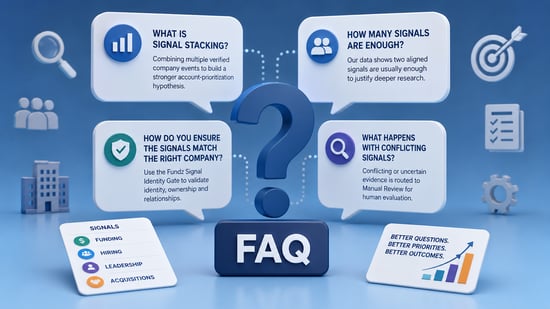
What is signal stacking in B2B sales?
Signal stacking combines two or more verified company events to test whether they support the same operating need, timing window and buyer map.
How many signals should make an account a priority?
There is no universal number. A pair of aligned signals is a sensible threshold for deeper research, while three should trigger active-priority review only when company identity, ICP fit, source context and functional ownership are also clear.
Is funding plus hiring enough to prove buying intent?
No. The combination can support a capacity-building hypothesis, but the team being hired, the stated use of funds and the seller’s relevance to both still need to be checked.
How should conflicting signals be scored?
Conflicting signals should trigger manual review or a downgrade, not automatic promotion. They may reflect cost control, restructuring or simply two unrelated workstreams.
What should a CRM record about a signal stack?
At minimum, record what changed, which function is affected, how confident the team is that the signals align, who may own the response and what should happen next.
Conclusion: Prioritize Evidence, Not Alert Volume
Signal stacking shifts sales teams from collecting alerts to interpreting accounts. Company events become useful when they reinforce one operational direction and help reveal who owns the resulting work.
Act on evidence without mistaking alert volume for qualification. Verify the company and events, test whether they align, map the affected function and promote the account only when there is a credible reason to act.