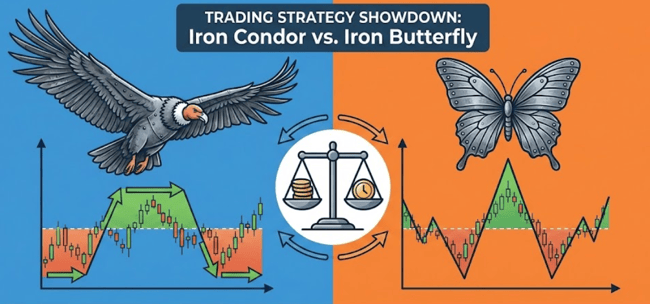
 Options traders often find themselves choosing between two popular neutral-market setups: the Iron Condor and the Iron Butterfly.
Both strategies seek to profit when the underlying asset stays within a range and time decay works in your favour. The difference comes down to how wide the “wings” are, how much premium you collect, and how much risk you’re willing to take.
In this article, we will compare both strategies and help you decide which one fits you best.
Understanding Iron Condor?
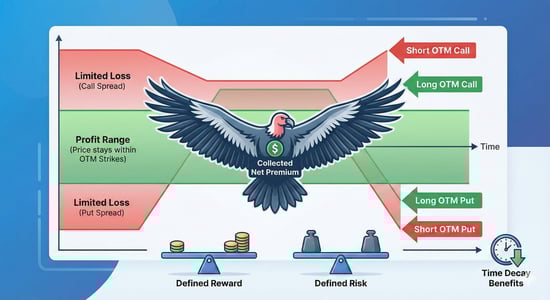 An iron condor is a trading strategy designed for situations when you expect the underlying asset to move little or stay within a certain price range.
In this, you sell an out-of-the-money (OTM) call spread and an OTM put spread with the same expiration date, which lets you collect a net premium while limiting your maximum loss.
Because the risk and reward are both defined at the outset, the strategy suits traders who anticipate low volatility rather than a strong move in either direction.
Understanding Iron Butterfly
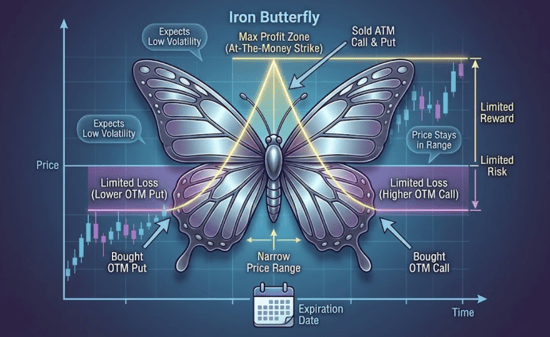 An iron butterfly is an advanced options strategy where a trader expects the underlying asset’s price to stay within a narrow range. It combines a short call and a short put at the same middle strike with a long call at a higher strike and a long put at a lower strike, all sharing the same expiry.
Its maximum profit occurs if the asset’s price finishes exactly at the middle strike at expiration. Because both risk and reward are limited, the strategy works best when implied volatility is expected to drop, and the asset remains relatively stable.
You can also enrol in option trading courses to understand it better.
Iron Condor vs Iron Butterfly: Key Differences
Understanding the real difference between Iron Condor and Iron Butterfly is a must. These two strategies may look similar, but their structure, risk, and reward profiles tell very different stories.
Here’s a simple comparison table to make it clear:
|
Feature |
Iron Condor |
Iron Butterfly |
|
Strike structure |
Four different strike prices: two short OTM options plus two long OTM options. |
Three core strike prices: selling an ATM call & put, plus buying an OTM call & put for protection. |
|
Profit zone width |
A wider range for the underlying price to stay profitable. |
Narrower range: the underlying must stay very close to the short strike to maximise profit. |
|
Reward potential |
Lower maximum profit, but higher probability of staying within range. |
Higher potential profit because sold options are tighter, but lower probability of landing exactly in the range. |
|
Risk-buffer / tolerance |
More room before loss kicks in because wings are farther out. |
Less tolerance for underlying price movement; a small move can hit the loss zone. |
|
Best market condition |
Suitable when you expect moderate volatility or a broad range, but not a strong directional move. |
Favours low volatility and a strong belief that the underlying will expire near the short strike. |
Which Strategy Fits You?
Decisiveness between the two will depend on your risk tolerance and how you perceive volatility.
When you are inclined towards a more stable direction and expect that the underlying asset will remain relatively range-bound, you can opt to use the wider range of an Iron Condor.
When you are confident that the asset will land very near one strike and you do not mind a narrower range but with potentially a higher gain, then consider the Iron Butterfly as a suitable option.
In either scenario, the most appropriate strategy is the one that best suits your risk tolerance, market perspective, and how well you’ve mastered the basics from a comprehensive option trading course. To explore these strategies in greater detail, take a look at Upsurge. club’s option trading full course.
Conclusion
In your trading journey, you have now learned that the Iron condor suits you when you anticipate the market will maintain a broader, calmer range, and the Iron butterfly suits you when you are anticipating the market to remain narrow and accurate. Selection between these options should be according to your risk appetite, market view, and comfort.