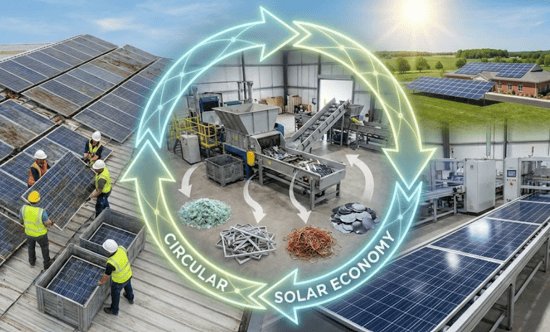
 Solar panels can keep delivering value after retirement. This guide explains how recycling supports a circular economy, what materials can be recovered, and why reuse sometimes beats processing.
You will learn the major cost and logistics barriers, safety considerations from heavy metals, and the patchwork of U.S. rules compared with the EU’s stronger standards. We outline collection options, specialized facilities, and manufacturer take-back programs.
The article also highlights new technologies that improve recovery rates and reduce waste. Finally, it covers business opportunities in collection, processing, and remanufacturing that help communities create jobs while cutting landfill use.
How Solar Recycling Supports A Circular Economy
The circular economy turns waste into resources by creating sustainable loops in which materials circulate continuously. Solar panel recycling demonstrates this principle in action; it turns end-of-life panels into valuable resources rather than landfill waste.
Keeping Materials In Use Longer
Solar panels can serve new applications after their 25-30 year lifespan through recycling. Recyclable materials from decommissioned panels could provide components for about 2 billion new panels by 2050. This approach creates USD 15 billion in recoverable value and reduces the industry's environmental footprint substantially.
Current technologies allow materials like aluminum, copper, and cobalt to reach recycling rates of nearly 100%. Solar recycling keeps these valuable materials in productive use beyond a single lifecycle.
Companies like SolarCycle demonstrate an innovative approach through panel refurbishment. Their factories run on refurbished modules. Panel reuse brings greater environmental benefits than recycling; each reused panel prevents more than 1.5 tons of CO2 emissions.
Creating New Business Opportunities
Solar panel recycling's economic potential opens new frontiers in the green economy. The global cumulative value of recoverable raw materials from end-of-life panels will reach about $450 million USD by 2030, enough raw materials to make 60 million new panels.
This growing sector creates several business possibilities:
- Specialized collection services are establishing regional networks
- Processing facilities employing advanced separation technologies
- Manufacturing enterprises incorporating recovered materials into new products
Regional economies benefit from these operations through job creation. Advanced recycling processes, such as hydrometallurgy and bioleaching, need skilled labor and technical expertise. Processing facilities near major solar installations reduce transportation costs and create jobs in communities, moving away from traditional energy sources.
Reducing Reliance On Mining
Recycling reduces the need for new mining operations, protecting ecosystems from habitat destruction, water pollution, and greenhouse gas emissions. This benefit becomes more significant as renewable energy adoption increases the demand for critical minerals.
Countries save valuable foreign exchange reserves by recycling rather than importing raw materials. Copper shows the highest recycling potential, followed by aluminum, rare earth elements, and nickel.
Developing regions can achieve greater self-sufficiency by building recycling capacity. About 35 developing countries, including 5 small island states, could recycle and recover more rare earth elements than they currently import.
These advantages exist, yet recycling rates for minerals like lithium and rare earth elements stay below 1% in many regions due to technological and economic barriers. This gap between potential and reality shows why supportive policies and continued advances in recycling technologies are vital to complete the circular economy loop.
Reducing Solar Waste And Protecting The Environment
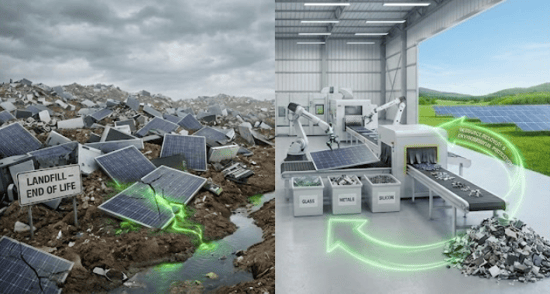 Solar panel decommissioning creates both challenges and opportunities as waste continues to pile up. These materials could damage the environment they were meant to protect without proper handling. Let's get into how proper solar panel recycling protects our ecosystems.
Preventing Landfill Overflow
The numbers tell a compelling story. By 2050, solar panel waste could reach 78 million metric tons – enough to fill nearly 8,000 Olympic swimming pools. The United States could generate up to 10 million tons of decommissioned panels by mid-century.
This impending "solar waste tsunami" could overwhelm landfills without intervention. Recycling these materials provides benefits beyond space conservation. We recycled these materials to prevent valuable resources from being buried forever. The International Renewable Energy Agency estimates that recovered raw materials from end-of-life panels globally will be worth approximately $450 million USD by 2030.
"Sending panels to landfills is substantially cheaper than recycling," explains one industry report, with recycling costs estimated at €100-200 per ton compared to minimal landfill fees.
This economic reality in part explains why only about 10% of solar panels are recycled today.
Avoiding Toxic Leaks From Old Panels
Solar panels operate safely during their 25-30-year lifespans, but improper disposal creates real environmental risks.
Some panels contain:
- Lead (in solder and cell connections)
- Cadmium (in certain thin-film technologies)
- Other heavy metals that can be harmful at high concentrations
These materials stay safely encapsulated during normal operation. "Working solar panels do not leach toxic metals," notes the EPA, as they're sealed between glass sheets with polymer encapsulants. Damaged panels or those improperly disposed of might release these substances.
Some panels may qualify as hazardous waste under the Resource Conservation and Recovery Act if they fail toxicity tests. These materials pose potential public health risks when they enter soil or groundwater. Proper recycling becomes not just economically sensible but a vital environmental concern.
Improving Waste Management Systems
Policy innovations have emerged to address these challenges. The EPA has undertaken the task of developing a proposed rule to add solar panels to universal waste regulations. This approach wants to "provide a clear, practical system for handling discarded solar panels".
Some regions show leadership with stronger measures. The European Union requires manufacturers to collect and recycle panels at end-of-life through their Waste Electrical and Electronic Equipment Directive. Washington state will require 87% recycling of each solar panel by 2025.
Extended Producer Responsibility (EPR) programs offer another promising solution. These initiatives hold producers responsible for the panel's entire lifecycle, creating powerful incentives to design more eco-friendly products.
Technology continues to advance. Innovations include salt-etching approaches that recover more than 99% of silver and 98% of silicon from end-of-life panels.
Proper solar panel management completes the sustainability promise of renewable energy. The environmental benefits achieved during operation could be lost through improper disposal.
Thoughtful recycling practices keep harmful materials out of our ecosystems while recovering valuable resources that would otherwise be lost.
Policies And Innovations Driving Solar Recycling Forward
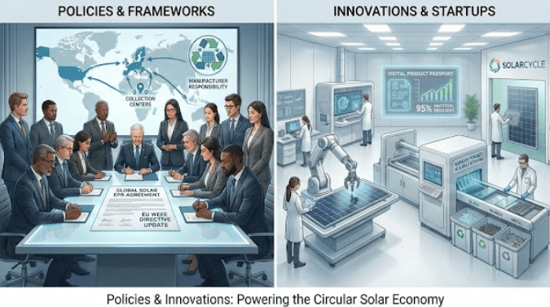 Solar installations continue to multiply worldwide. Better end-of-life management emerges through effective policies and groundbreaking technologies. Governments, researchers, and startups tackle solar waste challenges through innovative approaches.
Extended Producer Responsibility (EPR)
EPR programs are the foundations of successful solar recycling frameworks that move responsibility for end-of-life management to manufacturers. This approach changes the economics of waste handling because producers must finance the collection, handling, and treatment of their products.
Several countries have implemented EPR for solar panels using different approaches. Japan created a specialized recycling law that makes producers responsible for collection and recycling. EPR programs set up collection networks that create clear pathways for retired panels.
The best EPR schemes include separate collection targets for solar panels, given their long lifespans. They also set material recovery targets for valuable components like high-purity silicon.
These policies make manufacturers consider recyclability from the design stage, not just after panel installation.
WEEE Directive And Global Regulations
The European Union leads global solar recycling efforts through its Waste Electrical and Electronic Equipment (WEEE) Directive. The directive now covers all 28 EU member states after its original implementation in 2003 and the 2012 update to include solar panels.
WEEE regulations require manufacturers to meet ambitious targets: 85% recovery and 80% preparation for reuse and recycling rates for panels. Germany demonstrates the directive's impact by implementing financial mechanisms, including Business-to-Consumer and Business-to-Business transactions, to support its recycling program.
Regulatory landscapes differ widely outside Europe. The United States lacks national standards, and only five states have solar-specific recycling policies. China produces most of the world's panels but has limited enforcement of recycling policies.
New Recycling Technologies And Startups
Solar recycling technology advances faster than ever. The EU-funded QUASAR project wants to recycle 70-90% of key materials, including silicon, metals, glass, and polymers, at high purity levels. Their approach utilizes digital product passports and artificial intelligence to optimize resource recovery.
Some innovative companies achieve remarkable results:
- SOLARCYCLE – extracts up to 95% of panel value and returns materials to the supply chain
- 9-Tech – recovers 90% of silver, 95% of silicon, and nearly 100% of copper, aluminum, and glass
- We Recycle Solar – diverts 23 million pounds of hazardous waste by recycling 500,000 solar panels
The Path to a Sustainable Solar Future
Responsible end-of-life planning starts with triage. If panels still produce well, repurposing extends value and cuts emissions. When output falls, choose verified recyclers or manufacturer programs that recover glass, aluminum, silicon, and metals at high rates. Factor in transport and fees when budgeting.
Track state policies, federal proposals, and EU benchmarks, since standards shape options and costs. Support designs that simplify disassembly and material tracing. Emerging methods, from salt-etching to advanced sorting, raise yields and make recycling more practical.
Combine reuse where possible with safe recycling where needed. This balanced approach protects the environment and returns materials to productive use.