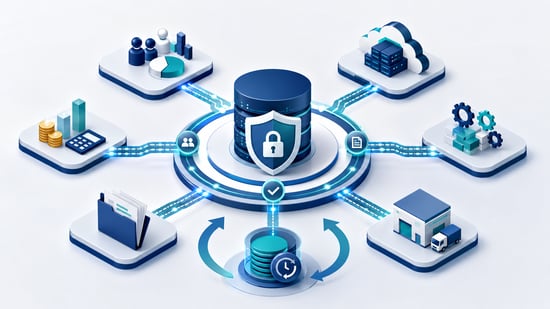
 Business data rarely sits in one place. Customer records may live in a CRM, financial information in an accounting platform, contracts in cloud storage, operational data in specialist systems, and sensitive working files across laptops, shared drives, and third-party applications.
That makes data protection a management problem before it becomes a technical one. A business cannot reliably secure, recover, or govern information it has not identified, assigned, and understood. The practical question is not simply how to stop data loss. It is how to know which information matters, who controls it, where it moves, how it is protected, and what happens when it becomes unavailable.
Key Points: Treat Business Data as an Operational Asset
Strong data management connects ownership, access, security, retention, and recovery rather than treating them as separate IT tasks.
Key points include:
- Know which data the business depends on, where it is stored, and which systems or third parties can access it.
- Assign an internal owner for important datasets and the decisions around access, retention, quality, and recovery.
- Match security controls to the sensitivity and business importance of the information rather than applying the same approach everywhere.
- Treat third-party access as an extension of the company’s data boundary, with clear responsibilities and exit arrangements.
- Test whether critical information can actually be restored within an acceptable period instead of assuming that a successful backup means the business is recoverable.
- Review data ownership and controls as systems, employees, suppliers, and business priorities change.
The bottom line: Data resilience depends on knowing what the business has, deciding who is responsible for it, limiting unnecessary exposure, and proving that critical information can be recovered when something goes wrong.
Data Management Starts Before Data Security
Even sound security controls can leave gaps when the business does not understand the information behind them. Encryption, monitoring, backups, and access controls may all work as intended while important data remains unmanaged because nobody has a complete view of where it sits or who is responsible for it.
That broader view is reflected in the NIST Cybersecurity Framework 2.0, which organizes cybersecurity outcomes around six functions: Govern, Identify, Protect, Detect, Respond, and Recover. The framework is designed for organizations across sectors and does not prescribe a single way to achieve those outcomes. For business data, the useful principle is that protection sits within a wider cycle of governance, identification, response, and recovery.
Start with the data the business cannot operate comfortably without, not with a list of security tools. This does not require cataloging every file. The aim is to identify the information the organization relies on to make decisions, meet obligations, serve customers, keep operations moving, and recover from disruption.
For every important dataset, leaders should be able to answer a few basic questions. Where is the authoritative copy? Who owns the business decisions around it? Which systems depend on it? Who can access or export it? How long should it be retained? What happens if it disappears, becomes corrupted, or cannot be reached?
Answers to those questions often reveal problems that technology alone cannot solve. Two teams may hold different versions of the same customer data. A former employee may still own a critical cloud folder. A supplier may hold the only usable export of operational records. Backups may exist even though nobody knows how long a full restoration would take.
Classify Data by Business Consequence
Not every file deserves the same level of protection. A duplicate presentation and the customer database may both be “data,” but the business impact of losing them is very different.
Classification becomes more useful when it starts with business consequence. Group information according to the damage caused by its loss, corruption, disclosure, or unavailability. Customer and payment records, payroll data, contracts, intellectual property, regulatory records, product data, system configurations, and key operational datasets often deserve tighter control because other activities depend on them.
That classification also helps show where sensitive data leakage could create the greatest legal, financial, or operational exposure.
Classification should also expose data that no longer serves a purpose. Keeping information indefinitely can add storage, compliance, discovery, and security burdens without creating business value. Good data management includes deliberate deletion as well as protection.
Data quality also matters. A dataset can be available and secure but still be unusable because it is incomplete, duplicated, stale, or inconsistent. Protecting business information means preserving its integrity and usefulness, not merely preventing someone from deleting it.
Assign Ownership Before Adding More Controls
Technology teams can administer systems, but they should not be expected to invent the business rules for every dataset. Important information needs an accountable business owner who can decide who needs access, how long records should be kept, which version is authoritative, and how quickly the information must be recoverable.
Ownership needs to survive staff changes. Saying “Finance owns it” is less useful than naming the role responsible for the data and documenting the decisions attached to that role. Outsourcing day-to-day administration does not change that requirement.
External support can strengthen monitoring, backups, device management, and recovery, but it does not remove internal accountability. A company assessing APC Integrated, an MSP should focus on which data systems the provider can access, what it is expected to monitor or protect, who controls administrative credentials, how restoration is handled, and which decisions remain with the business.
Operational responsibility and data ownership are different. A provider may administer the environment, but the company still decides what must be protected, who may use it, and what level of loss or downtime is acceptable.
Control Access as Roles and Relationships Change
Access should not be treated as a one-time decision made when somebody joins the company. Permissions need to move with roles, projects, suppliers, and business relationships.
The simplest starting point is need. Employees and contractors should be able to reach the information required for their work without automatically gaining broad access to unrelated systems or data. Higher-risk privileges, such as administrative access, bulk exports, configuration changes, or the ability to delete records, deserve closer oversight.
That discipline has to continue after onboarding. New employees need the right access quickly, but existing employees may need permissions removed as their roles change. Departing employees and contractors should not retain credentials, shared links, API keys, or accounts after their work ends.
Shared accounts create another problem because they make it harder to establish who performed an action. Where possible, access should be tied to identifiable users so activity can be reviewed and privileges can be removed without affecting everyone else.
Third Parties Expand the Data Boundary
Many businesses depend on cloud platforms, software vendors, consultants, managed service providers, payroll companies, agencies, and other external partners. Each relationship can create another path to company information.
Trust alone is not enough to govern a supplier relationship. Leaders need to know what the supplier can access, why that access is needed, how it is controlled, what evidence of activity the business can see, and how access will end when the relationship changes.
Process is as important as technology. When reviewing Attentus Tech's methodology, leaders should examine how the provider’s working model maps to internal data ownership, access approval, escalation, documentation, and recovery responsibilities rather than assuming that outsourced support transfers accountability.
Third-party arrangements should also account for subcontractors and underlying platforms. A provider may rely on its own cloud services, remote-management tools, backup platforms, or specialist partners. Understanding those dependencies helps the business see where its information may travel and which failures could affect access or recovery.
Mapping those dependencies is part of strategic risk management, because a weakness further down the supplier chain can still become an operational, security, or recovery problem for the business.
Exit planning belongs here as well. The company should know how it will recover its data, documentation, credentials, configurations, and administrative control if it changes provider or a supplier ceases trading.
Protect Data Across Its Full Lifecycle
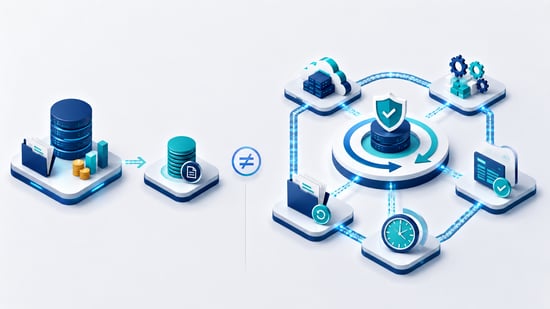
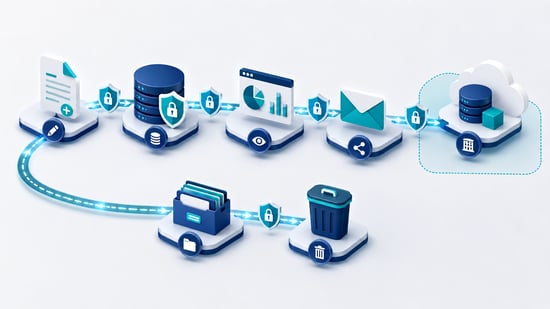
Following the data itself reveals risks that a perimeter-only view can miss. Information is created, stored, edited, shared, copied, exported, archived, and eventually deleted, and the risk changes as it moves through those stages.
When information is created or collected, the business should know why it is needed and where the authoritative version will live. During use, access and sharing should reflect business need. When data is transferred, the company should understand the destination and who can retrieve it. When records are archived, they should remain accessible to authorized users without becoming an unmanaged store of forgotten information.
Deletion also needs intent. Removing obsolete records can reduce exposure, but deleting information without considering contractual, legal, operational, or recovery requirements creates a different kind of risk. Retention rules need business input rather than being left entirely to storage settings.
This lifecycle view also exposes uncontrolled copies. Staff may download reports to laptops, export customer lists to spreadsheets, send attachments through email, or copy files into collaboration tools. Those copies can outlive the original purpose and fall outside the controls applied to the main system.
The Human Side of Data Security Matters
Many data problems begin with ordinary working behavior rather than a sophisticated attack. Files are sent to the wrong recipient, permissions are set too broadly, an employee overwrites a record, a spreadsheet is downloaded to a personal device, or someone approves a convincing phishing request.
Training helps, but the working environment matters just as much. Secure behavior is easier to sustain when naming is clear, permissions make sense, approved sharing tools are easy to use, access follows roles, and escalation or approval routes are obvious. That reduces the number of security decisions employees have to improvise.
Leaders should also pay attention to shadow systems: spreadsheets, personal cloud storage, unofficial SaaS tools, and local databases created because the approved system is inconvenient. These workarounds may solve an immediate operational problem while creating data that nobody formally owns or backs up.
Backups Are Not the Same as Recovery
A backup proves that a copy was created. Recovery proves something more important: that the business can restore the information or system it needs, when it needs it, in a usable state.
That distinction is easy to miss. A company can have regular backups and still face serious disruption if restoration takes too long, the backup is incomplete, credentials are unavailable, the recovery process has never been tested, or the restored system depends on another service that is still unavailable.
Critical systems therefore need recovery expectations as well as backup schedules. Leaders should decide how much recent data the business could tolerate losing and how long a system or dataset could remain unavailable before the impact becomes unacceptable.
NIST contingency-planning guidance distinguishes between a recovery point objective (RPO), the point in time to which data must be recovered after an outage, and a recovery time objective (RTO), which addresses how long system components can remain in recovery before business processes are negatively affected.
The terminology matters less than the business decisions behind it: If the latest usable copy were several hours old, would that be acceptable? If a system took a full day to restore, what operations would stop? Which records would have to be reconstructed manually?
Different systems can justify different answers. A marketing asset library may tolerate a longer outage than order processing, payroll, or a production system. The recovery plan should reflect business priority rather than applying one target to everything.
Test Recovery, Not Just Backup Completion
A green “backup completed” message is not proof that a full recovery will work. Testing should restore selected files, databases, applications, or complete environments according to how important the system is to the business.
A meaningful recovery test asks more than whether the data came back. Was it the expected version? Were permissions preserved? Could users actually reach it? Were dependent systems available? Did the team know who could authorize recovery? Were communications and escalation routes clear?
Testing also helps reveal hidden dependencies. The restored data may require a license server, encryption key, identity provider, network configuration, application version, or supplier account that was not included in the original recovery plan.
Recovery testing does not need to rehearse every possible disaster. It needs to give the company enough evidence to understand how its most important information would be restored under realistic failure conditions.
Protect Data During Business Change
Data risk often increases when the organization changes faster than its documentation. A merger, new software platform, office move, supplier change, restructuring, or rapid hiring period can leave behind duplicate datasets, forgotten accounts, temporary exports, and unclear ownership.
Migration projects deserve particular attention. Moving information from one platform to another is not finished when the new system goes live. Leaders should confirm that data arrived completely, access rules remain appropriate, historical records are usable, old copies are handled deliberately, and the business knows which system is now authoritative.
Role changes create a similar handover problem. Data ownership, administrative access, recovery knowledge, and supplier relationships should move with the responsibility rather than remain attached to one employee.
Treat Data Resilience as an Operating Discipline
Data management works better when it becomes part of broader operational excellence rather than an annual security exercise. Ownership, access, retention, supplier dependencies, and recovery requirements all shift as the business changes.
Regular reviews do not need to be complicated. Check whether important datasets still have named owners, whether access remains appropriate, whether new systems or suppliers have changed where information flows, whether old data should be removed, and whether recovery expectations still match the way the business operates.
A mature approach is visible in what leaders can explain: which information matters, where it sits, who can reach it, what controls apply, and how the business would recover it. The number of security tools is secondary.
Protect the Business Outcome, Not Just the Data
Data loss is not limited to files being permanently deleted. A business can suffer similar consequences when records are corrupted, locked, inaccessible, incomplete, or trapped inside a system it cannot operate.
The useful test is operational: if important information became unavailable tomorrow, could the business continue, restore it within an acceptable period, and identify who has authority to respond? That connects data management, security, and recovery to an actual business outcome rather than a checklist of controls.
Resilience comes from reducing avoidable risk, containing the effect of failures, and keeping an information problem from becoming a business problem that the organization cannot recover from.
Questions Leaders Ask About Business Data Management
The hardest questions usually appear where ownership, access, retention, recovery, and everyday working practices overlap.
What should happen when nobody clearly owns a dataset?
Treat the absence of ownership as a governance gap rather than leaving the dataset with IT by default. Identify which business process depends on the information, appoint a role with authority to make decisions about it, and document the immediate rules for access, retention, quality, and recovery. Give the dataset an accountable home rather than allowing responsibility to remain implicit.
Should every dataset have the same retention period?
No. A useful retention schedule works by data type, not by one default period for everything. The business should document why each category is kept and account for operational, contractual, regulatory, legal, and recovery requirements. This makes it easier to identify both records being held too long and records at risk of being deleted too early.
How often should access permissions be reviewed?
There is no single interval that suits every organization. Reviews should be frequent enough to catch role changes, departures, dormant accounts, excessive privileges, and new third-party access before they become established. High-risk systems and privileged accounts generally deserve closer review than low-risk shared resources.
Does cloud storage mean data is already backed up?
Not necessarily. Availability features, synchronization, version history, and backup are different capabilities. Businesses should understand what the platform protects, how long deleted or changed information can be recovered, whether independent copies exist where needed, and how restoration would work after a serious incident.
What are warning signs that data management has become fragmented?
Common signs include conflicting versions of the same records, important spreadsheets outside approved systems, former employees still owning files or accounts, unclear responsibility for access decisions, repeated manual exports, and suppliers holding information that the business cannot easily retrieve itself. Any one issue may be manageable; several together usually indicate that ownership and control have not kept pace with how the business now works.