 Most cyberattack stories focus on stolen data. A breach occurs, records are exposed, and attention turns to identity theft, financial losses, and reputational damage. However, another type of attack may not steal anything at all. Instead, it reaches into the machinery and control systems that keep a facility, production line, or essential service running.
What happens when the target is not your data, but your operations themselves? For any business that relies on physical systems, from a factory floor in Pittsburgh to a water treatment plant, this is the threat that keeps operations managers awake. The following seven operational technology risks can bring a business to a genuine standstill.
What Is OT and Why Does It Matter?
Operational technology, commonly shortened to OT, refers to the hardware and software that control physical processes. It includes industrial controllers, sensors, machinery, production lines, building-management systems, and infrastructure used to keep real-world operations functioning.
OT differs from conventional information technology. If an email system becomes unavailable, work may become inconvenient or slower. If an OT system fails, the physical operation itself may stop. The consequences can include lost production, damaged equipment, safety risks, interrupted services, and costly recovery work.
The distinction between IT and OT has also become less clear as businesses connect machinery, sensors, and operational systems to wider corporate networks. This connectivity supports automation, remote maintenance, and better operational data, but it also gives attackers more potential routes into systems that were once isolated.
Seven Risks That Can Halt Your Operations
Not every OT risk is exotic or technically sophisticated. Many of the weaknesses that cause serious shutdowns are ordinary problems that have remained unresolved, including aging equipment, poorly controlled access, incomplete asset records, and networks that were connected without sufficient protection.
These seven risks deserve particular attention because they are common, disruptive, and capable of affecting an entire operation. Each can be managed more effectively once the business understands where the exposure exists and who is responsible for addressing it.
1. Legacy Systems That Cannot Be Patched
Age is one of the greatest risks in many industrial environments. A significant amount of OT equipment was designed to operate for decades, often long before cybersecurity became a normal consideration during product development.
Older systems may rely on unsupported operating systems, proprietary software, or components that vendors no longer maintain. In some cases, applying a patch requires production to stop or creates a risk that the equipment will not restart correctly. As a result, known vulnerabilities can remain present for years.
Attackers understand this problem and actively search for outdated systems that are easier to exploit. Where replacement or patching is not immediately possible, businesses may need to isolate the equipment, restrict communication paths, increase monitoring, and introduce compensating security controls around it.
2. The Blurring Line Between IT and OT
For decades, many OT systems were physically separated from the internet and corporate IT networks. This separation was often described as an air gap. In modern operations, however, that isolation has largely disappeared as businesses connect equipment to improve efficiency, collect data, support remote maintenance, and coordinate production.
The problem is that connecting OT and IT networks can create a route from ordinary business systems into critical machinery. A phishing email that compromises an office computer may eventually provide access to the factory floor if the two environments are connected without proper security boundaries.
Connectivity is not inherently unsafe, but every connection should have a defined operational purpose, an accountable owner, and appropriate controls. Businesses should understand what information must pass between IT and OT, which systems initiate the communication, and whether that access can be restricted without affecting production.
3. Weak or Missing Network Segmentation
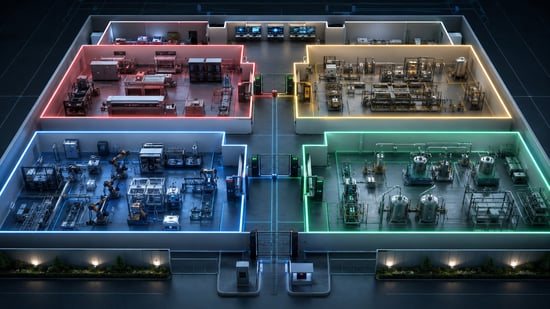
When devices and systems sit on one flat network, a single compromise can spread far beyond its original entry point. This remains one of the most common and dangerous weaknesses in connected operational environments.
Without effective segmentation, an attacker who gains access to one part of the network may be able to move laterally toward engineering workstations, industrial controllers, safety systems, or other critical assets. Strong OT cybersecurity depends heavily on separating networks so that a breach in one area cannot cascade into the systems responsible for running operations.
Organizations without sufficient in-house expertise may work with specialist providers to assess network architecture, identify unsafe connections, and design controls suited to industrial environments. The objective should be to limit unnecessary communication while preserving the availability and performance that operational systems require.
Segmentation acts like the watertight compartments of a ship. If one area floods, the barriers help prevent the entire vessel from going down with it.
4. Remote Access Left Wide Open
Remote access has become essential for maintenance teams, equipment manufacturers, engineers, and outside vendors. It is also one of the most frequently exploited routes into operational systems.
Every remote connection creates a potential entry point. Connections protected only by weak passwords, shared accounts, or outdated remote-access software give attackers opportunities to enter an environment without being physically present.
Third-party access presents a particular concern because a supplier's compromised credentials can become the customer's breach. Businesses should apply multi-factor authentication, individual user accounts, approval-based access, session logging, and strict time limits to remote connections. Access should also be removed promptly when a contract ends, or a vendor employee changes roles.
5. Ransomware Aimed at Production
Ransomware is particularly dangerous in an OT environment because attackers know that a halted production line or interrupted service can become extremely expensive within a short period. That urgency may place greater pressure on operators to pay.
The scale of the targeting is clear. Manufacturing has been the most targeted industry for cyberattacks for four consecutive years, accounting for approximately one-quarter of incidents, according to IBM's X-Force Threat Intelligence Index.
Ransomware does not always need to infect industrial controllers directly to stop production. An attack on scheduling software, engineering files, identity systems, or supporting IT infrastructure may force an organization to shut down operational equipment because staff can no longer run it safely or verify what the systems are doing.
6. Human Error and Insider Mistakes
Not every disruptive incident begins with a malicious hacker. Some serious outages result from ordinary mistakes made by employees, contractors, engineers, or vendors who have no intention of causing harm.
A misconfigured setting, an incorrect network connection, a well-intentioned shortcut, or a convincing phishing email can create an opening or cause an outage directly. Employees may also connect unauthorized laptops, removable storage devices, or diagnostic tools without understanding the potential consequences.
Training and clearly defined procedures therefore matter as much as technology. Staff should understand which actions require authorization, how to report a suspected mistake, and why unusual system behavior should be escalated immediately rather than ignored. A reporting culture that focuses on rapid containment rather than blame can reduce the impact of human error.
7. No Visibility Into What Is Actually Connected
You cannot protect what you cannot see, yet many organizations have an incomplete picture of their own OT environment. Equipment may be added over many years, ownership may change, and asset records may gradually become inaccurate.
Unknown or forgotten devices can remain quietly connected to a network long after their original purpose has disappeared. Each unmanaged device may contain outdated software, unused services, default credentials, or communication paths that security teams do not know exist.
A reliable asset inventory should record the device type, location, owner, software or firmware version, network connections, operational purpose, and business criticality. It should also be treated as a living operational record rather than a spreadsheet reviewed only during an annual audit.
Continuous monitoring can help organizations identify new devices and unexpected changes as they occur. Similar principles apply across connected facilities and control systems, where real-time visibility helps teams detect equipment, safety, compliance, and security issues before they become larger operational problems.
How to Reduce These Risks
The good news is that these risks can be managed through a deliberate and prioritized approach. An organization does not need to solve every problem at once, but it does need to understand which systems are critical, where the most serious exposure exists, and what would happen if those systems became unavailable.
- Map every connected device so the organization knows what it is protecting.
- Identify the systems and processes that are essential to safe operations.
- Segment networks so that a compromise cannot spread freely to critical systems.
- Secure remote access with strong authentication, individual accounts, and vendor controls.
- Patch supported systems and introduce compensating controls around equipment that cannot be updated.
- Back up essential configurations, engineering files, and recovery information.
- Train employees and contractors to recognize common mistakes, scams, and unsafe practices.
- Monitor the environment continuously so that unexpected activity is identified early.
- Test incident-response and recovery procedures before an actual shutdown occurs.
These measures should form part of a wider cybersecurity strategy that connects technical controls with business continuity, staff responsibilities, vendor management, and executive oversight.
No organization can eliminate cyber risk entirely, but practical preparation can significantly reduce both the likelihood of an incident and its operational impact. A planned maintenance window, controlled test, or staged security improvement is usually far less disruptive and costly than attempting to recover after an attack has already stopped production.
Frequently Asked Questions About OT Cybersecurity

The following questions address the governance, recovery, and assurance issues that businesses should examine after identifying their main operational technology risks.
How should a business decide which OT systems to recover first?
Recovery priorities should be based on operational dependency, safety, regulatory obligations, and the financial consequences of downtime. The most expensive machine is not automatically the first system that should be restored. A smaller controller, identity service, engineering workstation, or communications gateway may be required before an entire production process can resume safely.
Businesses should document those dependencies in advance and establish realistic recovery-time and recovery-point objectives. The plan should also identify who has the authority to restart equipment and what checks must be completed before production resumes.
What controls should be included in an agreement with a remote maintenance vendor?
The agreement should specify who may access the environment, which systems they can reach, how access is approved, and when it expires. It should also require individual accounts, multi-factor authentication, session logging, prompt breach notification, and removal of access when personnel leave or change roles.
Organizations should also clarify whether the vendor uses subcontractors, how its own devices are secured, and whether it can demonstrate that access controls are tested regularly. These expectations are easier to enforce when they are included in the contract rather than introduced after a security concern arises.
How can network segmentation be tested without disrupting production?
Testing should begin with documented communication flows, configuration reviews, and passive network monitoring rather than aggressive scanning. Teams can compare observed traffic with the connections that are supposed to exist and investigate anything unexpected.
More intrusive testing should be scheduled during controlled maintenance windows and coordinated with engineering, safety, production, and vendor teams. A rollback plan should be prepared before changes are applied, particularly where older equipment may respond unpredictably to altered network conditions.
What evidence should senior leaders request from an OT security program?
Leaders should ask for evidence that the organization knows which assets it operates, which are most critical, which vulnerabilities remain unresolved, and how remote access is controlled. They should also receive information about backup testing, incident-response exercises, unsupported systems, vendor access, and overdue risk-treatment actions.
A useful report explains the operational consequences of each major exposure rather than presenting only technical scores. For example, leadership should be told whether a weakness could stop a production line, affect worker safety, interrupt customer delivery, or prevent the organization from recovering within its agreed timeframe.
When should a business review its cyber insurance for OT incidents?
Coverage should be reviewed whenever the organization adds connected equipment, expands remote access, acquires another facility, changes critical vendors, or materially alters its network architecture. Businesses should confirm whether the policy covers operational interruption, physical damage, restoration costs, incident-response support, and losses caused by third-party access.
The organization should also understand the security conditions attached to coverage. A claim may become more difficult if required controls, such as multi-factor authentication, tested backups, or network segmentation, were declared but not actually maintained.
Conclusion
OT attacks are uniquely dangerous because their effects extend beyond information loss. A compromised operational environment can shut down a production line, halt a facility, interrupt an essential service, damage equipment, and create safety risks for employees and the public.
The seven risks share a common theme: most arise from limited visibility, weak separation, uncontrolled access, and gaps in basic operational discipline rather than from exotic threats. Addressing those weaknesses methodically can make an organization substantially harder to disrupt and far better prepared to recover when an incident occurs.