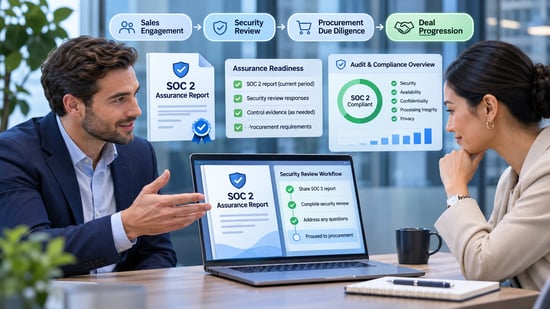
 A buyer asks whether your company has a SOC 2 report. That sounds like a yes-or-no question, but in a serious B2B review, it usually opens several more.
The buyer may want to know what the report covers, how current it is, whether it applies to the service being purchased, and whether anything in it needs further explanation. The seller wants to keep the opportunity moving without turning an assurance report into a claim it cannot support.
Used well, a SOC 2 report can remove some repeated work from a security review because it gives the buyer independent assurance information about a defined control environment. It does not guarantee that procurement will waive its own checks or that a deal will close faster.
The commercial advantage is assurance readiness: knowing what the report says, what it does not say, how it can be shared, and who should answer the questions that remain.
Key Points: A SOC 2 Report Is Evidence, Not a Shortcut
- SOC 2 is an examination performed by an independent CPA firm that results in an assurance report; it is not a general cybersecurity certification.
- Type I and Type II reports answer different questions, so sellers should know which one they have before describing it.
- A SOC 2 report may answer part of a buyer’s security review, but it does not automatically replace questionnaires, contractual checks, or service-specific due diligence.
- Scope matters. The system, services, criteria, date or period, and relevant third parties need to match what the seller is claiming.
- Detailed reports should be shared through the organization’s approved process rather than treated automatically as unrestricted marketing collateral.
- Exceptions, complementary controls, subservice organizations, and other report details can generate legitimate follow-up questions.
- Sales should be able to coordinate the review without being expected to interpret technical assurance findings on its own.
Start With What a SOC 2 Report Actually Does
The American Institute of CPAs describes SOC 2 as an examination of controls at a service organization relevant to security, availability, processing integrity, confidentiality, or privacy.
That makes the report commercially relevant when a prospective customer needs assurance about the supplier it may rely on. AICPA material on the SOC suite explains that assurance reports can provide users with information needed to assess and address risks associated with outsourced services.
This is why SOC 2 can surface during a live B2B opportunity rather than remaining an internal compliance matter.
The terminology matters. Saying a company is “SOC 2 certified” is common shorthand, but it is less precise than saying the company has undergone a SOC 2 examination or has a SOC 2 report. The report relates to a defined system and criteria, and the auditor’s opinion has to be read within that scope.
That distinction becomes important as soon as a buyer starts asking what the report actually covers.
Know Whether You Have a Type I or Type II Report
A sales representative should be able to identify the report type before sending anything to a prospect.
In a Type I examination, the service auditor evaluates controls as of a specified date. A Type II examination also addresses the operating effectiveness of controls over a specified period.
For a buyer, those are different forms of assurance. A Type I report can help the buyer understand whether relevant controls were suitably designed at the stated date. A Type II report adds evidence about how the controls operated during the period covered by the examination.
Neither should be reduced to “we passed SOC 2.”
A useful response is factual: identify the report type, the date or period covered, the service or system in scope, and the approved route for obtaining the report. If the buyer wants interpretation beyond that, the request should move to whoever owns security, compliance, risk, or the report internally.
Use the Report to Reduce Repetition, Not to End the Review
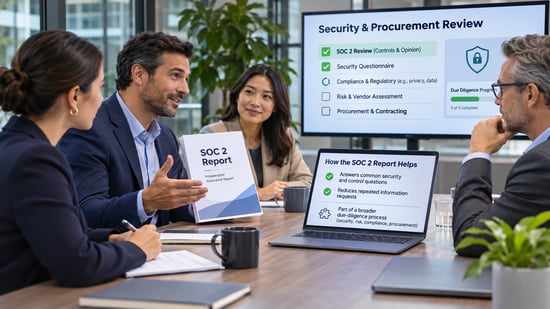
A buyer may already have a security questionnaire, procurement workflow, legal review, privacy assessment, or third-party risk process. The useful question is where the SOC 2 report can satisfy evidence requests inside that workflow.
What it can do is give the buyer evidence that may answer some of the questions those processes are designed to investigate. Instead of rebuilding an explanation of every relevant control from scratch, the seller may be able to point to assurance material it already has.
That matters because a security review can become part of the B2B buying process long before the commercial terms are final. Good evidence preparation helps the seller respond without constructing an assurance process from scratch in the middle of the deal.
Other questions will remain specific to the proposed relationship. A customer may need to know where its data will be stored, which subcontractors will be involved, how incidents are notified, what contractual commitments apply, or what happens when supplier access ends.
Those are not questions a seller should dismiss because it has a SOC 2 report. Even after due diligence, a buyer still has to decide what access to grant a supplier once the relationship begins. A SOC 2 report is one evidence source inside that wider decision, not a substitute for every other buyer question.
Check Scope Before Making a Sales Claim
The easiest mistake is to turn a scoped report into a company-wide statement.
A business may operate several products, environments, subsidiaries, or acquired systems. The SOC 2 examination may apply to only part of that estate.
Before sales relies on the report, it should know:
- Which service or system the report describes.
- The Type I date or Type II period.
- Which trust services criteria are relevant to the examination.
- Whether the service being sold to this buyer is actually within scope.
- How relevant subservice organizations are treated.
- Whether anything material has changed since the date or period covered.
AICPA’s SOC 2 report-review material highlights complementary user entity controls, subservice organizations, opinion types, exceptions, and bridge letters as issues report users may need to understand.
That is a useful reminder that a SOC 2 report is not just a logo or badge. A buyer may need information that is buried in the detail, and the salesperson should know where to route those questions.
Read Exceptions Before the Prospect Does
A Type II report can include tests of controls and the results of those tests. If exceptions are reported, the company should understand them before a prospective customer raises them.
An exception does not automatically make the supplier unacceptable. Nor should sales dismiss one without understanding what happened.
The useful questions are more specific: Which control was affected? What occurred? Was the matter isolated or recurring? What did management do in response? Does it matter to the buyer’s planned use of the service?
This is why a sales enablement process around SOC 2 should contain more than a copy of the report. The company should know who can explain exceptions, what questions sales can answer itself, what needs escalation, and what current information can be provided when the examination period is no longer recent.
The goal is not to turn salespeople into auditors. It is to prevent a commercial review from stalling because nobody knows who owns the answer.
Do Not Treat a Detailed SOC 2 Report Like a Public Brochure
Transparency does not mean every assurance document should be placed on a public website.
AICPA distinguishes SOC 3 reports from SOC 2 reports by describing SOC 3 as a less detailed, general-use report that can be freely distributed. In sales, that distinction allows a company to make appropriate assurance information public while still controlling access to more detailed material used during due diligence.
Depending on the organization, a SOC 2 report might be shared through a trust center, controlled data room, prospect portal, nondisclosure process, or another approved route. The exact mechanism is a policy choice, but sales should know it before a large prospect asks. Otherwise, the company can have the evidence the buyer wants and still lose time working out whether anyone is allowed to send it.
Build a Small Response Pack Around the Report
The report should be the center of the response, not the entire response.
A useful assurance pack gives the buyer enough context to understand what is being provided without forcing sales to improvise.
| Buyer need | What the seller should have ready |
|---|---|
| Is there a SOC 2 report? | Current report type and approved sharing route |
| What does it cover? | Short, accurate scope description |
| How current is it? | Type I date or Type II period |
| Has anything changed since then? | Approved current-status explanation or bridge information where appropriate |
| Were there exceptions? | Named internal owner who can explain them accurately |
| Which questionnaire items can the report support? | Map relevant report sections to the buyer’s questions and identify what still needs a separate answer |
| What is outside the report? | Clear ownership for service-specific, contractual, privacy, or operational questions |
This is where assurance work becomes commercially useful. The seller is not promising that the buyer will skip its review. It is reducing time lost to document searches, inconsistent terminology, unclear ownership, and repeated requests for evidence the company already has.
External Providers Can Support Readiness, but They Are Not the Evidence
Some organizations depend on outside specialists for managed IT, cybersecurity, compliance preparation, monitoring, documentation, or audit readiness.
The mix of managed IT, security, governance, and compliance services described by NuView's team is an example of the kind of outside support a business may use when operating and documenting controls.
That support can help the organization prepare for assurance work. It does not allow sales to substitute a provider’s website for the organization’s own control environment or SOC 2 report.
Another example is the managed IT, cybersecurity, and compliance support outlined on OCCSI's website. The practical question is not whether an external provider talks about security or compliance, but which services the company actually uses, how they fit into its control environment, and how any relevant third-party role appears in the assurance material.
A buyer is assessing the supplier it may contract with. The existence of an IT or compliance partner is context, not proof that every control described by that partner applies to the seller.
Give Sales a Short Approved Explanation
A SOC 2 discussion becomes easier when sales has a concise statement it can use consistently.
That statement should answer four points: what report the company has, what service or system it covers, how an eligible prospect can obtain it, and who will handle questions the report does not answer.
The wording should stay synchronized with reality. If a new examination is underway, say that. If one service is in scope and another is not, do not blur the distinction. If the buyer asks about something outside the report, answer it separately; that is more credible than turning SOC 2 into a promotional slogan.
Use Follow-Up Questions as Commercial Intelligence
What remains after the buyer reads the report can be useful to the sales team.
If the prospect keeps returning to data residency, privileged access, business continuity, subservice organizations, retention, incident notification, or another issue, that concern may affect implementation or contracting as well as security approval.
Sales does not need to weaken the requirement. It needs to recognize the potential blocker early and bring in the right owner. The unanswered questions then become commercial intelligence: they show what still stands between the buyer and approval even when the report has already answered part of the assurance review.
The Real Sales Asset Is Assurance Readiness
A SOC 2 report can be valuable in a B2B sale, but possession of the report is only part of the advantage. The stronger position is being ready to use it properly.
That means producing the correct report through an approved route, explaining its scope accurately, knowing what has changed since the covered period, identifying the right owner for exceptions and follow-up questions, and separating what the report supports from what must be answered elsewhere.
A serious buyer is unlikely to be persuaded by a SOC 2 badge alone. It wants evidence it can use in its own decision process.
The seller that can provide that evidence accurately and efficiently is better prepared for the review than one that starts building its assurance process after the prospect asks.
SOC 2 in B2B Sales: Frequently Asked Questions
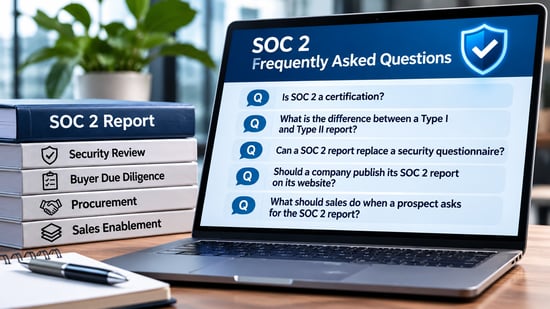
Is SOC 2 a certification?
No. SOC 2 is an examination performed by an independent CPA firm that results in an assurance report. “SOC 2 certified” is widely used informal language, but saying that an organization has undergone a SOC 2 examination or has a SOC 2 report is more precise.
What is the difference between a SOC 2 Type I and Type II report?
A Type I examination evaluates controls as of a specified date. A Type II examination also addresses the operating effectiveness of controls over a specified period. Sales teams should identify the actual report type instead of treating the two as interchangeable.
Can a SOC 2 report replace a buyer’s security questionnaire?
It may answer enough questions to reduce duplicated work, but it should not be assumed to replace the buyer’s process. Service-specific, contractual, privacy, operational, or risk questions may still need separate answers.
Should a company publish its SOC 2 report on its website?
Not automatically. Detailed assurance material should be shared through the organization’s approved process. AICPA specifically describes SOC 3 as a general-use report that can be freely distributed, which is one reason sales teams should not assume SOC 2 and SOC 3 have the same distribution purpose.
What should sales do when a prospect asks for the SOC 2 report?
Confirm that the report applies to the service being discussed, use the approved sharing route, give an accurate description of its scope, and route technical or assurance questions to the appropriate internal owner.