 A staffing or recruitment company can point to a huge candidate database and present it as part of the moat. That claim deserves testing.
A database with hundreds of thousands of records may contain valuable specialist talent, repeat placement history and information that helps recruiters fill roles faster. It may also contain duplicates, dead contact details, stale CVs, unclear retention decisions, recruiter-owned spreadsheets and records that cannot be moved cleanly out of the current ATS.
Record count is therefore a weak proxy for asset quality.
The investor question is more demanding: how much of this candidate-data estate can the business continue to use, govern, move and derive value from after the investment?
Key Points: Test the Candidate Database as an Investment Asset
- Start with the commercial claim. Establish exactly how management says the database creates value.
- Measure usable candidate intelligence rather than total records: recency, completeness, duplication, engagement and placement history matter.
- Check whether the business can legitimately retain and reuse candidate information under the rules that apply to it.
- Trace candidate data beyond the ATS into recruiter exports, client portals, email, third-party platforms and AI tools.
- Test portability before assuming the database can support consolidation, migration or a future exit.
- Separate institutional data value from relationships and knowledge concentrated in individual recruiters.
- Treat weaknesses according to their effect on the investment thesis: some are fixable operating debt; others can undermine the value case.
Start With the Investment Claim
A candidate database only matters to the investment case if management expects it to create value.
That value might come from faster placements, specialist talent pools, lower sourcing costs, repeat relationships, stronger client coverage, better matching or greater recruiter productivity. The investor should identify which of those claims supports the valuation.
If a staffing company says its historic network gives it an edge in cybersecurity recruitment, for example, a database containing 500,000 names is not enough. Diligence needs to establish how many relevant candidates are current, searchable, contactable and commercially useful to the recruiters serving that market.
The same principle applies when technology is part of the thesis. The broader question of what technical due diligence should tell investors before a Series B is whether technology can support the growth being underwritten. Here, the narrower question is whether the evidence supports the specific value management attributes to candidate data.
This is increasingly consistent with investor priorities. KPMG’s 2025 Private Markets Pulse surveyed 301 U.S. institutional investors, 30% of them venture-capital investors. Eighty-one percent said cybersecurity and data-protection reporting had become more important in their investment decision-making over the previous year.
The point is not that every candidate database is a cybersecurity problem. It is that data quality, control and governance now sit much closer to the investment decision than they once did.
Measure the Usable Database, Not Just the Total Database
A candidate record can exist for years while contributing very little to a current search.
People change jobs, locations, compensation expectations, skills and availability. Email addresses fail. CVs age. Multiple recruiters create duplicate profiles. Records arrive through job boards, direct applications, imports, referrals and earlier systems.
The first commercial test is source of hire. Rather than treating the ATS as valuable because it is large, calculate the share of placements in the last 12 months that came from candidates already in the database before the job order opened. A stricter version can require the candidate record to pre-date the order by 30 days, separating a genuinely reusable talent pool from people sourced only after demand appeared.
Pair that with time-to-shortlist. If the existing database is part of the moat, it should show up in delivery performance: recruiters should be able to produce credible candidates faster, or at lower sourcing cost, when the required talent is already known to the firm.
Four questions then matter more than the headline record count:
- What share of placements came from candidates whose records existed before the job order?
- How does time-to-shortlist compare when a placement comes from the existing database rather than fresh external sourcing?
- How current, complete, and duplicate-free are the records supporting those placements?
- Which parts of the database are genuinely differentiated from information readily available elsewhere?
There is no universal threshold that makes one answer “good” and another “bad.” The useful signal is whether management can show that the database changes commercial outcomes rather than merely preserving historical records.
A 2026 New York Case Shows Why Fresh Candidate Intelligence Can Have Real Value
A recent staffing-industry dispute gives this distinction unusual clarity.
In Columbia Technology Corp v EJR Search Partners, decided by New York’s Appellate Division on June 30, 2026, Columbia Technology Corporation was an IT recruiting and staffing firm serving financial-services clients. The dispute involved candidate information passed to a rival recruiting firm.
The appellate court upheld a finding of trade-secret misappropriation. Importantly, the court said the protected value was not simply that a particular candidate existed or was available. It was the up-to-date resume taken from Columbia Technology’s candidate database. The rival firm received a $45,787 commission after placing that candidate.
This was not an investment case, and it does not mean every staffing database or resume is automatically a trade secret.
It does show something highly relevant to diligence: the commercial value can sit in the freshness, detail and accumulated context of candidate information rather than in the headline number of names stored in a system.
For an investor, that sharpens the question. What has the target actually built that a competitor could not recreate quickly from public or stale information?
Establish Why the Company Can Keep Using the Data
Candidate data is not ordinary inventory. It concerns identifiable people and may include employment history, compensation information, interview notes, assessments and, in some situations, sensitive information. The rules governing collection, retention, use and deletion vary by jurisdiction and by the company involved.
California provides a useful U.S. example. The California Privacy Protection Agency states that CCPA privacy rights extend to California residents who are employees or job applicants when the law applies to the business.
This is not merely theoretical. In September 2025, the CPPA required Tractor Supply Company to pay $1.35 million to resolve multiple alleged CCPA violations. The agency described the decision as its first addressing job-applicant privacy rights and said one issue was failure to notify California job applicants of their privacy rights and how to exercise them.
That enforcement action was not against a staffing company, and the fine covered several alleged violations rather than job-applicant notices alone. Its relevance is narrower: applicant information can sit inside active privacy enforcement.
A target should therefore be able to explain:
- How candidate information enters the business.
- What privacy notices or other grounds apply to its use.
- What purposes the information is used for.
- How retention periods are set and applied.
- How deletion, correction and other applicable rights requests are handled.
- Whether different candidate populations are subject to different rules.
- What happens when data collected for one purpose is proposed for another.
The investment team does not need to become the privacy function. It does need enough evidence to know whether management’s commercial assumptions fit the way the information can actually be used.
Trace the Data Beyond the ATS
The applicant-tracking system may be the system of record without being the whole candidate-data environment.
Recruiters work through email, spreadsheets, sourcing platforms, messaging tools, client portals, background-check services and collaboration software. CVs are downloaded for shortlists. Candidate summaries are prepared for clients. Notes may live in inboxes or local documents.
That creates a gap between the database management can point to, and the places candidate information actually travels.
A simple diligence map can expose it:
| Candidate-data stage | What to establish |
|---|---|
| Collection | Where records originate and how they enter the business |
| ATS/CRM | Which platform is treated as the primary record |
| Recruiter workflow | What can be exported, downloaded or copied elsewhere |
| Client sharing | What candidate information reaches employers and through which route |
| Third parties | Which providers receive, process or enrich candidate information |
| AI and automation | Which tools can read, classify, summarize, rank or generate from records |
| Retention | When records are refreshed, archived or deleted |
| Exit/deletion | How information is removed when it is no longer required |
The aim is not a perfect architecture diagram.
It is to find material candidate information that disappears from view when diligence stops at the ATS.
Test Whether the Database Can Move
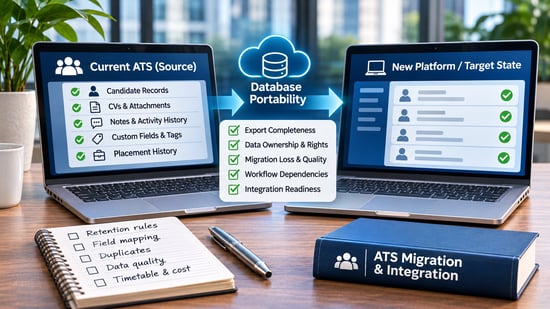
Portability matters even when nobody plans to replace the ATS immediately. An investor may later want to integrate another recruitment business, migrate platforms, introduce new matching technology or prepare the company for sale. A database that is valuable only inside one operating setup may be less flexible than management assumes.
The diligence test should go beyond whether an export function exists. First, establish export completeness: can the company extract core candidate records together with notes, attachments, activity history and custom fields in a usable format? Then establish ownership and contractual limits: which elements belong to the company, what is restricted by a platform or third party, and whether extraction or reuse changes when a contract ends.
Finally, test migration loss. A buyer should know what context would disappear, which fields would degrade and which workflows depend on proprietary platform functionality rather than the underlying candidate data. A technically exportable database can still lose much of its commercial usefulness in transit.
This becomes more important when consolidation is part of the thesis.
Combining two recruitment businesses can mean combining different schemas, duplicate candidates, conflicting retention histories, separate tagging systems and different assumptions about what information should be kept.
That connects directly to the wider post-acquisition question of what should be integrated first to protect deal value. Candidate data should not be merged because two businesses happen to own databases. It should be integrated when the buyer understands what is being combined and why the integration releases value.
Find Out How Much of the Asset Lives in Individual Recruiters
A clean ATS can still conceal a people-dependency problem. Recruiters may know which candidates are genuinely open to moving, which employers they would consider, what compensation would change their mind, or why they rejected a previous opportunity. Some of that intelligence may never reach the system.
Other information may sit in personal notes, inboxes, spreadsheets or message histories.
For an investor, the distinction is important. A firm can have strong candidate relationships without having captured them as an institutional asset.
A useful stress test is simple: if several senior recruiters left six months after the investment, how much of the candidate network would remain commercially actionable?
The evidence is operational rather than cosmetic. Candidate engagement history should be recorded centrally; notes should be shared rather than trapped in personal systems; skills, sector, placement and submission histories should be usable by more than one recruiter. Handover processes, multi-recruiter relationships and repeatable re-engagement workflows all help show that the firm has converted individual recruiter knowledge into an institutional asset.
The 2026 Columbia Technology dispute sharpens the legal as well as the operational distinction. The defendants did not dispute that CTC’s candidate database constituted a trade secret, and the court focused on an up-to-date resume taken from that database.
If equivalent intelligence remains scattered across personal inboxes, undocumented notes or private message histories, the company may lose continuity when a recruiter leaves and may face a harder task showing that it treated the information as a protected corporate asset. Trade-secret protection depends on the circumstances, including secrecy and the measures used to protect the information; simply placing data in an ATS is not enough.
Investors should therefore distinguish information the company can retain, control and operate from relationships and knowledge that remain dependent on particular people.
Map Third-Party Dependencies to Offboarding and Continuity Risk
Candidate information often passes through more organizations than the target’s management summary suggests.
Background-check companies, payroll systems, job boards, assessment platforms, CRM tools, cloud services and other vendors can all become part of the chain. Outside IT support can also sit directly in the control path for user accounts, laptops, backups and access to cloud systems.
The managed-services description published by IT experts at Perimetra, for example, includes system monitoring, endpoint protection, user support and backup readiness. For an investor, the relevant diligence question is operational: if a recruiter leaves unexpectedly, who is responsible for removing access, recovering the device, preserving relevant logs and confirming whether locally stored candidate exports are covered by backup or recovery processes?
If an external provider owns part of that workflow, the buyer needs to know who can trigger the action, what the escalation path is and how quickly it can happen.
A New York staffing firm operating on a lean internal footprint might rely on outsourced IT management in Manhattan. PROTELI’s published service description includes device monitoring, backup and recovery, cybersecurity and compliance support.
In that model, leaver control may depend partly on an outside provider. Diligence should establish how promptly account access and active sessions can be ended, whether endpoints can be recovered or secured, and whether evidence needed after an incident can be preserved without waiting for an improvised response.
The same principle applies to other material providers. Investors should map what candidate information each provider can access, how that access ends, whether data can be extracted or deleted at contract termination and whether further subprocessors sit underneath the service.
A dependency map is more useful than a vendor list because it shows which outside relationships could affect continuity, containment and control when something changes quickly.
Treat AI as a Data Question as Well as a Product Feature
AI can make a candidate database more useful. Recruitment tools can assist with sourcing, CV summarization, candidate matching, ranking, outreach and workflow automation. That makes it tempting to treat AI as an additional source of upside in the investment thesis.
But the feature only creates durable value if the underlying data and decision process are understood.
The U.S. Equal Employment Opportunity Commission’s Strategic Enforcement Plan for fiscal years 2024–2028 explicitly identifies technology, including AI and machine learning used to recruit applicants or make or assist in hiring decisions, within its recruitment and technology-related discrimination priorities.
California adds another time-sensitive consideration. The CPPA’s finalized automated-decisionmaking regulations are already effective, with ADMT-specific compliance requirements beginning January 1, 2027 for covered uses, including significant employment decisions.
The exact obligations depend on the company, technology, use case and jurisdiction. For diligence, the practical questions are more immediate:
- Which candidate fields can the AI system access?
- Does it assist recruiters or materially influence decisions?
- Is candidate information sent to an external provider?
- What outputs are retained?
- How are recommendations reviewed by people?
- How does the company test for inappropriate or discriminatory outcomes?
- Can management show that the AI functionality produces the recruiter or placement improvement claimed?
AI can increase the economic value extracted from candidate information.
It can also scale weak data practices faster.
Turn the Findings Into an Investment Decision
Candidate-data diligence should not end in a long defect list.
Established staffing businesses will often have stale records, duplicates, inconsistent tagging or local workarounds. The investment question is whether those weaknesses are manageable or whether they change the value case.
A useful classification is:
| Finding | Investor interpretation |
|---|---|
| Thesis support | The database is current and differentiated enough to support a material commercial assumption |
| Underwritable remediation | Weaknesses exist, but management understands them and a credible cleanup or governance plan can be funded |
| Post-investment milestone | The issue need not block the deal, but needs an owner, timetable and evidence of completion |
| Thesis challenge | The database cannot reliably deliver a benefit the investment case assumes |
The classification matters more than a generic red, amber or green score.
A large duplicate population might be manageable if the database is not central to the thesis. A smaller portability or usage problem could matter much more if the investor is paying a premium for proprietary candidate intelligence.
The Database Should Be Worth More Than Its Record Count
A candidate database can be a real commercial advantage.
It can shorten sourcing time, deepen specialist coverage, preserve placement history and give recruiters information that competitors do not have.
But the valuable database is the one the company can explain.
Management knows what is current, what is duplicated, where the data came from, who can reach it, how it moves, what third parties touch it, what AI tools do with it and what will remain usable after systems, ownership or key people change.
That is the difference between owning a large quantity of candidate information and owning a data asset that genuinely supports the investment thesis.
Candidate Database Due Diligence: Frequently Asked Questions

Is a large candidate database automatically valuable to investors?
No. Record count says little about recency, duplication, engagement or commercial usefulness. Investors should test how the database contributes to placements, sourcing efficiency or another specific part of the investment thesis.
Should investors inspect candidate-level personal information during diligence?
Not by default. The objective is normally to validate the database’s quality, governance and commercial characteristics without unnecessarily exposing identifiable candidate information. The target and its advisers should determine an appropriate evidence-sharing process for the information involved.
Why does ATS portability matter to an investor?
Because the strategy may later require migration, integration or new technology. A database that cannot be exported cleanly, loses important context during migration or depends heavily on proprietary platform functions may be less flexible than the record count suggests.
What should investors ask about AI used in recruitment?
They should establish what candidate information the system accesses, what decisions or recommendations it influences, whether outside providers receive data, how outputs are reviewed and whether management can evidence the business benefit attributed to the technology.
Does poor candidate-data hygiene have to stop an investment?
No. Some deficiencies are ordinary operating debt. The important question is whether they can be fixed at an acceptable cost and whether they undermine a material assumption in the investment thesis.