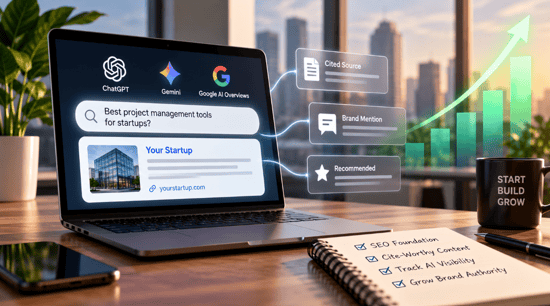
 Can potential customers find your startup when ChatGPT, Gemini, or Google AI Overviews answer a direct category question? If you want to secure early AI search visibility, the time to act is now. Early discovery depends on building searchable entities, authoritative content, and credible citations before competitors establish stronger signals.
Using platforms like Addlly AI can help streamline this process and ensure your brand is positioned correctly for modern answer engines.
This guide covers traditional rankings, AI-generated answers, measurement, governance, and a focused 90-day action plan. Operating in a competitive digital market means startups often face limited content resources, multilingual audiences, and strict privacy responsibilities under laws like the California Consumer Privacy Act (CCPA).
Generative Engine Optimization (GEO) complements your startup SEO strategy rather than replacing it. We will explore practical steps for founders and lean marketing teams to build a reliable baseline, though inclusion in an AI answer cannot be guaranteed.
Quick Summary
- Treat SEO and GEO as one connected discovery strategy.
- Build entity clarity before scaling content.
- Publish direct answers supported by credible evidence.
- Track AI mentions, citations, and qualified conversions.
- Use a 90-day sprint to establish the first benchmark.
What Is AI Search Visibility for Startups?
AI search visibility is how often and how accurately a startup appears in AI-generated answers, recommendations, citations, and summaries. It measures your brand presence within modern answer engines.
A strong AI visibility strategy ensures that large language models (LLMs) understand your business well enough to recommend it. This visibility directly influences discovery long before users ever visit a traditional website.
How AI Answer Engines Select Sources
Understanding how AI answer engines select sources is crucial for your GEO strategy. These systems rely on retrieval-augmented generation to pull real-time facts.
- Retrieval and Selection: Answer engines scan the web for the most relevant, factual data to satisfy a prompt-based search behavior.
- Source Authority: Systems prioritize domains with high trust signals and verifiable expertise.
- AI Citations vs. Mentions: Cited links actively drive referral traffic, while unlinked brand mentions build entity confidence.
- Platform Differences: ChatGPT, Gemini, and Google AI Overviews all evaluate sources differently, without relying on identical ranking systems.
Key Insight: Search engines focus on content quality and factual accuracy, rewarding startups that provide unique, first-party data.
How Search Rankings Support AI Discovery
Strong organic search foundations directly support AI discovery. Excellent crawlability, clean indexing, and high relevance help machine learning models find and understand your startup content. When your website is technically sound, AI crawlers can extract information efficiently.
However, strong rankings do not guarantee AI citations. A page ranking first in traditional search might not be cited in an AI answer if it lacks direct, factual responses. This is exactly why generative engine optimization should extend your traditional SEO foundations rather than replace them.
Why Early Visibility Creates a Startup Advantage
Early visibility creates a startup advantage by establishing entity recognition, capturing citation opportunities, and compounding content authority before larger competitors adapt.
Startups possess a brief first-mover advantage. Because citation patterns for niche industry queries are still fluid, agile teams can secure valuable digital real estate quickly.
Build Entity Recognition Before Rivals
Building a clear brand entity helps AI models confidently connect your company to its category.
- Maintain Consistency: Keep your company name, category, founders, products, and claims completely consistent across the web.
- Align Official Records: Ensure your website identity matches authoritative profiles and state Secretary of State corporate filings.
- Use Structured Data: Deploy Organization schema and detailed About pages to reduce ambiguity in the knowledge graph.
Earn Citations While Results Are Fluid
You can earn AI citations before competitors by targeting unanswered category questions while answer formats are still developing. Create highly useful definitions, industry benchmarks, and detailed process content that LLMs want to reference. Content freshness matters immensely in generative search.
Always update your assets when products, local regulations, or AI search ranking factors change. Providing the most current data makes your startup the most reliable source to cite.
Compound Authority With Every New Asset
You can compound content authority for startups by treating every new asset as part of a larger ecosystem. Connect your articles, product pages, original reports, and founder expertise using smart internal links. This reinforces semantic relationships and topical authority.
A coherent, interconnected content library is far more useful to an AI crawler than isolated blog posts. Establishing the building blocks of domain authority early supports long-term visibility.
Build the SEO Foundation AI Engines Need
To build the SEO foundation AI engines need, you must map user demand, fix technical access, and strengthen entities and proof. These technical SEO basics are non-negotiable.
AI models cannot cite what they cannot crawl. A reliable technical foundation ensures your startup SEO checklist actually yields results.
1. Map High-Intent Customer Questions
Action: Group customer questions by awareness, evaluation, and purchase intent to capture commercial intent accurately.
Tools: Use Google Search Console, customer interviews, sales calls, and AI prompt testing.
Time: Set aside two to four hours for an initial query mapping session.
Include locally used terminology and multilingual query variants to capture a wider target audience.
2. Fix Crawlability and Indexing Signals
Action: Review robots directives, XML sitemaps, canonical tags, rendering performance, and index coverage.
Tools: Rely on Search Console, crawling software, and schema validators.
Time: Dedicate one working day for a comprehensive audit of a small website.
Prioritize your product pages, comparison charts, pricing tables, and social proof pages first.
3. Strengthen Entities, Authors, and Proof
Action: Add author profiles, verified company details, external citations, clear policies, and verifiable evidence to boost E-E-A-T signals.
Tools: Implement Organization, Person, Article, Product, and SoftwareApplication schema.
Time: Spend one to two days building core templates for business identity.
Always state whether displayed prices include local taxes and carefully date all changing claims.
Create Content AI Systems Can Cite
To create content AI systems can cite, publish direct, verifiable answers, add original evidence, and connect pages around core entities. Citation-ready content is the backbone of GEO.
LLM content optimization requires clarity over cleverness. AI models prefer structured, factual statements over lengthy marketing narratives.
Step 1: Publish Direct, Verifiable Answers
Action: Answer the primary question clearly in the first one or two sentences of your content block.
Tools: Utilize content briefs, query maps, and strict editorial templates.
Time: Allocate ten minutes per answer block during the final editing phase.
Always separate established facts, brand recommendations, and subjective opinions clearly to secure featured snippets.
Step 2: Add Original Evidence and Sources
Action: Add first-party data, expert commentary, specific examples, publication dates, and clear methodology.
Tools: Leverage product analytics, customer surveys, and founder interviews for original research.
Time: Budget half a day for a small evidence-led asset.
Cite primary authorities like the Federal Trade Commission (FTC) or relevant state agencies when discussing regulated topics.
Pro Tip: Unique data points and proprietary statistics are highly attractive to AI answer engines looking to provide information gain.
Step 3: Connect Pages Around Core Entities
Action: Build topic clusters around your specific products, customer problems, target audiences, and primary use cases.
Tools: Use an entity map, internal link reports, and comprehensive content inventories.
Time: Spend two hours mapping out a small content cluster.
Keep product names, feature attributes, and factual claims perfectly consistent across every single page.
Measure Visibility Across AI and Search
Measuring visibility requires tracking mentions, citations, sentiment, share of voice, referral traffic, and qualified leads. AI visibility measurement goes beyond traditional click-through rates.
You must separate organic search performance from AI search tracking tools to understand your true digital footprint.
Track Mentions, Citations, and Sentiment
Tracking brand mentions in AI-generated answers requires a systematic approach to data collection.
- Record Everything: Track linked citations, unlinked mentions, source pages, and overall answer sentiment.
- Schedule Tests: Run a fixed prompt set on a documented, recurring schedule.
- Capture Context: Always log the specific answer engine, date, exact query, and position context.
Benchmark Share of Voice by Prompt Theme
To benchmark your AI search share of voice, group your test prompts by problem, product category, comparison, and purchase intent. This reveals where your brand dominates and where it falls short.
Measure visibility against named rivals only when reliable data is available. Review which external sources repeatedly shape generated answers, and aim to earn mentions on those specific domains.
Respect CCPA Rules in Conversion Tracking
When tracking marketing attribution, you must respect state privacy frameworks like the CCPA.
- Define Purpose: Clearly define the business purpose for collecting any attribution data.
- Review Controls: Regularly review consent management, notification procedures, retention limits, and access controls.
- Aggregate Data: Use aggregated reporting where personal data is entirely unnecessary.
Avoid Common Early-Stage GEO Mistakes
Avoid common GEO mistakes by refusing to publish generic AI content, maintaining technical SEO basics, following AI governance guidance, and separating ranking metrics from visibility metrics.
Startups often rush content production, sacrificing the very quality that AI answer engines require for citations.
Do Not Publish Generic AI Content at Scale
Undifferentiated summaries add little information gain and actively harm your content quality. If your article simply repeats what is already available, an AI engine has no reason to cite it.
Always require human review, strict fact-checking, and brand-specific evidence. Use AI to accelerate your workflows rather than to remove editorial accountability.
Do Not Ignore Technical SEO Basics
Technical SEO mistakes for startups will completely derail your AI search visibility.
- Flag Issues: Actively flag blocked pages, duplicate URLs, slow page templates, and broken structured data.
- Ensure Access: Inaccessible content simply cannot become a dependable AI source.
- Prioritize Fixes: Rank technical fixes by their direct business value and indexation impact.
Do Not Ignore NIST AI Governance Guidance
Startups must align with federal frameworks like the NIST AI Risk Management Framework for responsible deployment. Use these governance principles to document oversight, accountability, and testing.
Consider established model governance resources when evaluating your AI tools. Always maintain strict approval controls for regulated, legal, or financial claims.
Do Not Confuse Rankings With AI Visibility
Never confuse SEO rankings with AI visibility. A page ranking highly in traditional search may not be cited in generated answers if the format is poor.
Track your AI visibility and organic performance as related but distinct visibility metrics. Avoid claiming sweeping success from just one isolated prompt result.
Scale the Workflow Without Losing Control
Startups should retain manual execution for highly sensitive pieces, but governed agentic workflows become essential when scaling multi-channel content operations. An efficient AI content workflow prevents bottlenecks.
Choosing the right operational model determines how quickly you can capture the market.
Choose Manual or Agentic Execution
Comparing a manual versus agentic SEO workflow helps clarify resource allocation. A manual approach remains manageable for a handful of pages, but governed agents reduce handoffs without removing editorial review.
| Aspect | Addlly AI Marketing Content Agents | Manual SEO and GEO Workflow |
|---|---|---|
| Strategy and audit coverage | ✓ Automated multi-channel audits | ✗ Time-consuming manual checks |
| Brand consistency | ✓ Custom-trained on specific brand voice | Partial (relies on human editors) |
| Prompt and code requirements | ✓ Zero-prompt, zero-code interface | ✗ Requires prompt engineering skills |
| Multi-channel production | ✓ Generates blogs, social, and newsletters | ✗ Requires separate creation steps |
| Visibility measurement | ✓ Integrated SEO and GEO tracking | Partial (requires multiple disjointed tools) |
Set Human Review and Brand Guardrails
Setting brand guardrails and human review processes is critical for brand safety.
- Assign Roles: Assign clear approval roles for factual accuracy, legal claims, tone, and publication.
- Create Rules: Create reusable brand guidelines, approved source lists, and prohibited-claim rules.
- Document Escalation: Document clear escalation paths for highly sensitive or regulated content.
Plan a 90-Day Visibility Sprint
A 90-day AI search visibility plan is the most practical way to start. Choose a narrow product category, a specific prompt set, and a small page group for your pilot program.
Assign weekly owners for auditing, content creation, review, and measurement. Define your visibility baseline and progress metrics clearly before publishing any new assets.
Put Your 90-Day Visibility Plan to Work
Execute your 90-day AI visibility plan in three time-bound phases: audit demand, publish citation-ready assets, and measure the results. A structured sprint guarantees momentum.
Focus on execution speed and strict adherence to your brand guidelines.
Days 1-30: Audit Demand and Visibility
Action: Run an AI search visibility audit covering rankings, indexed pages, AI mentions, citations, and entity consistency.
Tools: Rely on Search Console, crawling software, web analytics, and a fixed AI prompt set.
Time: Dedicate one full month with weekly checkpoints.
Start with one high-value commercial category rather than attempting to audit the whole website at once.
Days 31-60: Publish Citation-Ready Assets
Action: Publish direct answers, comparison pages, original evidence, and clear product explainers.
Tools: Utilize editorial briefs, schema validators, and robust content review workflows.
Time: Commit to one month of highly focused content production.
Review all advertising claims against applicable FTC guidance before publication to ensure total compliance.
Days 61-90: Measure, Refresh, and Scale
Action: Recheck your initial prompts, citations, rankings, qualified conversions, and source coverage.
Tools: Use your visibility dashboard, analytics platforms, Search Console, and a living content inventory.
Time: Spend one month reviewing data, ending with a final retrospective.
Scale only the specific content formats and topics that produce measurable, positive signals.
Conclusion
Startups do not need the largest content budget to establish visibility, but they do need focused entities, useful evidence, reliable technical foundations, and consistent measurement. Traditional SEO creates necessary discoverability, while GEO significantly improves the chance of accurate inclusion in generated answers.
Start building your entity and authority signals today, before your specific category becomes too crowded. Combine your technical SEO basics with citation-ready GEO content, and always measure AI mentions separately from traditional rankings. Select one commercially important topic, document your current baseline, and run the 90-day sprint.
Review this strategy quarterly as answer formats, source preferences, privacy expectations, and AI governance guidance evolve. Run a GEO audit of your domain or map a 90-day pilot across 20 priority URLs to assess your current visibility.
Frequently Asked Questions
How Fast Can AI Search Visibility Improve?
Usually, startups can establish measurable baselines within 90 days. Citations and mentions still depend on authority, content quality, competition, and how often each answer engine refreshes its sources.
Which Schema Types Help AI Search Discovery?
Organization, Article, FAQPage, Product, and SoftwareApplication schema clarify entities and page meaning. Use only markup that matches visible content and validate it before publishing.
Is Addlly AI Suitable for Early-Stage Startups?
Yes, Addlly AI suits startups with recurring SEO, GEO, and multi-channel content needs. Its brand-trained, zero-code agents are most relevant when a team needs governed workflows rather than a standalone writing tool.
How Does Addlly AI Combine SEO and GEO?
Addlly AI combines SEO and GEO audits with brand-trained content workflows. Teams can plan prioritized fixes, create citation-ready assets, and measure visibility across traditional and AI-powered discovery.