 Most SaaS founders don't realize how much legal exposure they're carrying until their first international sale triggers a VAT audit. Merchant of record solutions exist precisely to remove that risk, shifting tax liability, PCI DSS compliance, and payment processing responsibility away from your team entirely.
The problem is that not every platform handles the full picture, and gaps in chargeback management or multi-jurisdiction tax remittance can get expensive fast. After reviewing five of the leading options in this space, this guide breaks down what each one actually does and who it's built for.
The Shortlist Methodology
Only platforms with a demonstrated track record in payment processing and global merchant of record services made the cut.
Why the Right Merchant of Record Solutions Make a Difference
Picking the wrong merchant of record platform doesn't just create checkout friction. It can expose your company to missed VAT filings across the EU, unresolved chargebacks that erode margins, and authorization-rate problems that quietly damage free-to-paid or trial-to-subscription conversion in specific regions.
The challenge is that global tax laws, including VAT, GST, and digital services taxes, vary by jurisdiction and change regularly. Without a platform that tracks those changes, your team is left managing compliance manually, which most SaaS teams aren't equipped to do.
The right platform absorbs all of that, acting as the legal seller of record so your business isn't the one filing in 40 countries.
That shift can directly improve your checkout conversion rate by geography, help keep your chargeback ratio in check, and support higher authorization rates by routing payments through infrastructure built for international volume.
Top 5 Merchant of Record Solutions: Specs at a Glance
Note: All data in this table is sourced from review platforms and the official websites of the listed companies.
| Company Name | Years Operating | Price |
|---|---|---|
| Fungies.io | 3 years | 5% + $0.50 per transaction |
| Paddle | 13 years | 5% + $0.50 per transaction |
| FastSpring | 19 years | Custom pricing |
| Lemon Squeezy | 5 years | 5% + $0.50 per transaction |
| Dodo Payments | 1 year | Pay-as-you-go |
1. Fungies.io - Best for Global SaaS and Digital Product Sales
What Capabilities Are Offered by Fungies.io?
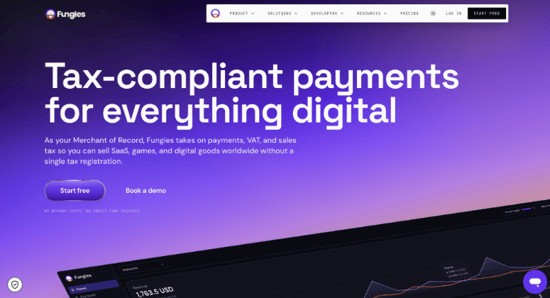 Fungies.io is a merchant of record platform built for SaaS companies, digital creators, and game studios that want to sell across 150+ countries without assembling a compliance team.
The platform covers payment processing, VAT and GST collection, subscription billing, and fraud prevention under one roof. Pricing runs at 5% + $0.50 per transaction with no monthly fee, so early-stage teams aren't carrying fixed overhead before revenue scales.
Getting started takes roughly 15 minutes, and developer tooling includes CLI and MCP integrations that make the whole setup feel light.
What Sets Fungies.io Apart?
Fungies.io solves the problem of fragmented payment infrastructure by handling tax remittance, payment processing, and subscription management from a single platform, so founders aren't stitching together three separate tools just to sell in Germany and Japan.
That kind of all-in-one coverage at a transparent per-transaction price is rare among newer platforms and removes a real bottleneck for teams scaling internationally.
The Verdict from Users
Customers consistently call out fast setup and responsive support as standout qualities, and the commission-only pricing model gets mentioned repeatedly as a major reason they chose it over subscription-based alternatives.
Featured customers such as Leadsin.io and RenderAI.app show that digital product businesses of different sizes are putting it to work. The pattern across reviews suggests the team releases updates regularly, which is the kind of signal that builds long-term trust.
2. Paddle - Best for SaaS and Subscription Software Businesses
What Capabilities Are Offered by Paddle?
Paddle is a full-service merchant of record platform founded in 2012, covering subscription management, checkout, payment processing, tax compliance, invoicing, fraud protection, and revenue analytics across 300+ markets.
In 2024, the company processed over $1 billion in payments and collected more than $100 million in sales taxes on behalf of its 4,000 customers. That scale reflects the infrastructure behind those figures.
Its pricing matches the market standard at 5% + $0.50 per transaction, and its scale gives it meaningful payment-network relationships, certifications, and partnerships.
What Sets Paddle Apart?
The specific problem Paddle solves is running billing, tax collection, and fraud management across hundreds of markets without a dedicated payments team on staff.
That kind of end-to-end depth across 300+ markets puts it in a different category from lighter-weight tools built for simpler use cases.
The Verdict from Users
Customers such as Fortinet and MacPaw have shared case studies pointing to outcomes such as 3X ARR growth and 200% revenue increases, which gives Paddle's claims some real grounding.
The platform's $293 million in funding and $1.4 billion valuation also signal that the market has taken a close look at what the company is building.
From what the reviews show, the main appeal is the confidence that comes with handing off global compliance to a platform with this much operational history behind it.
3. FastSpring - Best for Global SaaS, Digital Products, and Subscription Billing
What Capabilities Are Offered by FastSpring?
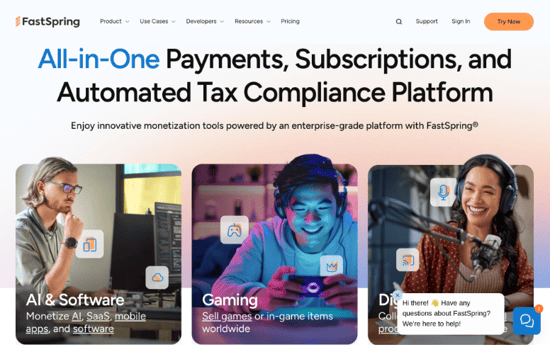
FastSpring has been operating as a merchant of record since 2006, giving it one of the longer track records in this space.
The platform supports 200+ regions, 21+ languages, and 35+ currencies, and processes over $1 billion in annual transactions. It covers cross-border tax compliance, subscription billing, and localized checkout experiences, all with developer tools including REST APIs and low-code options for teams that want flexibility without a heavy build.
Its 3,200+ customer base spans SaaS, AI monetization, and traditional software, which says something about how adaptable the platform actually is.
What Sets FastSpring Apart?
FastSpring addresses a real friction point for companies selling internationally: credit card authorization rates tend to drop across borders, and its infrastructure is built to improve those rates for international transactions.
That kind of focus on checkout conversion rates by geography is what separates a platform built for global selling from one that merely supports it.
The Verdict from Users
Customer testimonials call FastSpring "a real partner," which is the kind of language that appears when support quality holds up over time.
The feedback pattern points to strong conversion performance and solid integration with existing sales processes. For a platform that's been around since 2006, the consistency in how customers describe it suggests the company has kept the product competitive rather than coasting on tenure.
4. Lemon Squeezy - Best for Software Companies and Digital Product Creators
What Capabilities Are Offered by Lemon Squeezy?
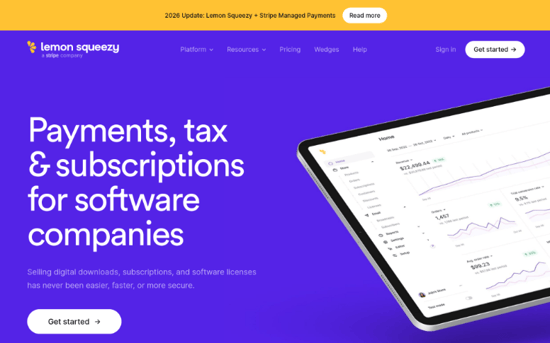
Lemon Squeezy is built specifically for software companies and digital product creators, handling payment processing, VAT and tax compliance, fraud detection, and automatic license key issuance from one place.
The platform supports 200+ countries and 130+ currencies, which covers most realistic global distribution scenarios for indie developers and growing SaaS teams.
Pricing runs at 5% + $0.50 per transaction with no card required to start, keeping the entry barrier low. Fraud detection is a real differentiator for creators selling high-volume, low-cost digital products where fraud exposure adds up quickly.
What Sets Lemon Squeezy Apart?
The acquisition by Stripe in July 2024 validated what the platform had already built, and it signals that Lemon Squeezy's approach to merchant of record services for digital creators was strong enough to attract serious infrastructure investment.
That combination of Stripe's payment network depth with Lemon Squeezy's creator-focused features puts it in a strong position for software businesses prioritizing both compliance and checkout conversion.
The Verdict from Users
Lemon Squeezy crossed $1 million in ARR within nine months of launching, which reflects real traction with the indie software and digital creator audience it targets.
Users point to its clean setup experience and transparent pricing as reasons for choosing it over older, more complicated platforms. The Stripe acquisition adds confidence for teams that want assurance about the platform's long-term prospects.
5. Dodo Payments - Best for SaaS and AI Builders Scaling Globally
What Capabilities Are Offered by Dodo Payments?
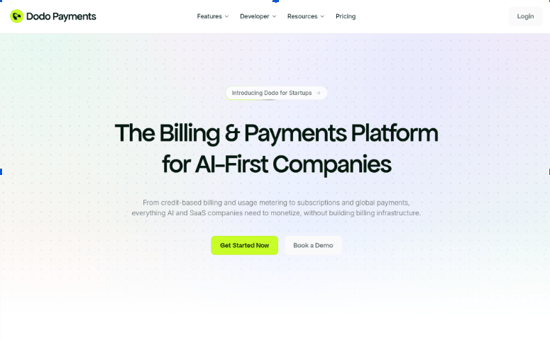
Dodo Payments launched in 2024 with a clear focus on SaaS builders and AI-native products that need to monetize globally from day one.
The platform supports credit-based billing, usage-based billing, subscriptions, and one-time payments across 150+ countries with 40+ payment methods, covering the variety of billing models that AI and SaaS products actually need, including usage tracking alongside flat subscription tiers.
Built-in tools handle global tax compliance, fraud protection, and chargeback management without requiring separate integrations.
Its zero-fixed-cost, pay-as-you-go pricing makes it accessible for solopreneurs and micro-SaaS founders watching overhead closely.
What Sets Dodo Payments Apart?
Dodo Payments targets a specific gap: AI-native monetization models that don't fit neatly into traditional subscription billing structures, especially for developer-first teams that want to configure billing directly in their code environment.
The Sentra AI assistant, integrated into VS Code, reflects an approach to merchant setup that's genuinely different from what older platforms offer.
The Verdict from Users
Since Dodo Payments only launched in 2024, formal review data is still thin, which is worth factoring in if you're evaluating long-term platform reliability.
The early signals from its 62-person team and its focus on solopreneurs and AI builders suggest the company is moving quickly and targeting an underserved segment. It's one to watch, especially as the AI product monetization space grows.
The Research Behind These Recommendations
Starting With Data Gathering
The research process started by building a broad list of merchant of record platforms through payment industry directories, SaaS tool review sites, and product-focused case study libraries.
Platforms were identified based on their presence across multiple sources, not just one directory or a single mention. The goal was to capture the full range of active options serving SaaS, digital product, and AI-native businesses before applying any criteria.
Filtering Candidates to Your Requirements
Once the initial list was assembled, platforms without verifiable documentation of merchant of record services were removed early.
Review patterns were analyzed across sources to identify which platforms had consistent feedback versus those with thin or one-sided review histories. Platforms with unresolved questions about their compliance coverage or unclear pricing structures were also removed at this stage to keep the shortlist grounded in real-world usability.
Validating Each Recommendation Through Research
Each shortlisted platform was cross-checked by comparing the claims made on its official website against what users actually reported in reviews and case studies.
When a platform claimed broad international tax coverage, that claim was checked against real customer accounts describing the compliance experience. Platforms where marketing language and actual user experience diverged significantly were either dropped or noted with appropriate caveats.
Where Each Pick Stands in the Industry
Industry standing was assessed through signals such as funding history, customer mentions, press coverage, and references in payment industry publications.
Platforms such as Paddle, with a $1.4 billion valuation and documented processing of over $1 billion annually, carry a different weight from newer entrants. That context was factored into the final ordering and the framing of each recommendation, particularly for teams evaluating platform stability over time.
Merchant of Record Solutions Validation
The final layer of review focused on merchant of record depth. This meant checking for dedicated service pages covering VAT, GST, and digital services tax handling, verifying that platforms were acting as the legal seller of record rather than just processing payments, and reviewing case studies where customers specifically called out tax compliance and chargeback management as outcomes.
Platforms that served the full merchant of record function, not just parts of it, were prioritized in the final recommendations.
User's Guide: Choosing the Right Merchant of Record Solution
Choosing a merchant of record platform is less about finding the flashiest feature set and more about matching the platform's actual coverage to where your business is selling and how it bills. Here are the factors worth weighing carefully.
- Industry and Domain Experience: Look for platforms with a documented history serving SaaS and digital product companies. General payment processors may not handle VAT OSS filings or digital services taxes the same way a purpose-built merchant of record does.
- Features: Confirm the platform covers your actual billing models, whether that's subscriptions, usage-based billing, or one-time digital product sales. Not every platform handles all three equally well.
- Pricing Structure: Per-transaction pricing with no monthly fees works well at lower volumes, but at scale, the effective take rate matters. Run the math against your projected transaction volume before committing.
- Results Measurement: Ask how the platform reports authorization rates, chargeback ratios, and checkout conversion by geography. Platforms that surface those metrics clearly make it easier to spot problems before they compound.
- Industry Knowledge and Compliance: Confirm the platform stays current with evolving requirements such as EU VAT OSS and marketplace facilitator laws. Tax rules shift, and a platform that hasn't updated its compliance coverage in two years is a liability.
Key Points to Remember
Picking the right merchant of record platform comes down to how well it covers your specific markets, billing models, and compliance obligations.
Paddle and FastSpring bring the most operational history, while Fungies.io and Lemon Squeezy offer strong value for teams that want transparent per-transaction pricing without monthly overhead. Dodo Payments is worth tracking for AI-native builders.
As global digital sales keep growing and tax authorities become more attentive, the platform you choose now will shape how smoothly you scale.