 The first two weeks of 2026 did not shout; they spoke clearly. Fundz recorded $1.87B across 126 announced rounds, with most of the action in the 5M–50M bands. That shape rewards teams that already know their market and need to industrialize.
Think hiring dozens rather than a handful, turning pilot lines into production, and putting security and compliance in place so big customers can say yes. In this snapshot, you will see where the dollars actually landed, which sectors carried the narrative, how the map split between breadth and depth, and what to watch as the quarter unfolds.
The shape of capital, not only the sum
The median round was $10M. Rounds between 5M–20M tallied 58 deals for $690.2M. Rounds between 20M–50M accounted for 27 deals totaling $923.1M. One entry in the 100M–250M band added $150M. There were no 50M–100M raises and no 250M-plus super rounds in view.
Read together, this points to selectivity at the top and conviction in the middle. Investors are paying for the ability to turn capital into near-term operating leverage rather than for optionality.
Independent reporting, such as KPMG Venture Pulse, describes an active but selective environment. That aligns with this window’s concentration in 5M–50M rounds and a sparse 50M–100M band. This picture is also consistent with the PitchBook–NVCA Venture Monitor, which highlights capital concentrating in companies with clearer paths to scale. This aligns with our analysis in Impact of AI Startups on Venture Capital Trends.
Deal size distribution, Jan 1–14
| Band | Deals | $ Raised |
|---|---|---|
| $250K–$5M | 40 | $110,313,847 |
| $5M–$20M | 58 | $690,156,217 |
| $20M–$50M | 27 | $923,065,986 |
| $100M–$250M | 1 | $150,000,000 |
For live rollups by industry and geography, see the Funding Trends overview.
Three engines are pulling the train
Biotech led total dollars with about $197.8M across seven raises, and health-adjacent categories, which companies label as Medical and Biotechnology, added another $81.2M. The pattern here is bench-to-scale. Platforms that proved out in validation are now moving into multi-site trials, instrument installations, and data integrity that can withstand audits.
Applied AI set the headline with a single $150M raise in AI-influenced software. Around that anchor, the stack showed steadiness rather than froth. Software accounted for about $104.3M across 12 rounds, and Information Technology added about $92.4M across 11. Buyers want productivity, reliability, and security that support real workloads.
Findings from the CB Insights State of Venture also point to a durable appetite for AI and enabling infrastructure over speculative use cases.
For a deeper look at diligence signals in this category, see From Pitch to Product: Why Investors Are Paying Attention to Voice AI Platforms.
Manufacturing contributed about $116.9M across seven deals. It is still the low-noise, high-signal corner. Capital funds automation, quality systems, new lines, and the data infrastructure that keeps operations auditable. This is where private equity–style discipline meets venture–style velocity, and both sides are comfortable with that mix.
Geography Split Between Breadth and Depth
The week’s funding map separates neatly into one broad market and two deep technical clusters. New York led by overall breadth, while the Bay Area and the Boston–Waltham corridor concentrated specialist deals that push categories forward.
| Region | $ Raised | What it signals |
|---|---|---|
| New York City | $307,582,308 | Broad mix of risk and compliance, enterprise platforms, and AI applications |
| San Francisco Bay Area (regional total) | $315,437,898 | Depth in applied AI and software scale-ups across multiple nodes |
| Boston–Waltham corridor | $241,996,351 | Life sciences tools and platforms moving from validation to scale |
Within the Bay Area, Berkeley contributed about $165.0M off a single AI anchor round, San Francisco added about $80.6M, and Palo Alto about $69.8M.
In the Boston–Waltham corridor, Boston accounted for about $123.2M and Waltham about $118.8M, reflecting a clear life sciences tilt. New York’s $307.6M spanned risk and compliance software, enterprise platforms, and AI applications in the same two-week window.
If you optimize for density of opportunity per mile, New York offered the easiest coverage. If your strategy is to track category leaders with deep technical moats, the Bay Area and Boston–Waltham remain the deepest wells.
Top funded cities, Jan 1–14
| City | Deals | $ Raised |
|---|---|---|
| New York | 18 | $307,582,308 |
| Berkeley | 3 | $165,000,000 |
| Boston | 7 | $123,207,637 |
| Waltham | 3 | $118,788,714 |
| San Francisco | 7 | $80,607,898 |
| Palo Alto | 4 | $69,830,000 |
The rounds behind the pattern
A mid-stage AI software company near Berkeley closed about $150M on January 9. The feel of that round is capacity and enterprise service levels rather than a moonshot. That usually means near-term spend on observability, cybersecurity, and data governance, and a visible bulge in platform hiring.
A biotech tools platform in Waltham took two tranches in the 47M to 48M range on January 8 and January 12. That cadence often marks milestone-gated capital used to support manufacturing ramp and multi-site deployments. Expect instrument uptime, quality assurance, and evidence generation to sit at the center of the next operating plan.
In advanced materials, a roughly $48.5M growth round on January 6 reads like new line commissioning and quality systems. Downstream, this typically pulls in traceability, predictive maintenance, and supplier qualification software.
In New York, a risk and compliance SaaS platform closed about $42M on January 13 with regulated buyers in view. Compliance engineering and customer success hiring tends to follow quickly.
In Boston, an oncology platform added $50M on January 7 aimed at clinical expansion and payer or provider integrations. Security, integration, and evidence workflows become the obvious procurement threads.
How to read the next 60 to 90 days
The center of gravity remains the 20M to 50M band. This is where repeatable engines live and where milestone-driven follow-ons most often appear when teams hit their numbers.
Expect spillovers from the single 150M AI round into data platforms, MLOps, and security, along with hiring for site reliability and platform teams. Biotech cadence is unlikely to slow since time to evidence and lab throughput remain fundable efficiency levers.
In manufacturing, watch for blended deal structures that bring private credit or PE-style covenants alongside growth equity, trading raw speed for disciplined scale. For readers who track post-raise leadership changes, see recent executive moves on Fundz and how they coincide with new funding.
Investor lens, concise
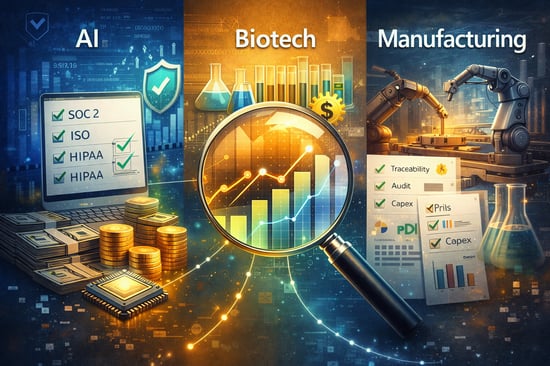 For AI infrastructure and applications, look at proprietary data and governance posture, margin behavior as usage scales, and enterprise readiness such as SOC2 or ISO or HIPAA where relevant, plus incident drills and customer-visible service level objectives. For biotech and tools, focus on throughput per dollar, manufacturability and yield risk, and the specific evidence package this round funds.
For industrial and manufacturing, identify the binding constraints across lines and changeovers, confirm traceability and audit readiness, and tie the capex plan to the KPIs it should move. If you want a broader stream of sector breakdowns, explore the Fundz Venture Capital blog hub for deeper cuts by category and stage.
Methodology and limitations
Figures reflect Fundz fundings and companies records from January 1 to January 14, 2026. Amounts are as disclosed by companies or verified by Fundz. Industry and location labels come from the uploaded companies dataset and, where combined such as Medical and Biotechnology, reflect company classifications.
Currency is standardized to USD at entry time. Some rounds are undisclosed at first and can appear in later snapshots, and late filings can shift totals. Editorial separates facts from interpretation so readers can see the line between data and opinion.
Possible VC Outlook
The opening curve of 2026 favors scale-ready operators in the United States. The market is not allergic to ambition; it is asking for evidence and a clean path to operating leverage. Expect the 20M to 50M spine to remain the dominant lane through the first quarter, with occasional 100M-plus outliers in applied AI, where compute, data rights, and enterprise service levels are already in place.
New York should continue to post broad totals, while the Bay Area and the Boston–Waltham corridor concentrate category leaders in AI and life sciences.
If this cadence holds into February, look for a compact wave of milestone-driven follow-ons in late Q2 and early Q3. In next week’s installment, we will test whether New York keeps the lead and whether the AI anchor begins to spin off second-order spending in security, data platforms, and observability.
Investor FAQs: Cut to the Signal

What does this period include
Announced funding events recorded by Fundz between January 1 and January 14, 2026.
Why focus on the mid-range of deal sizes
Because this window concentrates there, and because that is where capital most often converts to near-term operating leverage, such as hiring, production, compliance, and data infrastructure.
Are mega rounds gone?
No. They were rare in this snapshot. The absence of 50M to 100M and 250M-plus here signals selectivity, not a closed market.
Why do some industry labels appear combined
They are company-reported categories. We preserve them for fidelity and interpret the themes in context.
How should investors use this report?
Treat it as a heat map of conviction. Diligence the 20M to 50M spine, watch hiring and vendor adds within 60 days of a raise, and lean into biotech tools, AI infrastructure, and industrial traceability where the evidence is strongest.
How does Fundz verify the data?
We combine company disclosures, where applicable, with regulatory filings and reputable outlets. Outliers receive manual review.
Why might totals differ from other trackers?
Methodologies differ in terms of cutoff times, inclusion rules, and currency handling. Our numbers reflect what is visible and verified in the period we covered.
Will this report be updated?
We publish weekly snapshots. Late disclosures can shift prior windows. Use Fundz live views for the most current picture.
Source: Fundz proprietary funding and companies datasets (company-reported or disclosed, Fundz verified)