 Fundz records show $250M across five agentic-security rounds announced between March 17 and March 20, 2026, but sellers should not treat that cohort as a single generic cybersecurity list.
The better approach is to map each raise to its post-raise operating problem, autonomous offensive testing, agentic security operations, AI coding controls, or runtime governance, then target the buyer-operator pair most likely to own that problem in the next 14 to 60 days.
That matters because this cohort is deliberately uneven. A $120M Series C offensive-security platform behaves differently from an $8M seed-stage runtime governance company, even when both sit inside the same “agentic security” narrative. Treat the raise as the entry signal, not the full thesis.
Key Points: Selling Into the Agentic Defender Stack
Five funding events in four days created a usable sales signal, but only if the cohort is split by product architecture and likely post-raise mandate. The operating question is not “Who raised?” It is “What changed next, and who now owns the decision?”
Key points include:
- $250M across five rounds: $120M (XBOW), $57M (Surf AI), $40M (RunSybil), $25M (Corridor Security), and $8M (Manifold Security).
- Median round size: $40M: a barbell profile with one late-stage conviction round and a dense middle band of operator-grade checks.
- Three buying motions appear: offensive-security automation, AI-native development controls, and runtime governance for agent behavior in production.
- Contact coverage is uneven: the current Fundz cohort supports a buyer map by archetype, but not a definitive named-contact list for every company.
The Bottom Line: Funding is the timing signal; product architecture is the routing logic. Sellers who lead with the likely operating constraint will outperform teams that lead with “congrats on the raise.”
Fundz Data Insight
FundzWatch™ detected $250M across 5 agentic-security rounds in 4 days (Mar 17–20, 2026 UTC). The top two rounds total $177M, or 70.8% of the disclosed cohort dollars, suggesting the near-term buying window is likely to split between one mature platform expansion and several narrower build-versus-buy decisions.
What Fundz recorded in this cohort
At the facts layer, the cohort clusters around a shared design pattern: security systems that work more like agents than static controls. XBOW sits furthest along that curve with autonomous offensive security at the Series C scale. Surf AI positions around agentic operations for modern security teams. Corridor Security embeds controls directly into AI-driven coding workflows.
Manifold Security focuses on runtime monitoring, detection, response, and governance for agentic enterprise environments. RunSybil adds a strong offensive security signal by disclosing customer proof in the company description, including Cursor, Turbopuffer, Notion, Baseten, Thinking Machines Lab, major financial institutions, and Fortune 500 companies.
That is why the related venture capital view framed this cohort as the Agentic Defender Stack. For sellers, though, the usable takeaway is narrower. Each product architecture points to a different first buyer, a different second stakeholder, and a different reason the buying window opens after capital lands.
Who to contact next (the buyer map by company)
| Company | Raise | Stack role | Likely primary buyer | Best first angle |
|---|---|---|---|---|
| XBOW | $120M | Autonomous offensive security | Head of AppSec / Security Engineering | Expand exploit discovery and benchmark coverage without adding manual triage overhead |
| Surf AI | $57M | Agentic operations for security teams | CISO / Security Operations leader | Reduce exposure gaps and handoff-heavy workflows under human oversight |
| RunSybil | $40M | AI-native offensive security | AppSec / Security Engineering | Find exploitable paths beyond code scanning and surface issues, the way an attacker would |
| Corridor Security | $25M | Controls inside AI coding workflows | VP Engineering / Platform Engineering / AppSec | Keep AI-assisted development fast without shipping vulnerable code |
| Manifold Security | $8M | Runtime monitoring, AIDR, and governance | CISO / Security Engineering / GRC | Add visibility and response context for agent behavior in production environments |
Source: Fundz.net • Period: Mar 17–20, 2026 UTC
The table is intentionally a buyer map, not a contact dump. Available Fundz contact coverage in this cohort is strongest at XBOW, where disclosed contacts include the CEO, Head of Engineering, Chief Marketing Officer, and General Counsel.
That is a useful clue: later-stage platforms often expand beyond the security buyer into engineering, legal, and commercial stakeholders. The rest of the cohort should be read more carefully through the product description, stage, and disclosed use case.
How to read the motion behind each raise
Late-stage offensive-security platform. XBOW is the clearest example of a mature buying committee. The first conversation still belongs with a technical owner such as AppSec or security engineering, but the broader motion can touch legal review, brand risk, and internal rollout economics. The mistake is pitching “better testing” in generic terms when the real mandate is likely to be scale, benchmark confidence, and lower manual validation cost.
Security-operations orchestration. Surf AI points to a different problem: operational drag inside modern security teams. The strongest opener here is not “AI for security,” but “where do exposure gaps persist because work still moves through repeated handoffs?” That routes naturally to a CISO, security operations owner, or risk program lead.
Controls inside AI-native development. Corridor Security belongs in a conversation about trade-offs between build speed and control. These accounts are more likely to care about development velocity, guardrails, policy enforcement, and what happens before vulnerable code reaches production. This is where disciplined sales intelligence outperforms generic security messaging: the operator may sit in engineering or platform, while the economic buyer may still be security.
Runtime governance and response. Manifold Security is the governance play in the cohort. Seed-stage companies in this lane are often still proving where runtime monitoring, agent visibility, and response context create budget urgency. The first call should sound like operational risk reduction, not broad platform transformation.
Customer-proof offensive platform. RunSybil is the strongest proof point for near-term commercial urgency because the company description already names customers and major institutions. That changes the outreach posture. Instead of leading with category education, lead with where exploit-path discovery, authentication-flow testing, or exposure mapping can help a security team keep pace with real production complexity.
The 14 / 30 / 60-day outreach motion
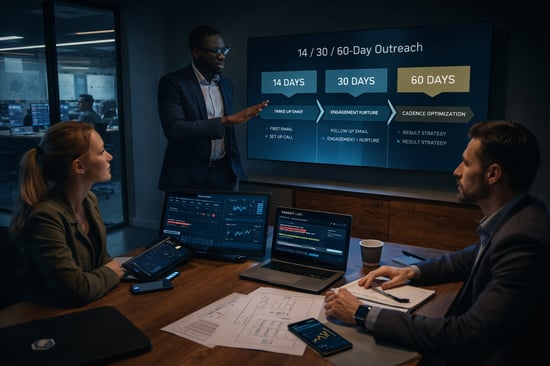
Days 0–14: classify the post-raise mandate
Do not start with congratulations. Start by classifying the likely mandate: platform expansion, workflow control, runtime governance, or proof-of-value acceleration. In this window, the best job is to map decision rights and isolate the operator who feels the bottleneck first.
Days 15–30: pair the buyer with the operator
Once the mandate is clear, pair the likely buyer with the operator who will live with the rollout. For offensive security platforms, that usually means security engineering and AppSec leadership.
For AI coding controls, it is often engineering plus security. For governance-oriented platforms, the motion may widen toward risk or compliance. This is also the right window to watch for disclosed executive moves, because leadership changes often sharpen ownership faster than a funding announcement does.
Days 31–60: look for proof that budget is converting into execution
By the second month, outreach should tighten around evidence of execution: customer proof, sharper positioning, implementation language, integration talk, or clearer enterprise-readiness claims. If none of that appears, downgrade the account rather than assuming every raise converts into active buying. Large rounds create attention; they do not guarantee an open purchasing cycle.
What sellers should not do with this signal?
The most common mistake is treating funding as the reason for outreach rather than as a timing signal. “Congrats on the raise” is rarely useful because it tells the buyer nothing about the operational bottleneck that now matters. A better opener names the next likely constraint: vulnerability validation at scale, AI coding controls, runtime visibility, or fewer handoffs inside security operations.
The second mistake is treating all five companies as a single ideal customer profile. This cohort shares language, but not the same buying committee. The right move is to route by architecture first, then by stage, then by any follow-on signal you can verify.
Turning the capital burst into a usable security-sales playbook
The useful signal in this cohort is not just that money moved into agentic security. It is that capital moved into different layers of the stack at once: offensive discovery, operations orchestration, coding controls, and runtime governance.
Sellers who can identify which layer they actually support and who, within that layer, owns the problem next will have a much cleaner post-raise motion than teams treating the whole category as one undifferentiated cybersecurity wave.
About the data
This article uses Fundz funding, companies, and related_contacts records for the five-company cohort disclosed between March 17 and March 20, 2026. Amounts are treated as disclosed in the export, with the stage noted where present. Buyer mapping is based on disclosed company descriptions, stage, and available related-contact context.
Methodology and limitations
- Scope: 5 distinct company funding events between March 17 and March 20, 2026 (UTC).
- Validation: Fundz's proprietary datasets for fundings, companies, and related contacts.
- Normalization: USD at entry; joins via Company UUID where applicable.
- Limitations: Stage is not disclosed for every row; location fields are incomplete for most of the cohort; related-contact coverage is uneven, so the buyer map should be read as a disciplined operating model rather than a definitive org chart.
Disclosure
This report is for informational purposes and is not investment, legal, or tax advice.
FAQ: Selling into Post-Raise Agentic Security Teams

Which buyer persona should outreach lead with after a security company raises?
Lead with the role most likely to feel the operating problem first, not the most senior title on the org chart. In offensive security and AI coding-control plays, that often means AppSec, security engineering, or platform engineering. In governance-heavy products, the first useful conversation may sit with a CISO, risk owner, or compliance stakeholder.
When should sellers shift from founder-led outreach to functional buyers?
Stage helps, but it is not enough on its own. Shift when the company starts describing implementation language, customer proof, integration depth, or a broader operating mandate rather than a narrow technical wedge. Later-stage rounds also tend to widen stakeholder coverage across engineering, legal, security, and commercial teams.
Why is a funding round a weak opener on its own?
Because the raise does not explain the bottleneck. Buyers already know they raised money; what they need is a sharper view of what becomes harder next. The strongest outreach connects the funding event to a concrete post-raise pressure, such as control coverage, runtime visibility, or lowering manual security work.
What follow-on signals make this cohort more actionable?
Look for new customer proof, changes in implementation language, integration announcements, security or engineering leadership changes, and clearer enterprise-readiness claims. Those signals help distinguish active rollout from headline-level momentum. Without them, a large round can still be early-stage noise for GTM teams.
How should teams handle sparse contact coverage in a live account list?
Use the product architecture to infer the first buyer and second stakeholder, then validate against any new disclosures that appear. Sparse contact coverage is a reason to narrow the message, not broaden it. A precise hypothesis about the operating problem is usually more valuable than a long but low-confidence contact list.