 A $225 million Series A looks like a stronger sales signal than a $23 million Series A.
For some sellers, it is. For others, the ranking could be backwards.
Fundz records from June through September 2026 include four Series A rounds announced within two weeks. The companies are all “funded growth” accounts, but the work being financed ranges from sales expansion to clinical trials, energy deployment and aircraft production.
The real sales-intelligence question is therefore not simply how large the event is. It is what new work the company has committed itself to doing, and how much of that work is actually addressable to you.
Key Points: The Same Funding Signal Can Rank Differently for Different Sellers
- Round size is not addressability. A $225 million specialist financing can be an excellent opportunity for one vendor and largely irrelevant to another.
- Operating model matters more than the sector label alone. How a company creates and delivers value determines what growth actually adds.
- Follow management’s stated next step. A Phase 2 trial, production line or sales expansion says more than “Series A.”
- Use public milestones to test the account thesis. Dated trials, deployments, hiring plans and test flights show whether expected work is appearing.
- The seller is part of the model. The same company can move up or down a target list depending on how closely its next work overlaps with what the seller provides.
- Route to the work. The relevant buyer is usually the person closest to the new operating obligation.
Bottom Line: A growth signal has no universal commercial value. Its value depends on what the company is doing next and how relevant that work is to the seller.
Four Series A Rounds, Four Different Operating Agendas
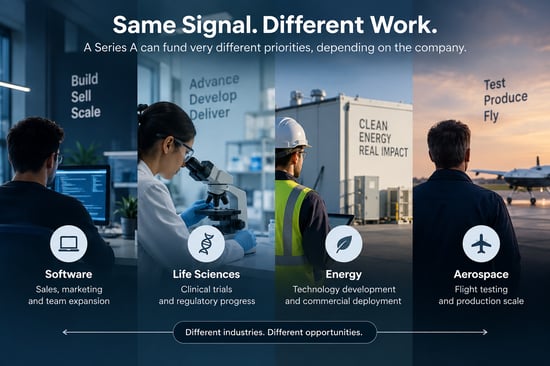
Fundz funding records dated June 11 through September 10, 2026 provide a clean comparison because the financing stage can be held constant.
| Company | Series A | What the Capital Is For | Public Milestone |
|---|---|---|---|
| Euno | $23M | Sales, marketing, AI research and enterprise expansion | Nearly 30 employees; expects to double by year-end |
| Solstice Oncology | $225M | Advance porustobart through clinical development | Phase 2 enrollment early Q4 2026; data expected H2 2027 |
| Voya Energy | $35M | Technology development and commercial deployment | Initial deployments in 2027; manufacturing scale-up in 2028 |
| Poseidon Aerospace | $60M | Flight testing, production and customer programs | First uncrewed Egret flight expected by end-2026 |
The headline is identical: Series A financing. The operating agendas are not.
Euno said its capital is going primarily to sales, marketing and AI research. Solstice Oncology, founded in February 2026 and publicly launched in September, is concentrating its financing on advancing porustobart, licensed from Harbour BioMed, through clinical development.
Voya Energy is moving its aluminum-based power system toward commercial deployment and later manufacturing scale. Poseidon Aerospace is funding flight testing, its first production line and customer programs.
A list that sees only “Series A” and dollars raised misses most of what separates these accounts.
The Same $225 Million Round Can Be Excellent or Irrelevant
Solstice is the clearest illustration of seller-specific addressability.
Its $225 million round is not a weak lead. It could be highly attractive to suppliers close to clinical development, trial execution, regulated infrastructure or other life-sciences requirements. For a vendor whose offer has little connection to that work, the financing size does not make the account more addressable.
Euno creates the opposite possibility. Its smaller $23 million round supports sales, marketing, AI research and headcount growth, potentially exposing more relevant surfaces for a wider set of general B2B suppliers.
Neither is universally the better prospect.
Signal magnitude belongs to the account. Addressability belongs to the relationship between the account and the seller.
Industry Is a Clue. Operating Model Is the Explanation.
A biotech and a multi-site clinic may both sit under healthcare, yet one absorbs growth through clinical-development milestones while the other may need facilities, clinicians, patient workflows and systems.
True North’s Tempe service page, which describes healthcare IT projects by True North, lists EHR/EMR environments, interoperability, cloud, cybersecurity and healthcare compliance. The geography is incidental here: those capabilities become relevant only when the operating change creates that kind of healthcare-specific work.
A cross-industry provider proves the seller-specific point from the opposite direction. For sellers who know wpgc.io and its managed IT, cybersecurity, cloud and procurement services, the same account-ranking problem applies.
The provider can remain unchanged while its addressability changes dramatically between a manufacturer scaling production systems, a healthcare organization expanding regulated workflows and a funded company whose capital is concentrated elsewhere.
A Five-Question Operating-Context Test
1. What Is the Capital Actually For?
Use the company’s own disclosure. “Series A” describes financing. “Phase 2 enrollment,” “first production line,” “commercial deployment” and “sales expansion” describe work.
2. What Operating Model Has to Absorb That Work?
Digital software growth, clinical development, industrial deployment and aircraft production create different dependencies.
This is where the broad industry label should give way to how the business actually delivers value.
3. What Public Milestone Would Show Progress?
The four cases already provide checkpoints.
Euno expects to double its nearly 30-person team by year-end. Solstice expects Phase 2 enrollment early in Q4 2026 and data in H2 2027. Voya has stated deployment and manufacturing milestones for 2027 and 2028. Poseidon expects Egret’s first uncrewed flight by the end of 2026.
Those dates do not guarantee outcomes. They let sellers update the account thesis as evidence changes.
4. Which Part of the Work Is Addressable to Us?
A clinical-development program may be highly addressable to a specialist life-sciences supplier and almost irrelevant to another vendor. Commercial expansion may create the reverse pattern.
The company has not changed. The seller-company fit has.
5. Who Owns the New Obligation?
Commercial expansion may point toward sales, marketing or RevOps. Clinical development, industrial deployment and production create different functional owners.
Route toward the people closest to the work rather than relying on a generic funding-event persona.
Re-Score the Account as the Plan Becomes Visible
A funding event is a snapshot. Subsequent activity shows whether the original interpretation still holds.
If Poseidon reaches its flight milestone, Solstice opens enrollment, Voya moves into deployment or Euno expands hiring, the account thesis gains evidence. If plans move or change direction, the ranking should change too.
Fundz Signal Intelligence monitors funding, executive moves, M&A, hiring surges and other company changes, allowing sellers to re-read a funded account as new evidence appears.
The related Fundz article What a Product Launch Tells Sellers About the Next Buying Cycle focuses on timing and corroboration after a launch. The question here is different:
Even when two accounts show the same signal, which one is more relevant to what you sell?
There Is No Universal “Hot Lead” List
A ranked account list can look objective while hiding an assumption: that every seller should value the same event in the same way.
The four Series A cases show why that cannot hold. Solstice can be extremely attractive to a specialist aligned with clinical development and weak for a supplier with no connection to that agenda. Euno, Voya and Poseidon each produce their own pattern of relevance.
A useful ranking system therefore needs two sides:
What is changing inside the account?
How much of that change overlaps with what we can credibly help with?
Questions About Interpreting Growth Signals Across Industries

Does a Larger Funding Round Mean a Better Sales Opportunity?
Not necessarily. A larger round may create deep specialist demand while offering little relevant work to another seller. Opportunity depends on the overlap between the company’s next operating agenda and the seller’s capabilities.
Why Is Operating Model More Useful Than Industry Alone?
Industry narrows the context. Operating model explains how the company creates and delivers value, which determines whether growth adds software users, clinical work, production, facilities, inventory or other obligations.
What Should Sellers Verify After a Funding Announcement?
Start with the stated use of proceeds and public milestones. Then watch whether hiring, trials, deployments, production activity or other changes remain consistent with that plan.
Can the Same Funded Company Be a Strong Lead for One Seller and a Weak Lead for Another?
Yes. Addressability is seller-specific. The company’s agenda remains the same, but its commercial relevance changes according to what each seller can credibly provide.
How Should Sellers Prioritize Funded Companies Across Industries?
Prioritize operating change, seller fit and timing together. Round size, stage and industry provide context, but none establishes addressability on its own.